This report analyzes documents and formats focusing on resource efficiency, resource conservation and the circular economy at the German, European and international level. It outlines significant developments and expected trends in resource policy and identifies research needs. Given the rapid increase in global resource use, driven by population growth and economic expansion, the transition to a resource-efficient and circular economy is a key challenge. This need is reinforced by various global crises such as climate change, biodiversity loss, pollution and increasing resource dependency. The report emphasizes that innovative and effective policies are needed at both national and international levels to promote and implement this transition.
The report "Research and Monitoring Activities on Litter in Groundwater, Rivers, Lakes, Transitional Waters, and Soil" discusses the results of a questionnaire that was distributed to European countries via the German Federal Environment Agency. The report focuses on current and planned research and monitoring activities as well as strategies to control litter in different environmental compartments.
This report focuses on the assessment of the status of the marine environment, the definition of environmental objectives and the development of programs of measures to achieve good environmental status. It provides guidance to Member States on the assessment of marine waters, identifies key pressures and pressures factors and offers approaches for setting environmental targets. It supports the development of monitoring programs and the implementation of measures to reduce pollution and conserve biodiversity. The technical assistance aims to promote cooperation between Member States and create a coherent framework for maritime policy in the EU.
The KOPOS criteria set serves to make the sustainability and transformation impacts of initiatives in the food sector measurable and visible. It provides a basis for evaluating and improving the sustainability of projects, and is useful both for initiatives themselves and for institutions wishing to promote sustainability projects. In addition to the actual set of criteria, this working paper provides an introduction and a derivation of the criteria.
This report analyzes the challenges and opportunities arising from the phase-out of coal in Germany, with a specific focus on the three major coalfields: the Central German, Rhenish and Lusatian coalfields. It offers a detailed insight into the challenges and strategic approaches and emphasizes the need to develop regional infrastructures in a targeted and sustainable manner in order to meet the economic, social and ecological challenges of the three major German coalfields. Innovative technical solutions and a stronger integration of different infrastructure sectors can support the transition from a fossil fuel-based economy to a sustainable and resilient regional development.
This study assesses the progress of EU Member States in embedding participatory governance processes to foster transformative climate governance. Through comprehensive criteria-based analysis and in-depth interviews across several nations, this publication unveils the current state of MLCED implementation, challenges in stakeholder engagement, and the adequacy of mechanisms designed to steer us towards a climate-neutral future.
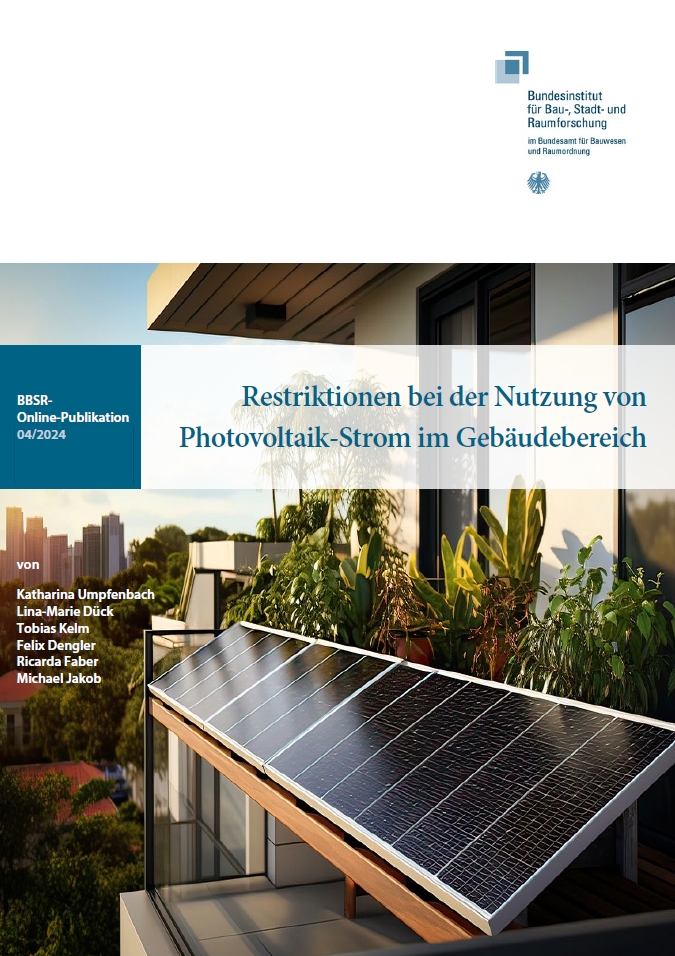
To achieve the ambitious climate targets of the Federal Climate Change Act a rapid expansion of renewable energies, particularly wind and photovoltaics (PV), is crucial. In this context, achieving 215 GW of installed PV capacity by 2030 has become a specific target of the Renewable Energy Sources Act (EEG). This report deals with the central role that buildings play in meeting PV expansion targets, with the potential to cover up to 25% of EU electricity consumption through rooftop PV.
This report discusses on the implications of the EU's Carbon Border Adjustment Mechanism (CBAM) for imports of PtX products to the EU. PtX means essentially hydrogen based on electrolysis and its derivates. After providing an overview of the CBAM mechanism, its implementation phases and the roles and responsibilities of producers within CBAM, the report provides insights into the calculation of embedded emissions for PtX products, including examples for imported ammonia and crude steel.
This report presents a stock-taking analysis of drought policies, planning and management in EU Member States and an outlook of planned work within the Member States and at EU level. It has been developed based on individual Member State assessments of the corresponding legislation, planning and management, including the latest available versions of (draft) River Basin Management Plans in spring 2022, using a common questionnaire, as well as more than 70 interviews with Member State administrations and stakeholders and a wide review process.
A new report by the Ecologic Institute and the Oeko-Institut explores the role of carbon removals in the EU's climate framework for 2040. The report gives an overview of past trends in carbon removals in the EU, and explores possible contributions from natural and technical sinks to reaching the 2040 climate target. With a focus on measures and policies governing and incentivizing carbon removals, the report also examines the extent to which temporary and permanent carbon removals can contribute to achieving the EU's 2040 target.
With climate change, the impacts of water scarcity and droughts are becoming of increasing concern in Europe. Water allocation mechanisms are major levers to increase water resilience, however, little work has yet occurred on the topic at EU level. This report, prepared in cooperation with members of the ad-hoc technical group on Water Scarcity and Droughts of the EU Common Implementation Strategy (CIS) for the Water Framework Directive (WFD), reviews the literature and practice for water allocation mechanisms. It identifies key challenges in EU Member States and highlights examples of methods in place.
In this study published by the European Commission, a first assessment is made of the strategic decisions made by Member States for the use of EUR 307 billion in support of agriculture and rural areas between 2023 and 2027. It maps the choices made in the CAP Strategic Plans (CSP) approved in December 2022 and analyses the joint efforts and potential impacts of Member States’ choices in relation to the nine specific objectives and the cross-cutting objective, with a focus on selected Green Deal targets.
This report by the Ecologic Institute and the Oeko-Institut provides an overview of design options for the EU's 2040 climate target and options for the implementation framework. The report discusses reforms how to make the EU climate policy framework fit for achieving the 2040 climate target.
The agriculture and land sectors must mitigate greenhouse gas emissions for the EU to meet its climate targets. In a new report published by the European Commission's DG CLIMA, Ecologic Institute, IEEP, and Trinomics investigate how an emissions trading system (ETS) could price greenhouse gas emissions from agricultural activities, and how this can be accompanied by providing farmers and other landowners with financial incentives to carry out land-based carbon removals.