The sustainability and transformation effects of sustainability initiatives can be summarized using this set of criteria and provides a range of possible indicators for recording them. The set of criteria is specifically tailored to sustainability initiatives in the food sector. The criteria were derived from the UN Sustainability Goals and adapted for the topic of food systems. In addition to the conventional three levels of sustainability (economic, ecological and social), the criteria set also offers selected transformation criteria, i.e. they can be used to record the "transformative potential" that a sustainability initiative can develop.
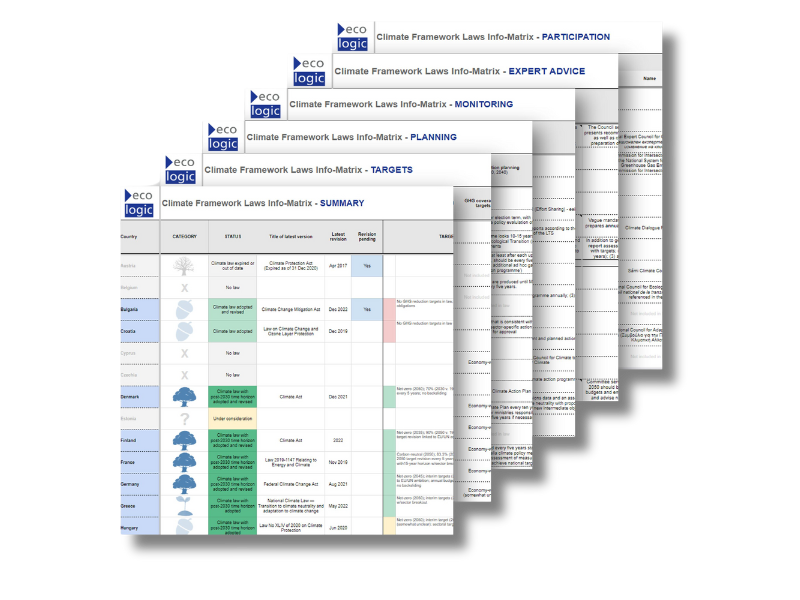
The Climate Framework Laws Info-Matrix aims to collect, organize, and present information on the status and substance of national climate framework laws in Europe. It presents a side-by-side comparison of existing laws and their provisions across five main areas: targets, planning tools, monitoring mechanisms, institutions for expert advice, and participation processes.
Lehmann, Karl, Melanie Kemper, Rebecca Noebel & Jennifer Reck 2023: Kommunikationskonzept MoorNet - Kommunikation zur Umsetzung der nationalen Moorschutzstrategie und Vernetzung der Akteure in Deutschland. Ecologic Institut. Berlin. Unpublished
This paper addresses a gap by providing a conceptual basis to further the understanding of security implications of the EU’s transformation to a net-zero economy. It first defines the aspects of security under consideration (Section 2) and proposes a typology to classify fossil fuel exporting countries based on their exposure to world market prices, their capacity to adjust and their importance to the EU in terms of security issues (Section 3). It then takes stock of policy options that can be adopted in other countries to reduce adjustment costs to a changed economic environment (Section 4) and discusses how the EU can support these policies (Section 5). Finally, it highlights key implications for EU policy makers (Section 6).
The EU has just updated its climate target for 2030 and most of the policy instruments in place to achieve it. Does this toolbox have all the items needed to achieve the shift to net-zero emissions by 2050? This discussion paper by Oeko-Institut and Ecologic Institute addresses and analyses the main pillars of the EU's climate policy identifies crunch issues on the path towards climate neutrality and offers potential solutions.
Almost one third of all packaging in Germany is so-called transport packaging, which becomes waste after its single use. Despite the factual relevance of this packaging group, it is strongly underrepresented in the public perception as well as in the political discourse. During the online expert dialogue "Reusable Transport Packaging" on 27 February 2023, good examples from practice were presented and potentials, challenges and necessary elements for the expansion of reusable transport packaging were discussed together with experts from trade, logistics industry, civil society and politics. The summary is available for download.
This document drafts a concept of the information architecture and user interface of the European Climate Neutrality Observatory (ECNO) website. It served to develop a common vision of the website and its data structure within the project team.
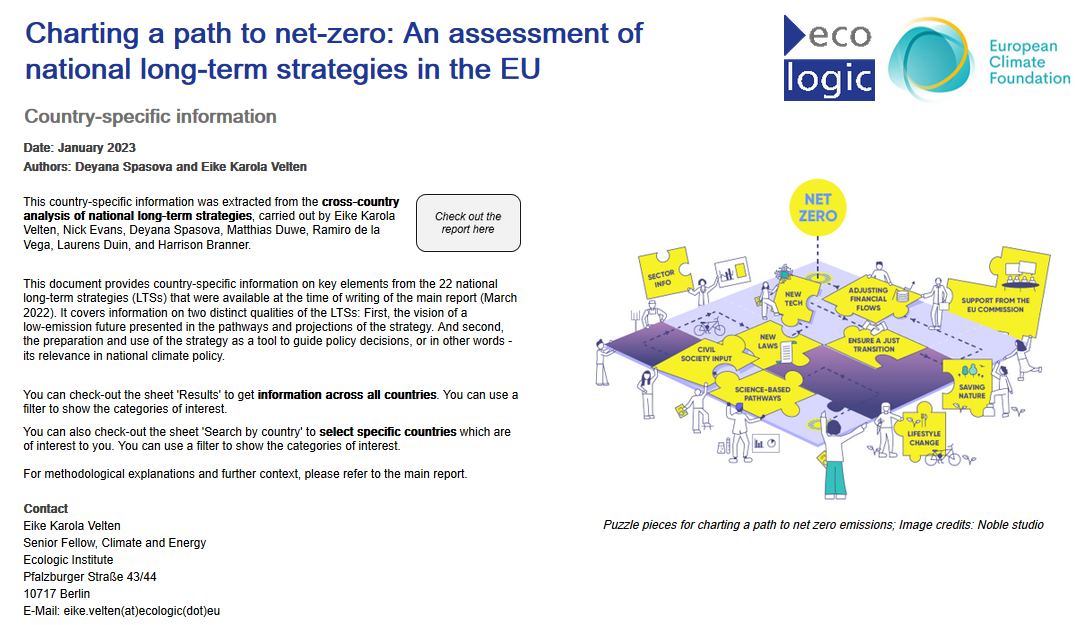
This document provides country specific information on key elements from the 22 national long-term climate strategies extracted for the cross-country analysis in table format. It allows for selection of specific criteria as well as for the selection of specific countries.
Indicators measuring progress towards climate neutrality must address the often structural, sectoral, and cross-sectoral changes implied by the transition, covering both the economic and social dimensions. To address this, Ecologic Institute developed this working document, testing an indicator framework for assessing the progress to climate neutrality by 2050. The document offers a glimpse at areas where developments are currently headed in the right direction or lagging behind.
In this brief, researchers from Ecologic Institute and Öko-Institut critically assess the Commission's 2022 proposal for Framework for Carbon Removals Certification as it applies to climate-friendly soil management. In particular, they evaluate whether Framework's so-called QU.A.L.ITY criteria (Quantification, Additionality, Long-term storage, Sustainability) are sufficient to ensure high quality soil carbon removals. The brief summarises the specific challenge posed by soil carbon sequestration, identifies problems with the current proposal, and makes recommendations for improvements. The brief is available for download.
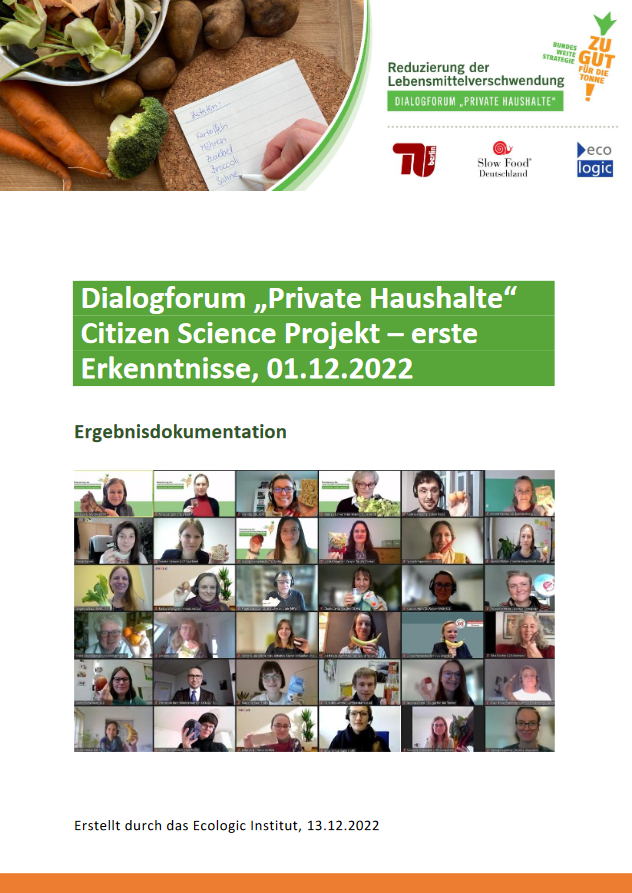
As part of the "Private Households" dialog forum project, a fourth online dialog forum was held on December 1, 2022. The event focused on the Citizen Science project "Germany saves food!". This results report provides an overview of the core content of the presentations, the survey results and the discussion content. The results report is available for download.