As a candidate country, Montenegro aims at adapting itself to the level of European legislation in the energy sector. Within an EuropeAid project and a consortium with IBF International Consulting SA and EuroPartner Consulting International, Ecologic Institute is supporting the Ministry of Economy in improving the conditions for investments in sustainable energy and developing the related legal framework.
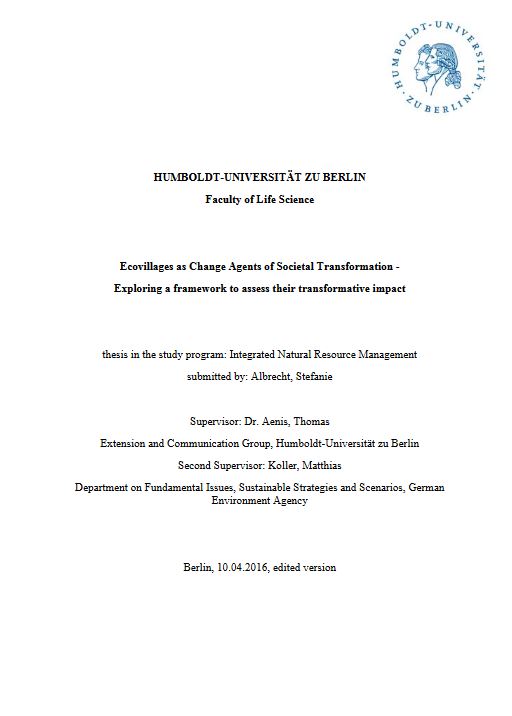
Ecovillages are change agents as models of sustainable lifestyles implementing structural change and intending a political statement. They are intentional communities with larger settlement structures designed and owned by their inhabitants, oriented to live within ecological boundaries and fulfill their socio-cultural needs of community, autonomy, participation and personal development. This thesis explores a framework that allows assessing their impact on changes to the interlinked elements of the established regime, centering change agents as complex socio-ecological systems and diagnosing barriers and opportunities to overcome the (re)production of unsustainble practices. To approach the complexity of transformation and ecovillages, concepts on multiple levels of change (GEELS 2011), complex socio-ecological systems (OSTROM 2006, POTEETE et al. 2010) and practices-as-entities (SHOVE et al. 2012) are used. It is explored how to integrate the change agent’s valued stable practices that formed institutions (rules, norms, forms of organisation). The transformative impact of a change agent is conceptualised as a process of diffusion (SCHOT et al. 2008) of its innovative socio-ecological (ZAPF 1989, CAULIER-GRICE et al. 2012) practices and institutions. Finally, the case of Ökodorf Sieben Linden is analysed in a mixed-method approach to show the explanatory potential of the developed framework.
Given that airlines will need to offset their greenhouse gas emissions via a market-based mechanism recently decided by the International Civil Aviation Organisation (ICAO), this report evaluates the current carbon offsetting programs of major airlines. These are mainly voluntary, offered to airlines' customers. The structure of such programs, as well as the types of offsets offered, give an indication of airlines' existing involvement with offset projects and carbon markets ahead of that involvement becoming mandatory.
On 30 October 2016 Canada and the EU signed CETA. Ratification of the agreement will be the next step. Ecologic Institute analysed the environmental implications of regulatory cooperation under CETA. The analysis is available for download.
Vivienne Parry welcomed approximately 1700 attendees from over 100 countries to the fourth edition of Adaptation Futures 2016, one of the largest conferences ever held on climate change adaptation. The Bottom-Up Climate Adaptation Strategies (BASE) project was selected to be featured as a best practice project at the conference. BASE partners, among them Ecologic Institute, presented the project's research and tools in two sessions.
After the success of the ECCA conference in 2015, the BASE project has been selected as a Best Practice project to be featured at the upcoming Adaptation Futures (AF 2016) Conference from10 until 13 May 2016, in Rotterdam (the Netherlands). BASE partners will present the project's research and tools in two sessions, several presentations and a variety of information material. Key adaptation tools developed within the projects will also be presented in the Tool Shed.
Tröltzsch, Jenny; Rodrigo Vidaurre; Hans Bressers et. al. 2016: "Flanders: Regional Organization of Water and Drought and Using Data as Driver for Change", in: Bressers, Hans; Nanny Bressers; Corinne Larrue (eds.): Governance for Drought Resilience. Land and Water Drought Management in Europe. Heidelberg: SpringerOpen, 139-158.
Özerol, Gül; Jenny Troeltzsch; Corinne Larrue et. al. 2016: "Drought Awareness Through Agricultural Policy: Multi-level Action in Salland, The Netherlands", in: Bressers, Hans; Nanny Bressers; Corinne Larrue (eds.): Governance for Drought Resilience. Land and Water Drought Management in Europe. Heidelberg: SpringerOpen, 159-180.
Bressers, Hans; Koen Bleumink; Nanny Bressers et. al. 2016: "The Fragmentation-Coherence Paradox in Twente", in: Bressers, Hans; Nanny Bressers; Corinne Larrue (eds.): Governance for Drought Resilience. Land and Water Drought Management in Europe. Heidelberg: SpringerOpen, 181-202.
Özerol, Gül; Jenny Troeltzsch 2016: "Cross-cutting Perspective on Agriculture", in: Bressers, Hans; Nanny Bressers; Corinne Larrue (eds.): Governance for Drought Resilience. Land and Water Drought Management in Europe. Heidelberg: SpringerOpen, 203-2216.
Stein, Ulf; Gül Özerol; Jenny Tröltzsch et. al. 2016: "European Drought and Water Scarcity Policies", in: Bressers, Hans; Nanny Bressers; Corinne Larrue (eds.): Governance for Drought Resilience. Land and Water Drought Management in Europe. Heidelberg: SpringerOpen, 17-43.
Furusho, Carina; Rodrigo Vidaurre; Isabelle La Jeunesse 2016: "Cross-cutting Perspective Freshwater", in: Bressers, Hans; Nanny Bressers; Corinne Larrue (eds.): Governance for Drought Resilience. Land and Water Drought Management in Europe. Heidelberg: SpringerOpen, 217-230.
Vidaurre, Rodrigo; Ulf Stein; Alison Browne et. al. 2016: "Eifel-Rur: Old Water Rights and Fixed Frameworks for Action", in: Bressers, Hans; Nanny Bressers; Corinne Larrue (eds.): Governance for Drought Resilience. Land and Water Drought Management in Europe. Heidelberg: SpringerOpen, 67-82.
Bressers, Hans; Ulf Stein 2016: "Cross-cutting Perspective on Nature", in: Bressers, Hans; Nanny Bressers; Corinne Larrue (eds.): Governance for Drought Resilience. Land and Water Drought Management in Europe. Heidelberg: SpringerOpen, 231-244.