
From EU Restoration Targets to Local Action
Implementing the Nature Restoration Regulation in Germany
- Presentation
- Date
-
- Location
- Online
- Speech
On 4 November 2026, Dr Benjamin Kupilas, Coordinator Biodiversity at Ecologic Institute, contributed to the sixth workshop of the Transatlantic Forum for Nature and Environment (TAFNE), organised by the German Marshall Fund. The online workshop brought together German and US perspectives on biodiversity protection and conservation, with particular attention to the role of regional and local actors. In his presentation, Benjamin Kupilas examined Germany's implementation of the EU Nature Restoration Regulation and the challenges of translating ambitious European restoration targets into effective action on the ground.
Germany's National Restoration Plan: From targets to measures
The EU Nature Restoration Regulation aims to restore degraded ecosystems across Europe, with restoration measures covering at least 20% of the EU's land and sea areas by 2030. National Restoration Plans set out how Member States intend to meet the regulation’s targets and obligations. Benjamin Kupilas presented Germany's draft plan, published for public consultation in April 2026 , which identifies 226 restoration measures across forest, agricultural, marine, wetland, river, floodplain and urban ecosystems. He also outlined the plan’s preparation, including cooperation between federal and state authorities and public consultation.
From restoration targets to restoration landscapes
Drawing on the recently published paper by Hering, Kupilas and Schinegger, he highlighted implementation priorities for translating national targets into spatially coordinated restoration landscapes. These include strengthening coordination across sectors and administrative levels; identifying and prioritising suitable restoration areas using transparent criteria, (spatial) data, and reproducible method; securing predictable, long-term financing and implementation capacity beyond individual project cycles; and involving land managers and local communities early to strengthen local ownership.
Building on expertise and partnerships established through programmes such as LIFE can support wider restoration efforts. Regional success stories can demonstrate benefits for climate resilience, water management and local livelihoods, helping build trust and lasting societal support.
Identifying restoration opportunities
Kupilas highlighted how practical methodological guidance using transparent criteria, (spatial) data and reproducible methods could help identify and prioritise suitable restoration areas. By combining ecological and administrative considerations and linking national datasets with regional and local information and knowledge, such guidance could provide a transparent basis for further restoration planning and discussion.
Contact

- Organizer
-
German Marshall Fund of the United States (GMF), United States - Speech
- Date
-
- Location
- Online
- Language
-
English
- Keywords
-
EU Nature Restoration Regulation, Nature Restoration Law, National Restoration Plan Germany, biodiversity restoration, ecosystem restoration, nature restoration targets, EU biodiversity policy, ecological restoration Germany, restoration financing, spatial data for restoration, restoration planning, local biodiversity conservation, stakeholder engagement, Benjamin Kupilas, Transatlantic Forum for Nature and EnvironmentBerlin, Germany, EuropePolicy analysis, stakeholder consultation, spatial data analysis, multi-criteria assessment, geospatial mapping
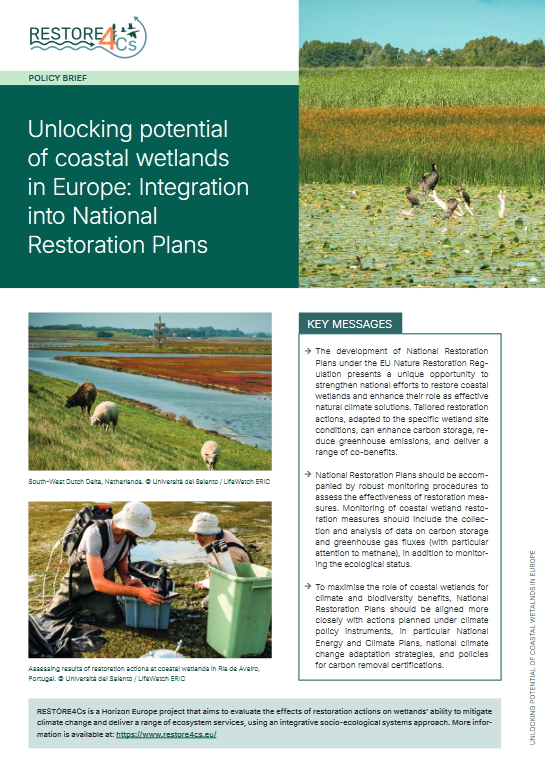
Kampa, E., Elkina, E., Otero, M., 2025. Unlocking potential of coastal wetlands in Europe: Integration into National Restoration Plans. Policy Brief. RESTORE4Cs project.
Modelling Restoration of Wetlands for Carbon Pathways, Climate Change Mitigation and Adaptation, Ecosystem Services, and Biodiversity, Co-benefits (RESTORE4Cs)
- Duration
-
-
- Funding
-
European Commission, Directorate-General Research & Innovation (DG Research & Innovation), International
Supporting the National Implementation of Nature Restoration Targets
- Duration
-
-
- Funding
-
Federal Agency for Nature Conservation (BfN), Germany
Bild von Michal Jarmoluk auf Pixabay, Abbildung des Kommentars: Nature Reviews Biodiversity (Springer Nature), 2026
Hering, D., Kupilas, B. & Schinegger, R. Implementation of the EU Nature Restoration Regulation requires a shift from restoration targets to restoration landscapes. Nat. Rev. Biodivers. (2026). https://doi.org/10.1038/s44358-026-00186-6
Hart, E., Mc Guinness, S., Wild, T., Puértolas, L., Kupilas, B., Canavan & Fisher, J. (2026). Enabling Public-Private Partnerships (PPPs) to Finance EU Nature Restoration (Policy Brief). Biodiversa+ BiodivRestore Knowledge Hub. https://www.biodiversa.eu/policy-briefs