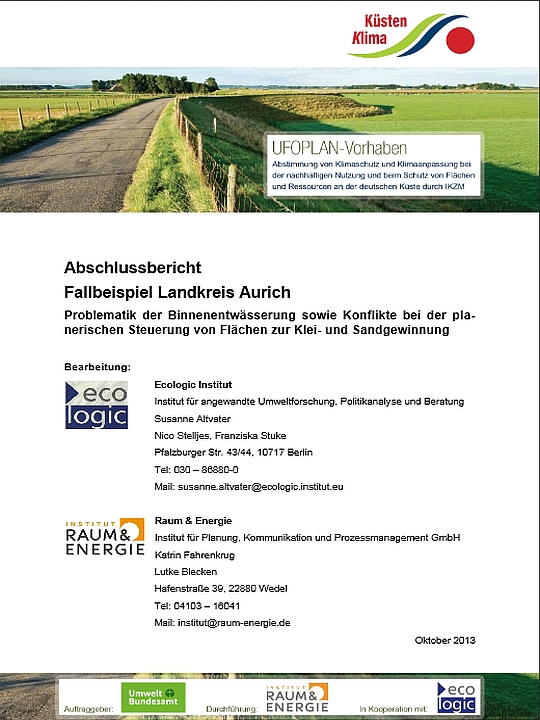
This case study documents the knowledge gained in the case study of the "Aurich district". The "problem of inland drainage" and "conflicts in the planning control of land for clay and sand extraction" are the main focus points of this case study. The aim of the project KüstenKlima in the district of Aurich was to identify together with the relevant local actors ways to resolve possible conflicts of objectives and to discuss synergies. Reciprocal interactions were taken into account with other matters. The case study is available for download.
The existing measures in Germany are not sufficient to meet the efficiency targets of the Energy Concept and the requirements of the EU Energy Efficiency Directive. On behalf of the European Climate Foundation, Ecologic Institute has compared essential proposals aimed at increasing energy efficiency and deduced possible political demands.
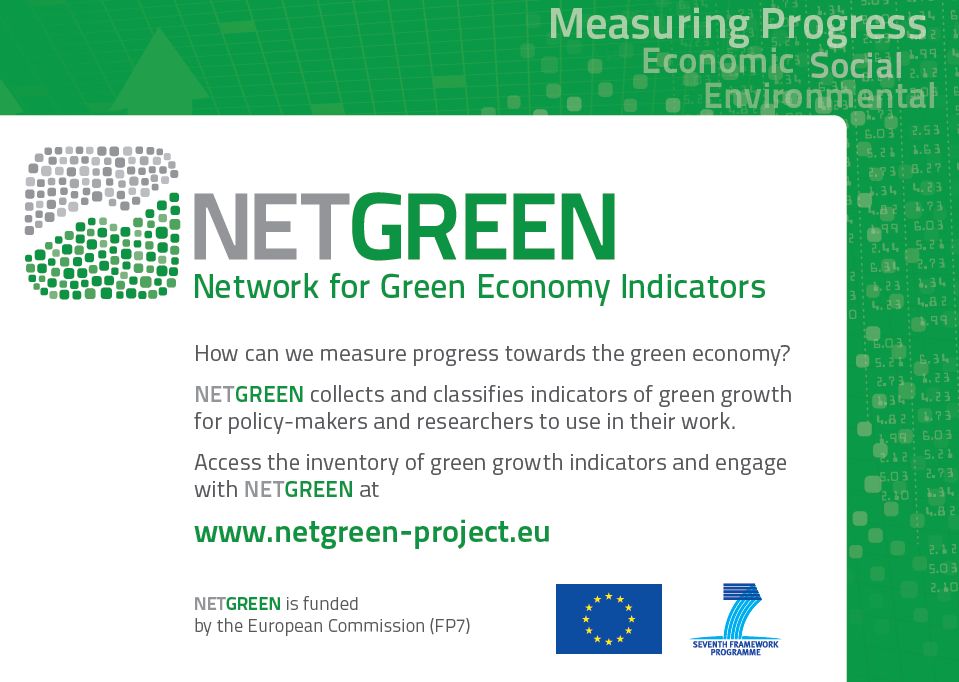
As part of the visual identity for the project "NETwork for GREEN Economy Indicators" (NETGREEN), Ecologic Institute designed a promotional flyer in small postcard format. The flyer summarize general objectives and aims of the projects, is styled according to the project style-guides and contain besides an project information also a list of partners, contact and an QR-code directing to the project website. Flyers are distributed during project events.
From 30 to 31 October 2013, a workshop entitled "Shaping Arctic Change through Conscious Choices" took place at the Abisko Scientific Research Station in Northern Sweden, ca. 200km north of the Polar Circle. Together with Shiloh Fetzek (International Institute for Strategic Studies - IISS, London) Golo Bartsch, Associate of the Ecologic Institute and PhD candidate at Bielefeld University, chaired one of the workshop's panels dealing with security issues. The workshop's results were drafted in a joint paper, which is due to publication in the coming weeks.
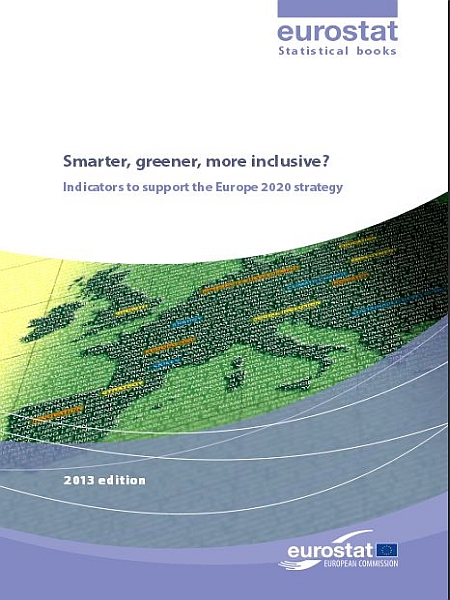
On 29 October 2013, Eurostat published its most recent Flagship Publication 'Smarter, greener, more inclusive?'. The report assesses the EU's progress in implementing the Europe 2020 strategy. Commissioned by Eurostat, Katharina Umpfenbach and Krista Timeus of Ecologic Institute edited the climate change and energy chapter. It discusses progress towards the so-called 20-20-20 targets which aim at cutting EU greenhouse gas emissions, increasing renewable energy supply and improving energy efficiency. The report is available for download.
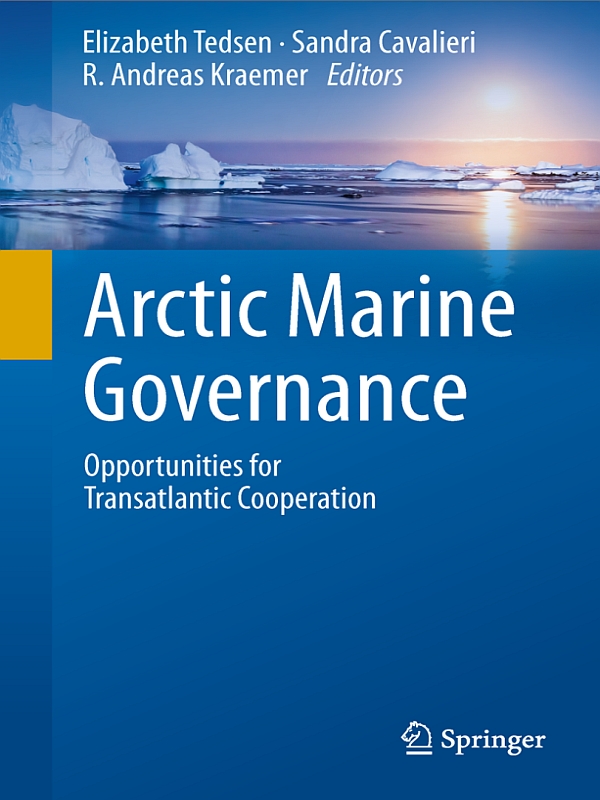
The Arctic region not only plays an important role in regulating the world's climate, but is also highly affected by climate change. A new book edited by Ecologic Institute's Elizabeth Tedsen, Sandra Cavalieri, and R. Andreas Kraemer addresses the significant changes and developments the Arctic has undergone in the recent years. "Arctic Marine Governance: Opportunities for Transatlantic Cooperation" looks at the current governance environment in the marine Arctic, considers how policy frameworks can adapt to address new challenges in the region, and examines opportunities for cooperation between the European Union and the United States.
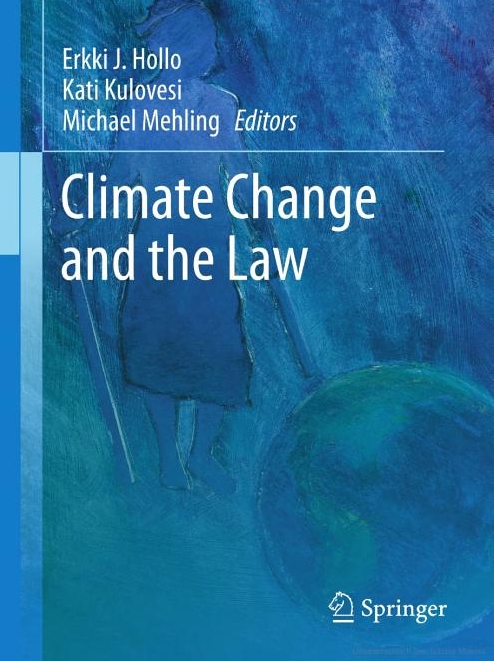
20 years after the adoption of the United Nations Framework Convention on Climate Change, the international climate regime has evolved into a highly specialized area of legal expertise. This book explores the relation of climate and law, highlighting international climate law as an emerging discipline. Not only are cross-cutting and sectoral issues examined, but also comparative climate law plays an important role.
On 22 October 2013, Dr. Stephan Sina, Senior Fellow at Ecologic Institute, moderated a discussion on the planned Energiewende Act for Berlin with about 90 representatives taking part, from business, policy, and administration, in Berlin City Hall. This was the second event on an Energiewende Act for Berlin organized by the Senate Department for Urban Development and the Environment. A summary of the discussion is available for download.
Ecologic Institute designs and conducts a workshop to enhance the negotiating capacity of Lebanon in the international climate change negotiations. The workshop targets representatives from ministries, academia and civil society and provides background and practical knowledge on the negotiations.