<p>
On 14 October 2010, the German American Energy Forum - a one-day international event that aims to open a dialogue between experts on various energy issues - was held in Washington DC Michael Mehling, President of Ecologic Institute, Washington DC, moderated the first panel focused on energy infrastructure. Ecologic Institute is a supporting partner.</p>
<p>
Electric vehicles can potentially make significant contributions towards achieving the EU’s climate protection goals in the transport sector. In the context of a stakeholder workshop convened by the DG Environment of the European Commission in Brussels, Max Grünig, Fellow at Ecologic Institute Berlin, presented a summary of the interactions between the energy sector and electric vehicles.</p>
Ecologic Institute co-convened the NATO Advanced Research Workshop (ARW) on "Environmental Security in the Arctic Ocean" in Cambridge, England, on 14 to 17 September 2010. R. Andreas Kraemer of Ecologic Institute introduced and moderated the session entitled "Environmental State-Change in the Arctic Ocean" on the consequences of environmental change for security.
<p>While the world waits for an international emissions reduction agreement under the UNFCCC, negotiating governments continue a stalemate on key issues. Historical emissions, population dynamics, and trade may be the missing pieces of the puzzle. Hannam (UNEP-Tongji Institute) and McGlynn (Ecologic Institute) connect these components under one framework for adjusting national emissions reduction responsibilities. To determine how much each nation should reduce emissions, they ask: Who benefits from past, present, and future emissions?</p>
Gantioler S., Rayment M., Bassi S., Kettunen M., McConville A., Landgrebe R., Gerdes H., ten Brink P.: Costs and Socio-Economic Benefits associated with the Natura 2000 Network. Final report to the European Commission, DG Environment on Contract ENV.B.2/SER/2008/0038. Institute for European Environmental Policy / GHK / Ecologic, Brussels 2010.
Do the National Renewable Energy Action Plans concerning Member States' goals for 2020 address the long-term restructuring of electricity generation? Do they consider possibilities for European cooperation? Dr. Stephan Sina and Katharina Umpfenbach of the Ecologic Institute examined these questions in their analysis of the German Renewable Energy Action Plan commissioned by the European Green Foundation.
Ecologic Institute led a study examining how regional and local authorities contribute to the objectives of the Europe 2020 strategy by transforming their energy systems. The report, which was commissioned by the Committee of Regions, aims to propose a set of recommendations for future improvements of the program. The study is available for download.
Since 2010, the Zurich-Basel Plant Science Center (PSC) organises the PhD course "Evidence-based Policy-Making". Holger Gerdes, Fellow at Ecologic Institute, supports the course by supervising groups of PhD students in their work on practical case studies dealing with the integration of environmental research into the policy process.
Knowing the limits of the planet's ability to provide resources and absorb pollutants is directly linked to debates on the limits to growth. Together with their partners from SERI, Ecologic Institute analysed environmental thresholds and associated indicators for monitoring unsustainable trends caused by human activity that could lead to the crossing of environmental thresholds in Europe. The areas covered are freshwater quality and quantity, soil erosion, and nonrenewable resource consumption. The report is available for download.
As the Cold War ends and the ice is melting in the Arctic, security and arms control, climate change and energy, present a new situation for the relations among nations and the joint management of the region. On 29 September 2009, the Friedrich Ebert Foundation and the Rideau Institute convened an expert meeting in Ottawa to take stock of "The Arctic Today and Finding Common Transatlantic Ground". R. Andreas Kraemer of Ecologic Institute acted as discussant and moderated a session on energy and the environment. The key findings and a summary report of the Arctic Future Forum in Ottawa, ON, on 29 September 2009 is available download.
Climate change requires adaptation measures in multiple areas, including, among others, the energy sector. At a stakeholder workshop, Max Grünig, Fellow at Ecologic Institute Berlin, presented a methodology for assessing costs and benefits of such measures.
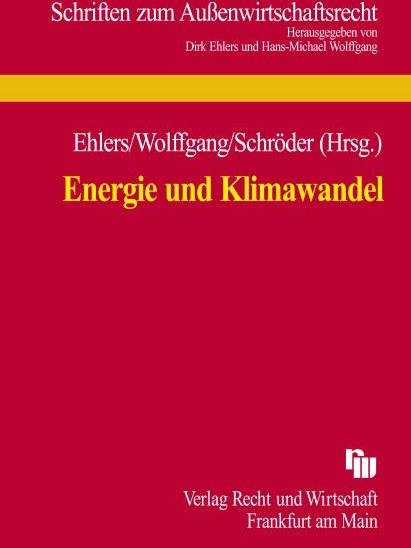
From 15 to 16 October 2009, the Center for Foreign Trade Law of the Westphalian Wilhelms University in Münster hosted its 14th Foreign Trade Law Day, focusing on energy and climate change. At this conference, Benjamin Görlach, economist for the Ecologic Institute, delivered a presentation entitled "Economic Instruments between Kyoto and Copenhagen: quo vadis Climate Protection?" This presentation is now available as an article in the conference volume.