This policy paper serves as a German translation of a memo on the 'Landscape of climate framework laws in Europe'. It provides a brief overview of the current status of national climate laws in Europe. It focuses in detail on the pending revisions to the German Climate Protection Law passed in 2019 and amended in 2021.
In this interview with klimafakten.de, Nils Meyer-Ohlendorf from Ecologic Institute talks about the results of two recent surveys about polarization on the topic of climate change in the German society, and discusses their significance for the climate movement.
How can water bodies become more resilient in the face of increasing droughts and heavy rainfall events? Which adaptation measures can be combined well and which are in conflict with each other? What is the potential of selected measures and how likely is their implementation in specific future scenarios?
The issue of fish protection and downstream fish migration is discussed intensively - even controversially - between and within the individual disciplines and areas of competence, both from a technical and an environmental policy perspective. The German Participatory Forum on Fish Protection and Downstream Migration has been dedicated to this discussion since 2012. This report, which concludes the German Participatory Forum on Fish Protection and Downstream Migration summarizes a selection of key issues from the forum's workshops across six central topics.
This policy brief examines the Forest Landscape Restoration (FLR) approach, considering global (e.g., the Bonn Challenge) and regional (e.g., AFR100) initiatives for restoring (forest) ecosystems, among others, and assesses their contribution to the UN multilateral goals.
A coherent German foreign climate policy is essential for the success of the national and European energy transition, as well as for the effective support of ambitious climate policies outside the European Union. This Ariadne background paper provides cornerstones and discusses options for the elaboration and further development of Germany's foreign climate policy. To this end, it distinguishes four categories of relevant goals: traditional climate policy goals, industrial policy goals, security and trade policy goals, and broader foreign policy goals. For each goal, it is necessary to identify appropriate means by which it can be achieved and barriers that stand in its way and need to be considered accordingly.
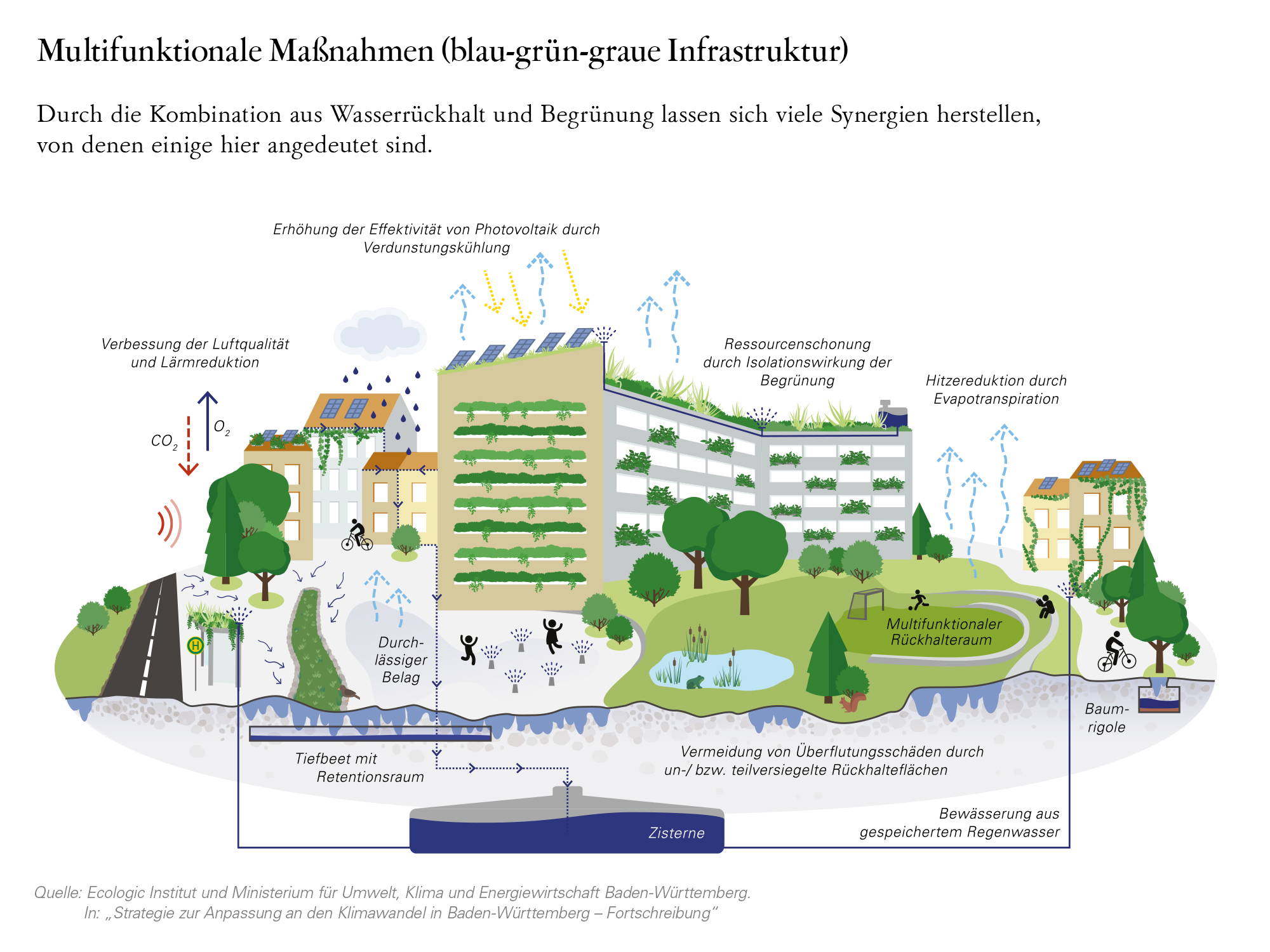
Ecologic Institute provided editorial and graphical support for the update of the adaptation strategy in Baden-Württemberg. Using graphical elements and a well-designed reader guidance, the reading orientation was improved and the visual quality of the document was increased. In addition to the graphic design, Ecologic Institute provided support for the drafting of several chapters, e.g. on climate change impacts, summarized sectoral adaptation challenges and developed an abridged version of the update of the adaptation strategy.
Due to changing climatic conditions, the state government of Baden-Württemberg committed to update its adaptation strategy in 2023. This compact information highlights the measures from the state strategy in which municipalities have an important role to play. It is intended to help them define and implement, or work towards implementing, the measures necessary for their local conditions and risks. It provides a compact overview for municipalities on their way to adapt to the consequences of climate change.
The adaptation strategy provides the framework for the adaptation activities of the state of Baden-Württemberg and serves as a basis for implementation, especially for administration, municipalities and the economy. Due to changing climatic conditions, the state government of Baden-Württemberg committed to update its adaptation strategy in 2023. This short version summarizes the contents of the adaptation strategy.
This edition of the policy brief represents the 2023 updated and content-revised version of the original document, thereby integrating the latest insights and developments in the field of Nature-based Solutions (NbS) and ecosystem restoration.
The Ecologic Institute and AquaEcology developed an information flyer that translates scientific findings on sunscreen-related chemical inputs into clear, actionable guidance for everyday use. The flyer addresses a specific exposure pathway: the wash-off of sunscreen during swimming and bathing, which contributes to the release of UV filter substances into marine waters.
The Ecologic Institute, in cooperation with AquaEcology, developed an information poster addressing the environmental impacts of sunscreen products on marine ecosystems. The poster focuses on the release of sunscreen into the sea during swimming and bathing and highlights this pathway as a relevant but often underestimated source of chemical pressure. Estimates suggest that approximately 14,000 tonnes of sunscreen products enter marine environments each year, where certain ingredients may adversely affect marine organisms.
The brochure summarizes all the recommendations for action that were developed as part of the STErn project. Objectives and indicators are outlined for each key topic of the STErn project.
This interactive illustration combines all recommendations for action (a total of 39 proposed measures) from the STErn project and shows the time frame in which they should be implemented.
This publication provides a quantitative overview of the development and status of environmental crime in Germany between 2010 and 2020, with a supplementary presentation for the year 2021, based on data from the police crime statistics ("Polizeiliche Kriminalstatistik"), as well as statistics from the Federal Statistical Office's criminal prosecution ("Strafverfolgungsstatistik"). The report provides both an overview of general trends and an in-depth account of individual environmental offences. Additionally, the publication contains data on administrative offences relating to the trafficking of protected species. The report was prepared by a team from Ecologic Institute on behalf of the German Federal Environment Agency.