<p>Emissions trading systems are one of the most effective and cost-effective options to meet agreed climate change targets. Many countries in Latin America, including Brazil, Mexico, and Chile, are currently trying to implement such market-based instruments. In order to promote emissions trading systems as well as a continuously growing network of emission trading schemes in these newly industrialized countries, Ecologic Institute initiated contacts between employees of the German Federal Ministry of Environment and Latin American stakeholders dealing with emissions trading and its possible implementation.</p>
Ecologic Institute coordinated the work for the new 2012 Indicators Report for a Sustainable San Mateo County (SSMC), Ecologic Institute in San Mateo took on the role of Report Coordinator and Editor. Supported by more than 40 volunteers, among them students from Mills High School in Millbrae and students of urban and regional planning at San José State University, the report was developed and produced in a six month timeframe and can be downloaded free of charge from the website of Sustainable San Mateo County.
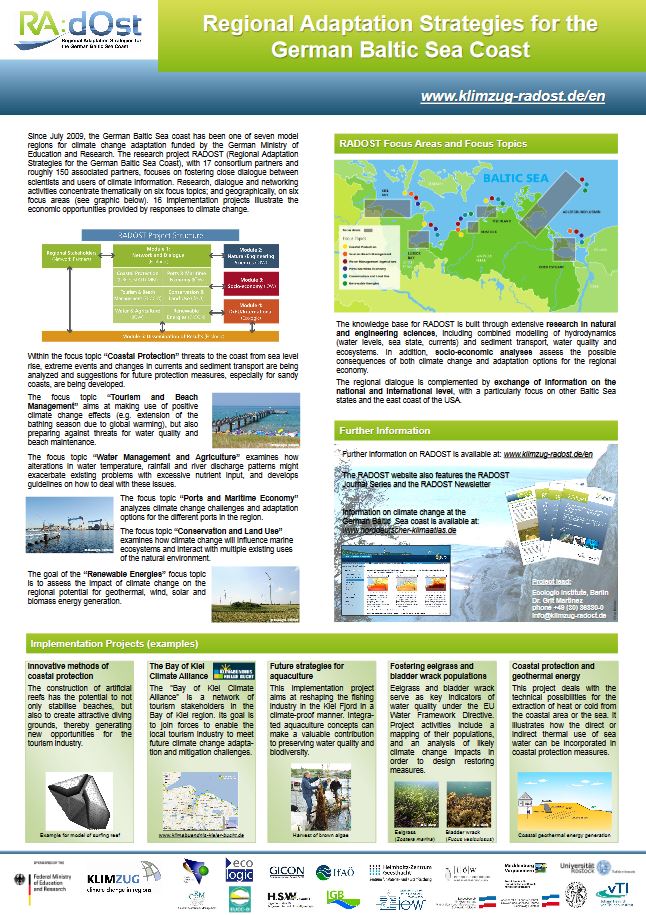
This new handbook was developed as part of the project RADOST (Regional Adaptation Strategies for the German Baltic Sea Coast). It provides a concise overview of adaptation policies being planned and implemented at the national, regional, and European level, including the status of National Adaptation Strategies for all Baltic Sea EU Member States.
This study by Ecologic Institute develops an organizing framework to summarize scientific findings concerning a wide selection of indicators and assesses their potential applicability for tracking sustainable industries and sustainable industrial development.
In this article published in Conservation Letters, members of the interdisciplinary Research Group on Ecosystem Services examine the possibilities and perspectives for a reorientation of the EU's Common Agricultural Policy (CAP). The authors find that the current reform proposals do not take into account the knowledge generated by ecosystem research. They argue that the CAP should be reformed such that it serves as an instrument to safeguard ecosystem services from agricultural land.
Ecologic Institute and Stiftung Wissenschaft und Politik (SWP) prepared a paper that gives an overview of selected sustainable development commitments, their shortcomings, and possible remedies, as discussed and agreed by relevant political fora. The paper and the summary of an expert workshop are available for download.
Elizabeth Tedsen, Researcher, attended the Visionary Arctic 2012 conference in Kirkenes (Norway), where she presented on the environmental and social risks and benefits attributed to Arctic offshore hydrocarbon development. The conference sought to explore intersecting themes of sustainability and territorial challenges and explore future scenarios in the High North.
Over the last 40 years, Germany has retooled policies to promote more environmentally sustainable growth. Michael Mehling contributed to an article focusing on four case studies from Germany in the areas of energy, urban infrastructure, and transportation. The article identifies potential opportunities for policy transfer from Germany to the United States as well as barriers that may hinder such transfer.