The economic valuation of biodiversity and ecosystem services has become a widespread tool to inform policy-makers about the consequences of environmental change. Assessments of environmental impacts at large geographic scales have led to growing policy and academic interest in transferring ecosystem service values from existing valuation studies to other ecosystem sites at a large geographic scale. This paper, published in Environmental and Resource Economics, proposes a methodology for scaling up ecosystem service values to estimate the welfare effects of ecosystem change at this larger geographic scale.
In a literature review, Ecologic Institute examined the effects of environmental tax reforms on the distribution of wealth among different population groups. The review was a contribution to a project commissioned by the European Environment Agency that analysed the long-term perspectives of a substantial shift of taxation from labour and income towards resource use in Europe. Distributional impacts of such a tax reform are addressed in one project report, while another one focuses on the effects of environmental tax reform on innovation.
In a literature review, Ecologic Institute examined the effects of environmental tax reforms on the distribution of wealth among different population groups. The review, which contributed to a study commissioned by the European Environment Agency, was included in a book publication offering in-depth assessments of experiences with environmental tax reforms and the benefits such a reform could bring about when implemented at a larger scale throughout Europe.
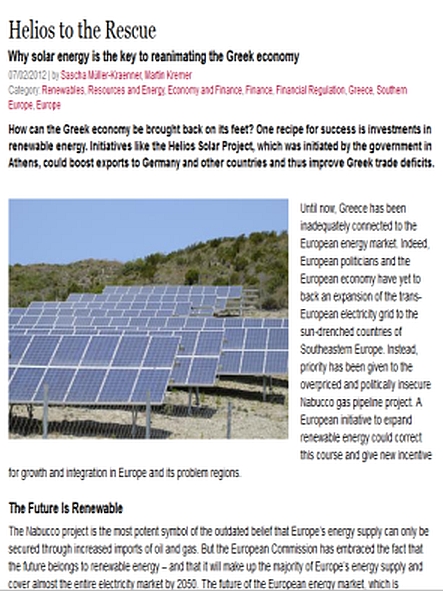
"Helios to the Rescue" – This is what Sascha Müller-Kraenner and Martin Kremer recommend to the economically weak Greeks in their "Internationale Politik" online article of the same title. What makes Greece so especially capable of producing renewable energy and what is preventing progress in this direction? Müller-Kraenner, Advisor of Ecologic Institute, and Kremer, Senior Fellow at the Stiftung Wissenschaft und Politik, analyze these issues and caution against passing up timely opportunities for investment and growth.
To date, developing countries have only participated in the carbon market as suppliers of offsets: through projects that reduce greenhouse gas emissions, they generate credits that are then sold to industrialised countries that have not acieved their mitigation targets. Since climate change is becoming an ever more pressing problem, however, mitigation in developing countries will need to go beyond offsets. At the same time, developing countries need to meet their responsibilities for the social welfare of their growing populations; scaled-up mitigation efforts will hence require time, capacity building, and large-scale investment. The so-called "Nationally Appropriate Mitigation Actions" (NAMAs) have been discussed as a way to enhance mitigation efforts in developing countries while taking into account their national circumstances and development priorities.