Ecologic analysed and compared different sources of data on the production and trade in Ozone Depleting Substances. Reporting data on production, imports and exports of ozone depleting substances (ODS) is one of the most fundamental bases for checking compliance with the Montreal Protocol. There are different sources for generating the necessary data. The European Commission has generally relied on the reporting by producers and importers/exporters as required under Article 17 of Regulation (EC) 3093/94 to generate the needed information. These data have provided the basis for submitting the annual data required under Article 7 of the Montreal Protocol to the Secretariat of the Protocol in Nairobi.
Bär, Stefani; R. Andreas Kraemer, Anne-Gabrielle Mazurek et.al. 2000: The Implementation of the IPPC Directive in Germany. Ecologic - Center for European and international Environmental Research, Berlin.
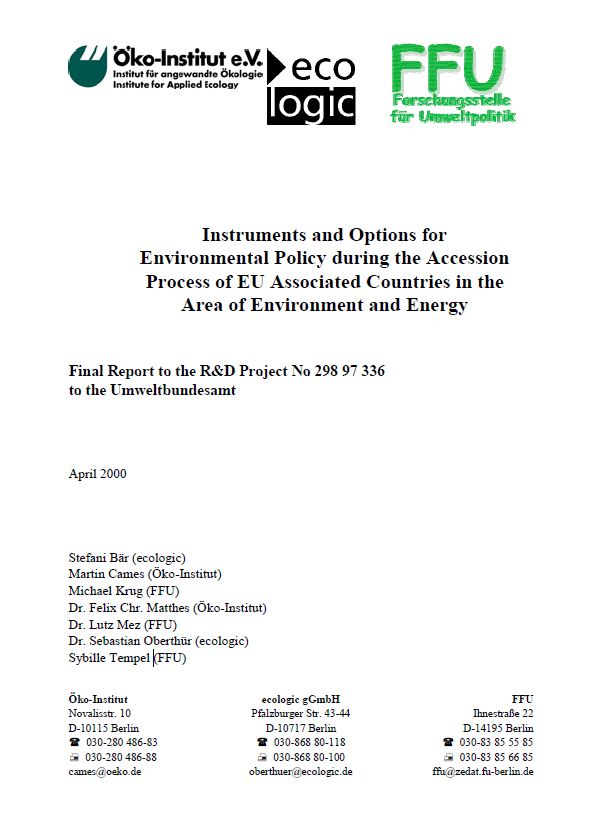
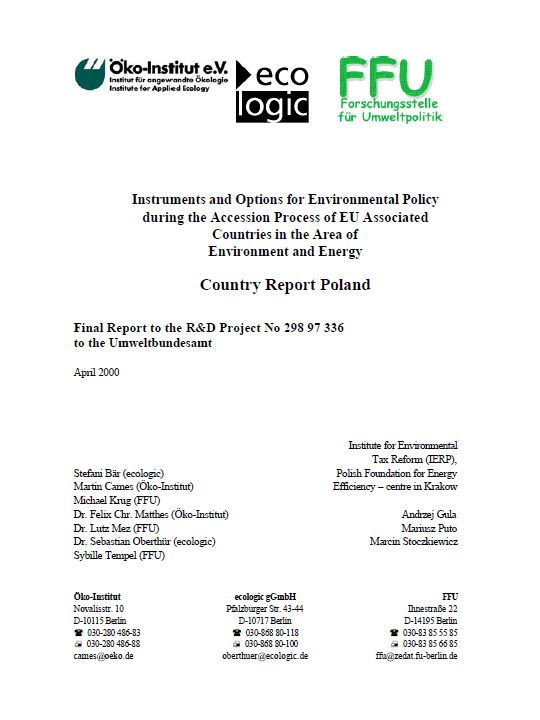
Bär, Stefani; Martin Cames; Michael Krug et al. 2000: Instruments and Options for Environmental Policy during the Accession Process of EU Associated Countries in the Area of Environment and Energy. Öko-Institut, Ecologic, FFU, Berlin.
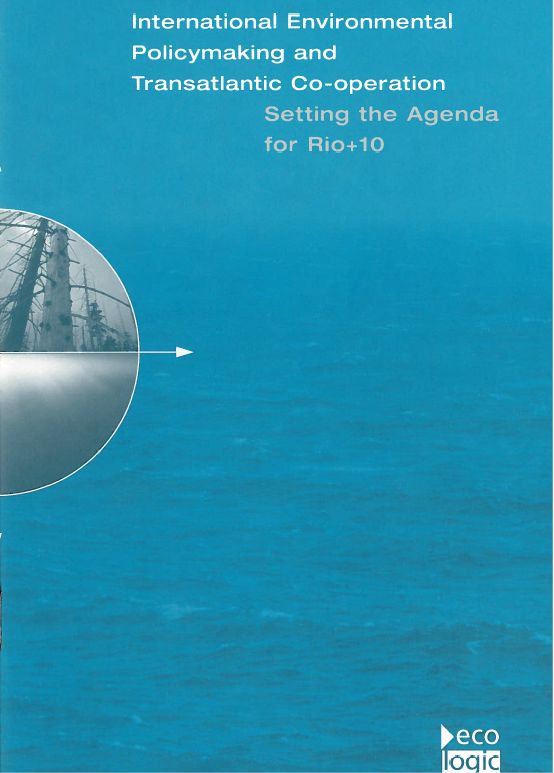
Buck, Matthias; Kelly Kollman and Alexander Carius 2000: International Environmental Policymaking and Transatlantic Co-operation. Setting the Agenda for Rio+10. [Ecologic Briefs on International Relations and Sustainable Development]. Berlin: ecoscript.
Oberthür, Sebastian 2000: Vorschläge zur Ausgestaltung der Kyoto-Mechanismen und deren Verknüfung mit dem System der Erfüllungskontrolle. Ecologic Institut: Berlin.
Büsgen, Uwe et al. 2000: Environmental Technology Transfer; Development of a Work Programme on the Subject of "Mega-Cities" for the Asia-Europe Environmental Technology Centre in Thailand. Documentation of Interviews Conducted in Asia in April and May 2000. Ecologic, Berlin.
Bär, Stefani et al. 2000: Conference on Closer Co-operation in European Environmental Policy. Held on 28 June 2000 in the Permanent Representation of Austria to the European Union in Brussels. Ecologic, Berlin.
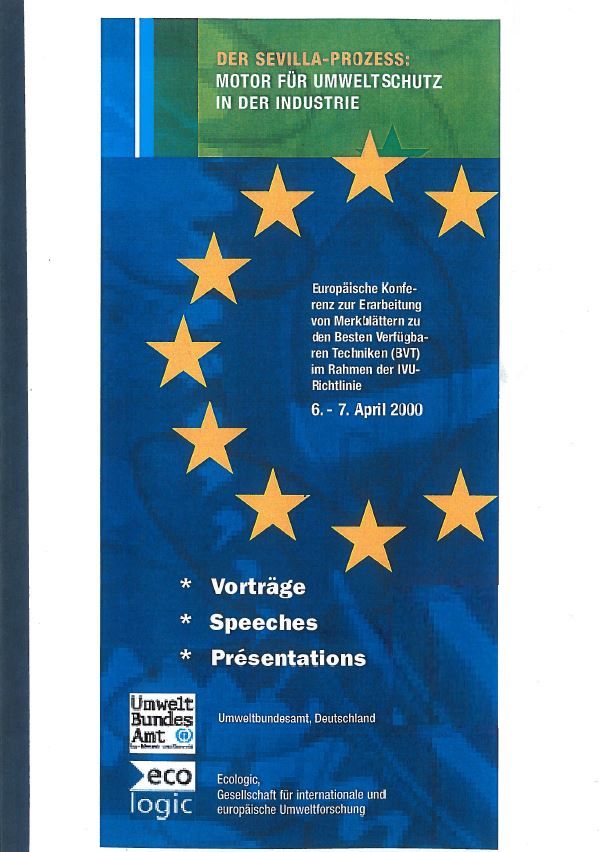
Umweltbundesamt and Ecologic Institut (Hrsg.) 2000: Der Sevilla-Prozess: Motor für Umweltschutz in der Industrie. Europäische Konferenz zur Erarbeitung von Merkblättern zu den Besten Verfügbaren Techniken (BVT) im Rahmen der IVU-Richtlinie, 6.-7. April 2000 - Conference Proceedings, Berlin.
Kraemer, R. Andreas and Kai M. Banholzer 1999: "Tradeable Permits in Water Resource Management and Water Pollution Control", in: OECD (Hg.): Implementing Domestic Tradable Permitsfor Environmental Protection. Paris: OECD, 75-107.
Pfahl, Stefanie et al. 2000: The Use of Global Monitoring in Support of Environment and Security. Ecologic, Berlin, commissioned by: European Commission, Joint Research Centre.
This study identifies EU accession requirements for the Accession Countries in the area of the environment and energy, and the relevant specific circumstances in each of the five countries (Estonia, Poland, Slovenia, Czech Republic, Hungary). Based on the respective findings, it is possible to draw conclusions with respect to co-operation at the EU, intergovernmental and company level.
This study identifies EU accession requirements for the Accession Countries in the area of the environment and energy, and the relevant specific circumstances in each of the five countries (Estonia, Poland, Slovenia, Czech Republic, Hungary). Based on the respective findings, it is possible to draw conclusions with respect to co-operation at the EU, intergovernmental and company level.
This study identifies EU accession requirements for the Accession Countries in the area of the environment and energy, and the relevant specific circumstances in each of the five countries (Estonia, Poland, Slovenia, Czech Republic, Hungary). Based on the respective findings, it is possible to draw conclusions with respect to co-operation at the EU, intergovernmental and company level.
This study identifies EU accession requirements for the Accession Countries in the area of the environment and energy, and the relevant specific circumstances in each of the five countries (Estonia, Poland, Slovenia, Czech Republic, Hungary). Based on the respective findings, it is possible to draw conclusions with respect to co-operation at the EU, intergovernmental and company level.