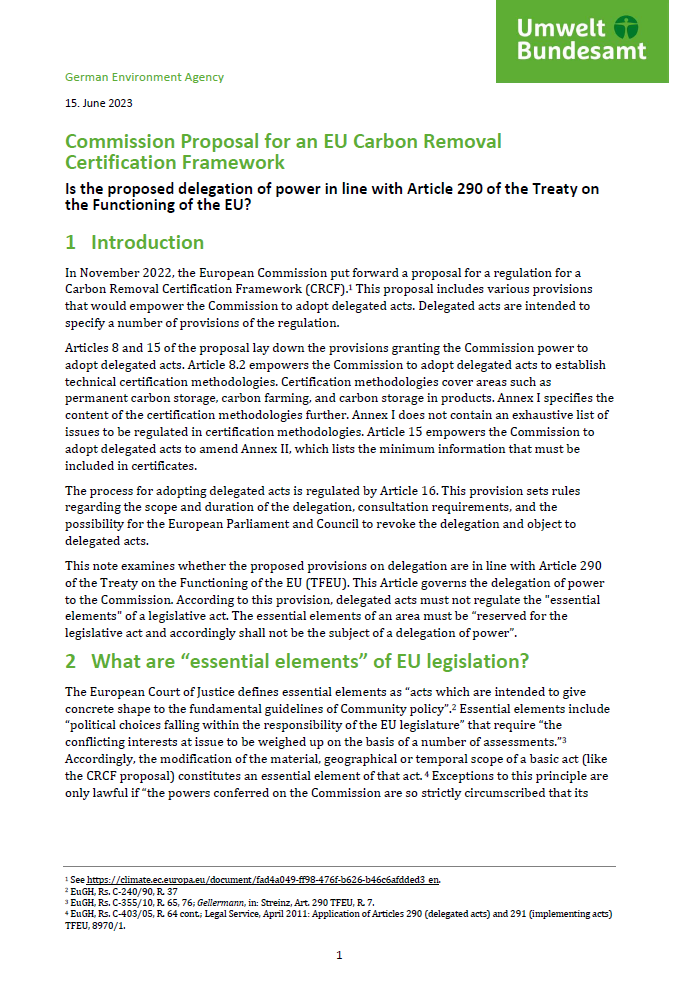
The Commission's proposal to certify carbon removals is a climate policy milestone, but it steers EU climate policy towards dangerous shoals. Nils Meyer-Ohlendorf – together with Anne Siemons and Hannes Böttcher from Öko-Institut – discusses how to circumnavigate them in the Tagesspiegel.
The project "Climate Adaptation Naturally Nature-based Solutions for Municipalities" aims to communicate the potential of nature-based solutions for climate adaptation in cities and municipalities in a targeted manner and to support cities and municipalities in the implementation of such solutions with the help of practice-oriented applications. The project primarily addresses climate adaptation managers in the municipalities, but also representatives from urban planning and development, green space offices and nature conservation authorities, education and culture, water and wastewater management.
This infographic provides an overview of the prevalence of strategic concepts for hydropower utilisation and general methods or recommendations for ensuring downstream continuity in Europe. The infographic is part of a fact sheet on fish protection targets in Europe.
This infographic summarizes the information on build-out flow and bypass flow at sites entered in the Atlas Fish Protection & Downstream Fish. The proportionate flow rate corresponds to the percentage of the bypass flow rate in relation to the development flow rate. The infographic is part of a fact sheet on fish protection and downstream fish migration measures.
This infographic evaluates the information on the aspects of the monitoring studies (multiple answers possible) at the sites entered in the
Atlas of Fish Protection & Downstream Fishways. The infographic is part of a fact sheet on fish protection and downstream fish migration measures.
This infographic summarizes the data on the monitoring studies, differentiated by screen bar spacing and build-out flow rate at the sites entered in the Atlas Fish Protection & Downstream Fish up to a build-out flow rate of 200 m³/s. The infographic is part of a fact sheet on fish protection and downstream fish migration measures.
The illustration provides an overview of the information structure of the Atlas sites. It is part of a fact sheet on fish protection and downstream fish migration measures.
This schema shows the three functions of a fish protection system: blocking, guiding, transferring. The infographic is part of the fact sheet "What makes a screen to a fish protection screen? The functional components of a fish protection system."
This infographic visualizes the range of hydropower plants included in the Atlas Fish Protection & Downstream Fish. The infographic is part of a fact sheet on fish protection and downstream fish migration measures.
This infographic shows the permeability for juveniles and adults of different fish species on 20- and 10 mm screens. The infographic is part of the fact sheet "What makes a screen to a fish protection screen? The functional components of a fish protection system."
This infographic shows the differences between horizontally angled and vertically angled fish protection screens. The infographic is part of the fact sheet "What makes a screen to a fish protection screen? The functional components of a fish protection system."
A fish protection system always consists of a fish protection screen and a bypass, designed as a functional unit. This infographic shows and explains the components. The infographic is part of the fact sheet "What makes a screen to a fish protection screen? The functional components of a fish protection system."
This infographic evaluates the information on the type of fish protection systems at the sites listed in the Atlas of Fish Protection & Downstream Fish. The infographic is part of a fact sheet on fish protection and downstream fish migration measures.
This infographic provides an overview of the legal regulations for fish protection at hydropower sites in Europe. The infographic is part of a fact sheet on fish protection targets in Europe.