What is climate change adaptation? How can we best approach implementing it across Europe? What lessons can we learn from people already working on adaptation today? In this video from the BASE project, four young reporters from the fictional 'BASE Broadcast Studio' interview a group of 'adaptation professionals' from across Europe to learn more.
How are member states in the EU implementing National Adaptation Strategies (NASs)? How do their approaches differ, and what lessons can we learn? Using case studies from across Europe, this policy brief analyses processes for designing, implementing and reviewing NASs. It identifies the positive role being played by the EU Adaptation Strategy in influencing NAS implementation, while also identifying shared challenges, including those related to short political timeframes and concretely realising mainstreaming of climate adaptation into all sectors.
This short animated video introduces the BASE project and its key issues to a wider audience. BASE (Bottom-Up Climate Adaptation Strategies Towards a Sustainable Europe) supports action for sustainable climate change adaptation in Europe by making experiences and scientific information about adaptation meaningful, transferable and easily accessible to decision-makers at all levels.
How can adaptation reduce the impacts of climate change and, in some cases, even yield benefits and business opportunities? Decision makers at all levels in Europe currently face a number of significant challenges when devising appropriate and sustainable adaptation strategies. This policy brief is an output of the EU FP7 project "Bottom-up Climate Adaptation Strategies Towards a Sustainable Europe" (BASE) and summarises the following challenges: Uncertainties and insufficient knowledge, as well as the need to improve assessments and the mainstreaming of adaptation in policy.
Weiland, Sabine et al. 2013: Criteria for Evaluating Climate Adaptation Measures: A Meta-Analysis. Science for the Environment. Mapping Knowledge Needs for Future Horizons. Aarhus: Aarhus University, DCE-Danish Centre for Environment and Energy, 102.
Pedersen, Anders Branth et al. 2013: Coherent Policy Instruments for Climate Change Adaptation? Science for the Environment. Mapping Knowledge Needs for Future Horizons. Aarhus: Aarhus University, DCE-Danish Centre for Environment and Energy, 101.
Russel, Duncan et al. 2013: A BASE Project Analysis of EU Member State Climate Change Adaptation Strategies: Comparing Approaches and Drawing Lessons. Science for the Environment. Mapping Knowledge Needs for Future Horizons. Aarhus: Aarhus University, DCE-Danish Centre for Environment and Energy, 38.
The electronic newsletter, published in English, includes stories on the latest findings of the BASE project (Bottom-Up Adaptation Strategies towards a Sustainable Europe), along with information on other key developments related to climate change adaptation in Europe. Furthermore, the newsletter includes a number of recurring features. These include the 'Adaptation Dialogues', chronicling the perspectives and experiences of local level stakeholders implementing adaptation activities, as well as the 'Adaptation Snapshots', images from around Europe of adaptation in action.
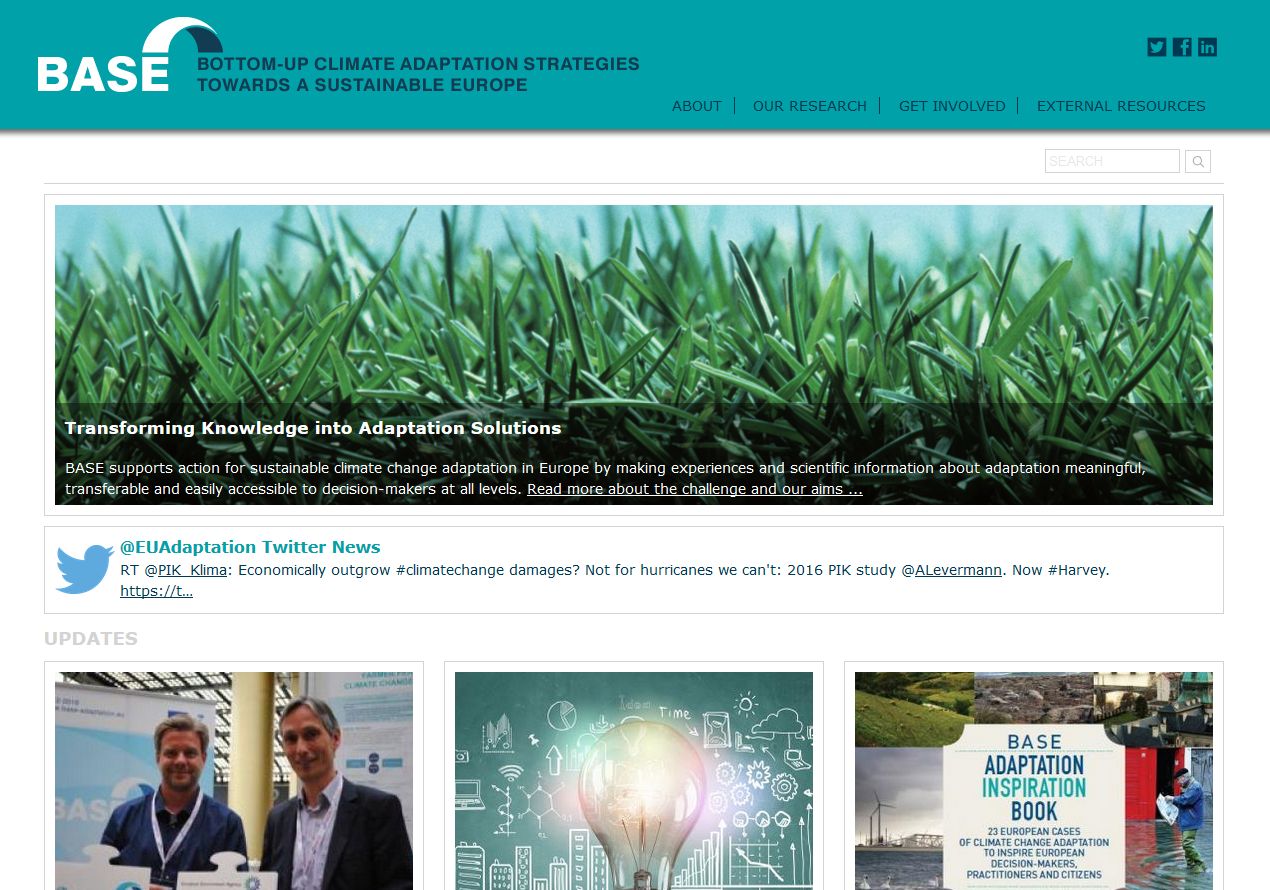
The EU research project "Bottom-Up Climate Adaptation Strategies for a Sustainable Europe" (BASE) supported action for sustainable climate change adaptation in Europe. BASE made experiential and scientific information on adaptation meaningful, transferable and easily accessible to decision-makers at all levels. The project was funded under the EU's 7th Research Framework Programme (FP7).
The Ecologic Institute designed and developed the BASE project's website. It contained an interactive map, which gave an overview of the BASE case studies. Furthermore, the webpage provided detailed information on the project and its events as well as publications for download. Users could also subscribe to the newsletter.