Related content for project "Pond Ecosystems for Resilient Future Landscapes in a Changing Climate (PONDERFUL)" (project ID 33005)
Publication:Article
Nature-based solutions (NbS) at the landscape scale are increasingly recognised for their role in supporting biodiversity, enhancing ecological connectivity and contributing to climate change adaptation. However, their assessment and implementation remain complex. This article examines these challenges using the concept of pondscapes – networks of ponds and their surrounding terrestrial habitats – as a case for landscape-scale NbS.
The report, "Overcoming policy, financial, social, and economic barriers to pondscape NBS for climate change mitigation and adaptation", has been released as part of the PONDERFUL project. Commissioned under the European Union's Horizon 2020 Research and Innovation Programme, this synthesis report refines and presents the final PONDERFUL framework – a comprehensive strategy for scaling up pondscapes as effective nature-based solutions (NbS).
On 8 November 2024, the final webinar of the EU project PONDERFUL took place. Led by Professor Jeremy Biggs (Freshwater Habitats Trust) and Hugh McDonald (Ecologic Institute), it discussed how national and regional plans can be developed to protect, restore and create ponds and ponded landscapes. The aim was to inform policymakers on how these small but effective ecosystems can be used as nature-based solutions (NbS) to adapt to and mitigate climate change.
At the International Pond Conference 2024, which took place online from 12 to 13 November 2024, Hugh McDonald from the Ecologic Institute in Berlin presented the results of a comprehensive study on the financing of ponds and pond landscapes as nature-based solutions (NbS). The work analyzed public and private financing models and assessed their suitability for the implementation of pondscapes, and for financing NbS more broadly.
The recently published guide "Using ponds and pondscapes as nature-based solutions" is a practical guide for policy makers. The guide provides detailed recommendations on using ponds and pondscapes as nature-based solutions, in particular to adapt to climate change and promote biodiversity. In addition to the policy dimension, it contains practical suggestions for monitoring, management and restoration of ponds.
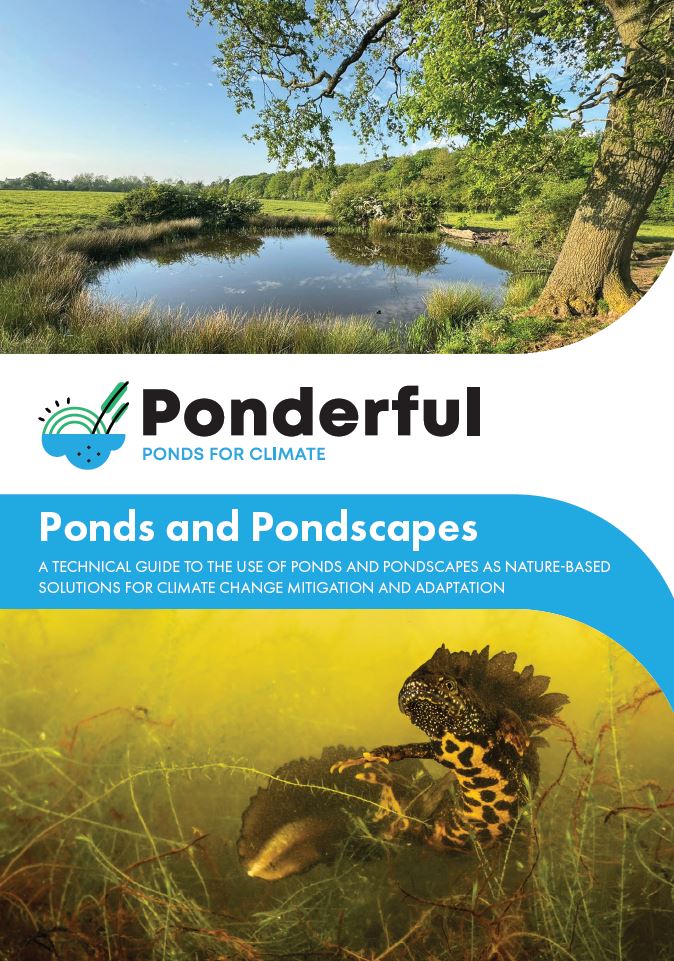
The technical handbook of the PONDERFUL project shows how ponds and pond landscapes can be used as Nature-Based Solutions (NBS) to tackle societal challenges such as climate change, biodiversity loss and water scarcity. The PONDERFUL handbook provides practice-oriented guidelines for dealing with these valuable ecosystems and shows how ponds can be integrated into existing landscapes so that nature and people benefit equally.
Financing has been identified as a key barrier that limits the upscaling of nature-based solutions (NBS), including pondscapes. This report aims to address this challenge by supporting pondscape developers to answer a simple question: how can I pay for my pondscape project?
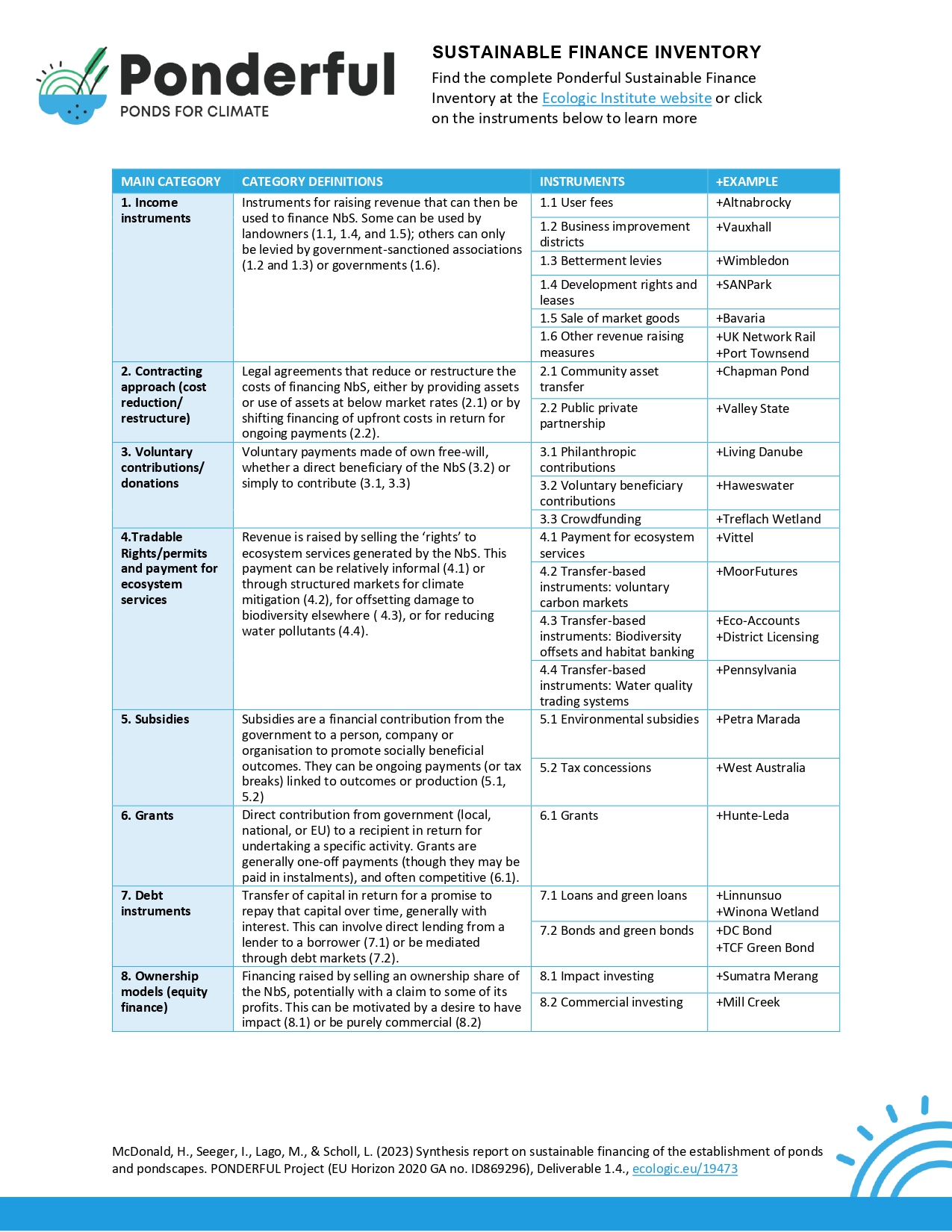
The PONDERFUL Sustainable Finance Inventory consists of a total of 22 financing instruments for nature-based solutions (NBS). Each instrument is matched by at least one concrete example of the financing instrument in action. Different financing instruments have different strengths and weaknesses, making them more or less appropriate for different contexts and actors. The Inventory aims to support pondscape developers to understand financing options and identify the finance instruments best suited to their pondscape NBS project.
Recognizing the European Union's (EU) influential role in shaping NBS conceptualization, we undertook a qualitative content analysis of 38 EU policies to discern opportunities and limitations in implementing ponds and pondscapes as nature-based solutions (NBS). While our primary focus is on these aquatic habitats, their ubiquity and diverse benefits enable extrapolation to broader implications for NBS in the EU.
This article reviews the role of ponds and pondscapes in delivering Nature's Contributions to People and provide an overview of the challenges and opportunities for their broader implementation as Nature-based Solutions. The authors, among them Manuel Lago (Ecologic Institute) propose a conceptual framework that can help the implementation of pond Nature-based Solutions, and that outlines future research needs.
The H2020 EU-funded PONDERFUL project will investigate how ponds can be used as nature-based solutions (NBS) for climate change. It will evaluate the interaction and feedback between biodiversity, ecosystem services and climate in pondscapes.