
Teodora Bibu
MSc (Integrated Natural Resource Management)
BA (Political Science)
Researcher
- Team
- Topics
Teodora Bibu is a Researcher at Ecologic Institute. Teodora’s work is guided by the understanding that food and agriculture are shaped by a wide range of interconnected political, social and structural factors. Her research seeks to shed light on this complexity and to support the transition towards more just and sustainable food and agricultural systems by translating insights into practical pathways for change. She works mainly in English and German, is fluent in French and Romanian, and occasionally supports projects in Portuguese and Italian.
With a background in political science, she draws on a broad methodological toolkit, ranging from participatory co-creation and stakeholder-oriented processes to qualitative interviews, policy analysis and more data-driven approaches. Across these methods, her aim is to connect knowledge from the ground with clear problem definitions and actionable options for political actors, practitioners and wider audiences. Her work spans local, national and European contexts: from developing food policy approaches for municipalities on food poverty to advising German public authorities on the implementation of the Common Agricultural Policy to contributing to pan-European work on food waste, pesticide reduction and more resilient food systems.
Teodora is currently engaged in FOODWISE “Empowering Equitable and Emotionally Intelligent Transitions to Circular Food Systems”, which examines how circular food practices can move beyond environmental awareness and become part of everyday retail and consumer behaviour. Her role focuses on translating project insights into policy recommendations and connecting them to the broader EU policy landscape. She is also involved in FLOODTRAIN “From Knowledge to Action: Empowerment and Training of Floodplain Restoration Managers”, which transforms scientific knowledge, practical experience and stakeholder perspectives into practical training for restoration professionals. Here, she helps shape the training module on floodplain restoration partnerships and financing. In AF4Value “Innovations in Value Chains to Promote Farming Viability through Agroforestry”, she focuses on the conditions needed for agroforestry to thrive across value chains, businesses and policy frameworks, while helping establish Living Labs in Germany, Italy and France. Alongside these projects, she takes part in a range of national and regional initiatives within the food and agriculture teams.
In previous work, Teodora contributed to the SPRINT project “Sustainable Plant Protection Transition: A Global Health Approach”, supporting an extensive bottom-up participatory process that developed transition pathways out of pesticide dependency and translated them into policy recommendations for EU and national decision-makers. She also worked on the project “Capacity Building for Ambitious Climate Action in the Agri-food Sector in Central Eastern Europe”, which examined the implications of the CAP in often-overlooked Central and Eastern European countries and the challenges of applying a common policy framework across diverse agricultural contexts.
Over the years, Teodora Bibu has gained thorough work experience in both research institutes related and unrelated to academia, such as the Otto Suhr Institute of Political Science at the Freie Universität Berlin and the Oeko-Institut Berlin.
Teodora Bibu holds a master's degree in Integrated Natural Resource Management from the Humboldt-Universität zu Berlin and a bachelor's degree in Political Science from the Otto Suhr Institute of the Freie Universität Berlin (Germany). She has furthermore spent time studying at Sciences Po Lyon (France) and the Universidade Federal do Rio de Janeiro (Brazil).
Contact Teodora Bibu by Email
Selected projects by Teodora Bibu
Spring in an intercropped almond orchard
|Trentin, M. (2026). Green spring in a intercropped almond orchard. Zenodo. https://doi.org/10.5281/zenodo.20160347
Innovations in Value Chains to Promote Farming Viability through Agroforestry (AF4VALUE)
- Duration
-
-
- Funding
-
Federal Ministry of Research, Technology and Space (BMFTR), Germany Projektträger Jülich, Forschungszentrum Jülich (PtJ), Germany
Sustainable Plant Protection Transition: A global health approach (SPRINT)
- Duration
-
-
- Funding
-
European Commission, Directorate-General Research & Innovation (DG Research & Innovation), International
Selected publications by Teodora Bibu
Riedel, Antonia & Bibu, Teodora (2026): Policy brief: Transition to pesticide-free agriculture. Policy brief of the Horizon 2020 project “SPRINT”. Available at: https://sprint-h2020.eu
Meier, Johanna; Bibu, Teodora & Riedel, Antonia (2026): Policy brief: Using the CAP to reduce pesticide dependence: Creating the conditions for structural change. Policy brief of the Horizon 2020 project “SPRINT”. Available at: https://sprint-h2020.eu
Recent content by Teodora Bibu
Using the CAP to Reduce Pesticide Dependence
Creating the Conditions for Structural Change
Year
Read moreMitigating Livestock Emissions Through the CAP
A brief analysis of livestock-relevant CAP interventions in five case-study countries
-
Read more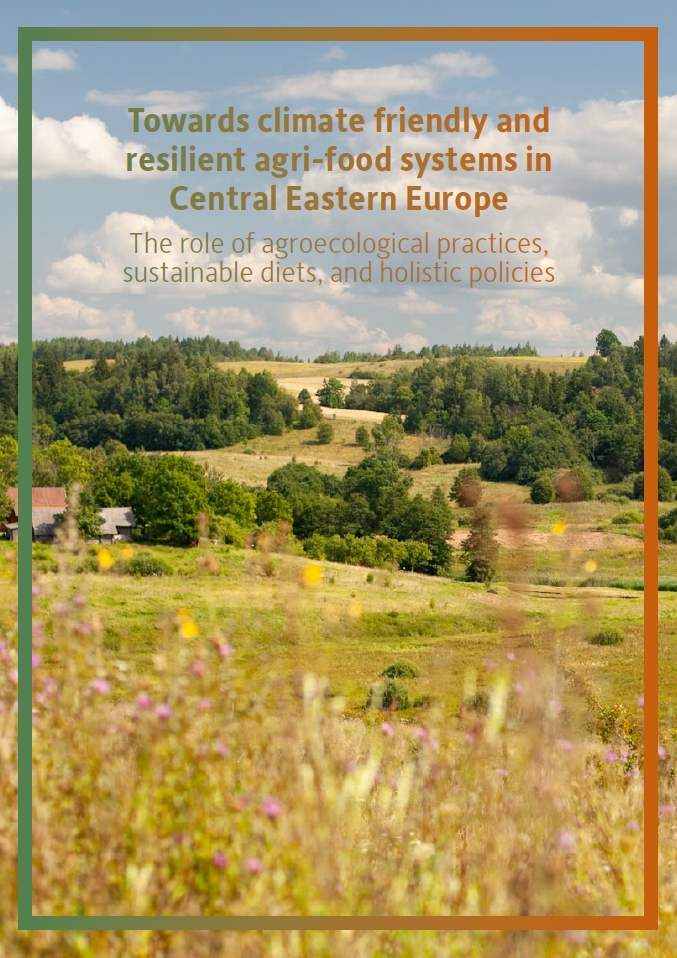
Towards Climate-friendly and Resilient Agri-food Systems in Central Eastern Europe
The role of agroecological practices, sustainable diets, and holistic policies
Year
Read more