
© Bodil Bartroff, 2025
Climate Policy in Agriculture
Insights from an EU Member State Dialogue
- Presentation
- Date
-
- Location
- Brussels, Belgium
- Panel discussion
European agriculture faces the dual challenge of significantly reducing emissions while maintaining economic resilience. These issues shaped a recent event hosted by the Danish EU Presidency 2025 in cooperation with the Directorate-General for Climate Action (DG CLIMA) and the Directorate-General for Agriculture and Rural Development (DG AGRI).
During a panel discussion, Hugh McDonald, Senior Fellow at Ecologic Institute, emphasised that only early, well-designed, and coherent policymaking will allow the sector to move towards climate neutrality.
Key Messages from his Intervention
- Ambitious climate action is unavoidable. To limit future costs and unlock opportunities, policymaking must start now.
- Clear, realistic, and gradual mitigation targets help farmers and agri-food stakeholders engage constructively in the transition.
- Pricing agricultural emissions creates incentives for climate-efficient practices. A dedicated emissions trading scheme for agriculture should be considered as a medium-term option – designed to protect smaller farms and low-income households.
- Enhancing capacities offers a double benefit: it reduces costs for farmers and strengthens the sector’s ability to meet ambitious targets.
- Monitoring, reporting, and verification (MRV) systems can already support effective emission reductions today, even as they continue to evolve.
The discussion highlighted that transforming the agricultural sector requires coherent, socially fair, and forward-looking policymaking.
Contact

- Organizer
-
EU Council Presidency, Denmark 2025 (DK 2025 EU), International European Commission, Directorate-General for Agriculture and Rural Development (DG Agriculture), International European Commission, Directorate-General for Climate Action (DG Climate), International - Panel discussion
- Date
-
- Location
- Brussels, Belgium
- Keywords
-
Klimapolitik Landwirtschaft, EU Landwirtschaft Emissionen, landwirtschaftliche Emissionen reduzieren, agrarischer Klimaschutz, Emissionshandel Landwirtschaft, landwirtschaftliche Klimaziele, Klimamaßnahmen Agrarsektor, MRV Landwirtschaft, EU Agrarpolitik Klima, klimaneutrale Landwirtschaft, Emissionsbepreisung Landwirtschaft, nachhaltige Agrarsysteme, Climate Action Agriculture, europäischer Agrarsektor, EU-Klimapolitik, EU-LandwirtschaftspolitikEuropaMonitoring Reporting Verification, MRV-Systeme, Emissionsbepreisung, Emissionshandelssystem Landwirtschaft, policy analysis, Klimapolitik-Analyse, Transformationspfade Landwirtschaft, Kapazitätsaufbau Agrarsektor, Zielsetzungsmodelle, sektorale Klimastrategien, politische Instrumente Emissionsminderung, Stakeholder-Engagement Landwirtschaft
McDonald, H., Siemons, A., Fallasch, F., Gardiner, J., Scheid, A., Scheffler, M., and Wiegman, K. (2025). Temporary carbon units from carbon farming and EU agri-food climate policy: Assessment of risks, opportunities, and alternatives for promoting temporary carbon sequestration. Ecologic Institute, Berlin.
Scheid, Aaron; Pazmino Murillo, Julia; McDonald, Hugh et al. (2025): Incentivizing farm-level climate action through rewarding mechanisms. A categorization framework. Deliverable of the Horizon Europe project "A European-wide network of pilot farmers implementing and demonstrating climate smart solutions for a carbon neutral Europe".
Scheid A, Hart K, Pazmino J, Riedel A, Tremblay L-l, Durrant L (2025) Leveraging the Common Agricultural Policy to accelerate livestock emission reductions – examples from five Member States, Ecologic Institute and IEEP
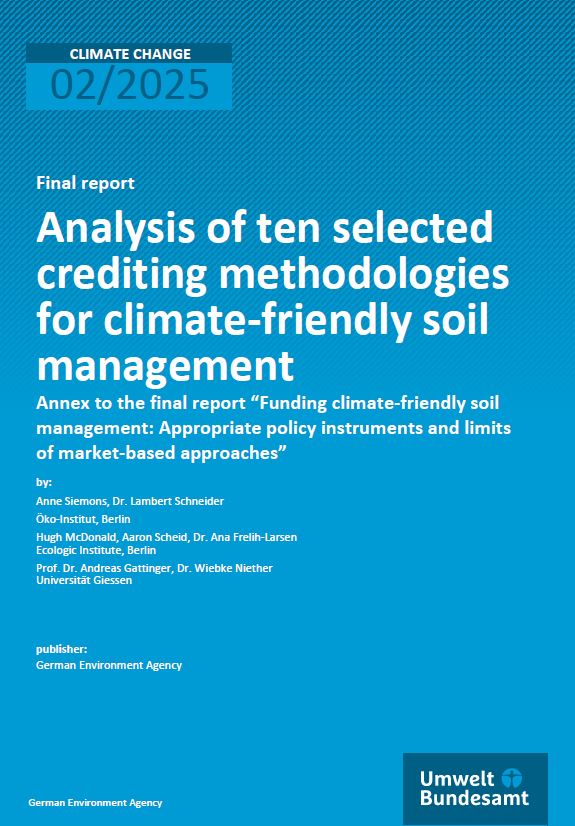
Siemons, Anne et al. 2023: Analysis of ten selected crediting methodologies for climate-friendly soil management. Annex to the final report "Funding climate-friendly soil management: Appropriate policy instruments and limits of market-based approaches". German Environment Agency: Dessau-Roßlau.
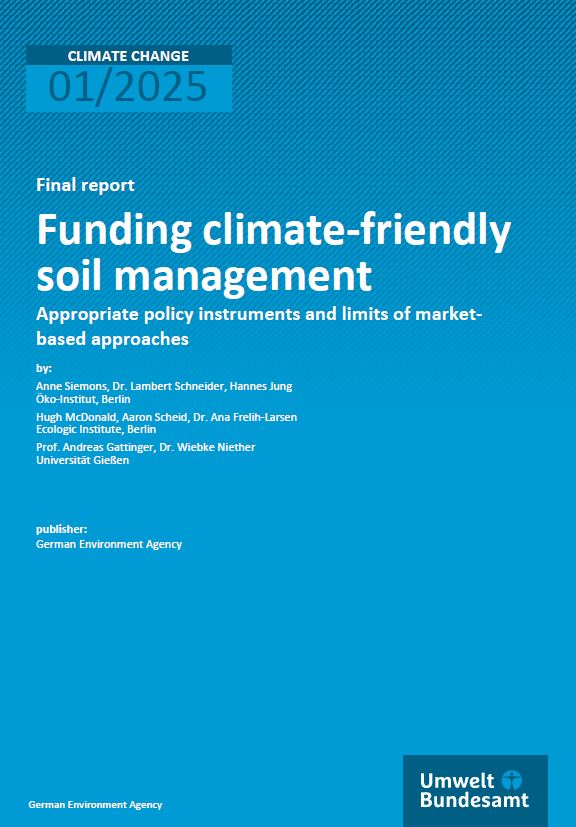
Siemons, Anne et al. 2025: Funding climate-friendly soil management. Appropriate policy instruments and limits and market-based approaches. Final report. 01/2025. German Environment Agency: Dessau-Roßlau.
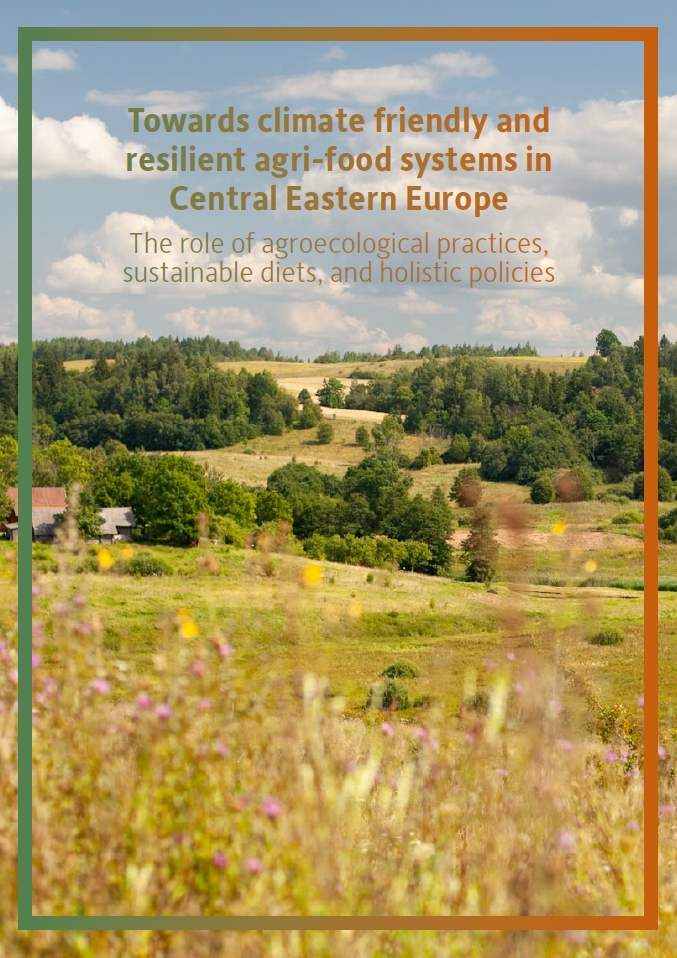
Frelih Larsen, A. et al. (2024). Towards climate friendly and resilient agri-food systems in Central Eastern Europe: the role of agroecological practices, sustainable diets, and holistic policies. Ecologic Institute, Berlin. ISBN 978-3-937085-37-1