This paper analyses the European Union's (EU) policy framework, alongside international and regional agreements relevant to wetland conservation and restoration, focusing on coastal ecosystems. Drawing on policy content analysis, it assesses how 36 EU policies and multilateral agreements support or limit coastal wetland restoration and conservation efforts in Europe.
Aquatic insects that emerge from streams are a crucial energy subsidy for riparian predators such as spiders. When streams are disturbed by human activities, these impacts can cross ecosystem boundaries, disrupting aquatic–terrestrial food web connectivity. This study, co-authored by Dr. Benjamin Kupilas from Ecologic Institute together with international partners, explores how such connections function and how they are shaped by human disturbance.
Anthropogenic litter poses a growing threat to aquatic ecosystems worldwide. While the EU's Marine Strategy Framework Directive (MSFD) addresses this pollution as an environmental status indicator, the Water Framework Directive (WFD) lacks such a measure.The publication, jointly authored by researchers from the European Plastic Pirates initiative, illustrates how citizen science can address this issue by using existing litter data from related initiatives. Members of the author team included Doris Knoblauch and Mandy Hinzmann from the Ecologic Institute.
To enable a genuine shift toward a circular plastic economy, the UN plastics treaty must confront two critical structural barriers: fossil fuel and plastic production subsidies, and the failure to internalize the true societal and environmental costs of plastic. Without addressing these root causes, efforts to end plastic pollution risk falling short, the authors of this article argue. Among them Ecologic Institute's Doris Knoblauch.
Under the EU’s Governance Regulation, Member States are legally required to hold multilevel climate and energy dialogues (MLCEDs), structured spaces for deliberation between governments, civil society, and other stakeholders. In the Review of European, Comparative & International Environmental Law (RECIEL), Ricarda Faber (Deutsche Gesellschaft für Internationale Zusammenarbeit (GIZ) GmbH), Deyana Kocher, and Matthias Duwe (Ecologic Institute) offer an assessment of how Member States are implementing these dialogues under Article 11.
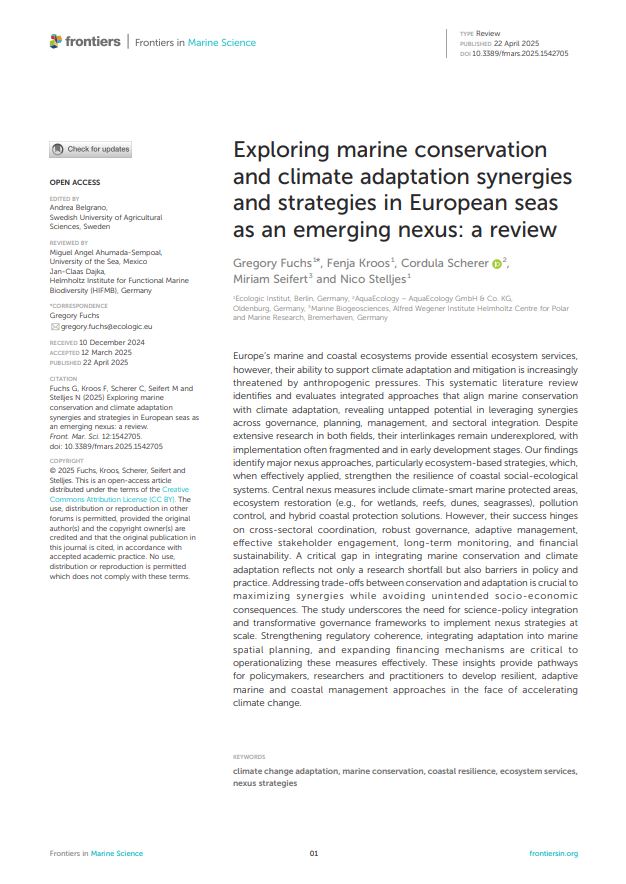
This review explores the potential synergies between marine conservation and climate adaptation strategies, which are critical for addressing climate change impacts in European coastal and marine areas. The article, published in Frontiers in Marine Science, identifies and evaluates integrated approaches that support both marine ecosystem protection and climate adaptation.
Plastic pollution has become a severe global crisis, posing grave threats to the environment, human health, and sustainable development. Driven by unchecked plastic production, the problem worsens through the entire lifecycle of plastics—from creation to disposal—releasing not only large debris but also microscopic particles, monomers, and thousands of chemical additives. These pollutants travel worldwide via air and water currents, damaging ecosystems and wildlife, including marine species that suffer from entanglement, ingestion, and toxicity. This editorial is part of a Special Issue "An effective plastic treaty for marine life".
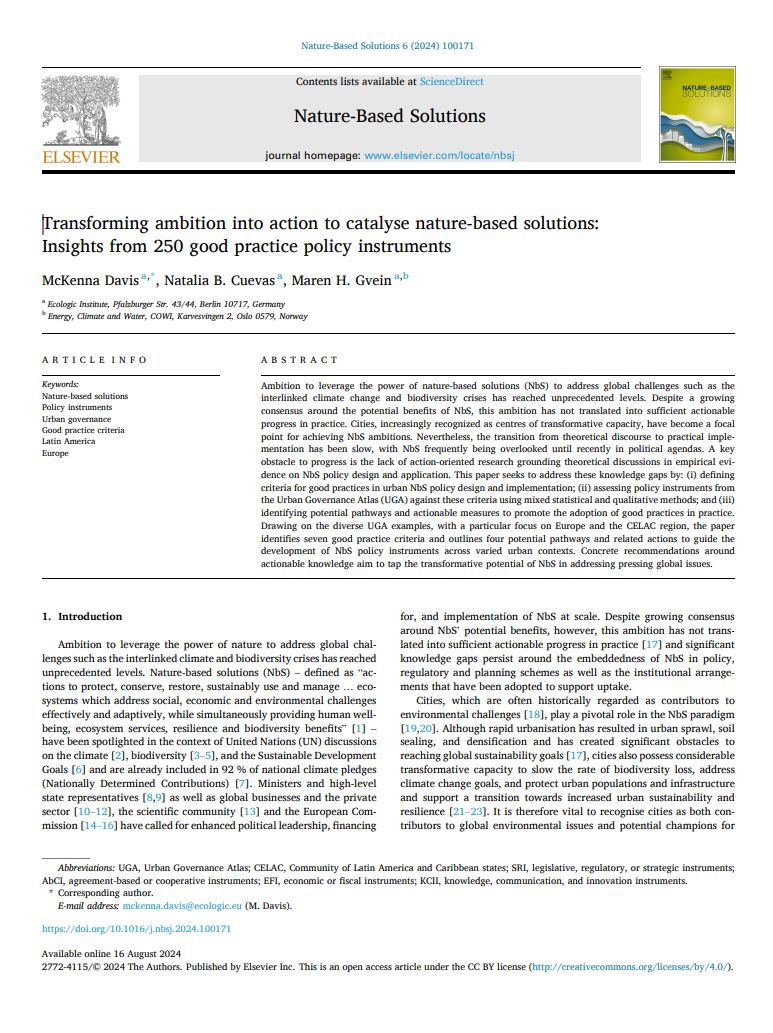
Nature-based solutions (NbS) hold immense potential to address global challenges such as climate change and biodiversity loss – but how can ambitious goals finally be translated into action? This article provides valuable insights into 250 practical policy instruments from 41 countries that successfully promote NbS. For the first time, a systematic evaluation of good practice examples is presented, aimed at helping cities and communities implement NbS effectively. From innovative approaches to long-term sustainable solutions, the authors highlight how policy design around NbS can be optimized globally. The article provides concrete recommendations and inspiring success stories to advance the implementation of NbS in your region!
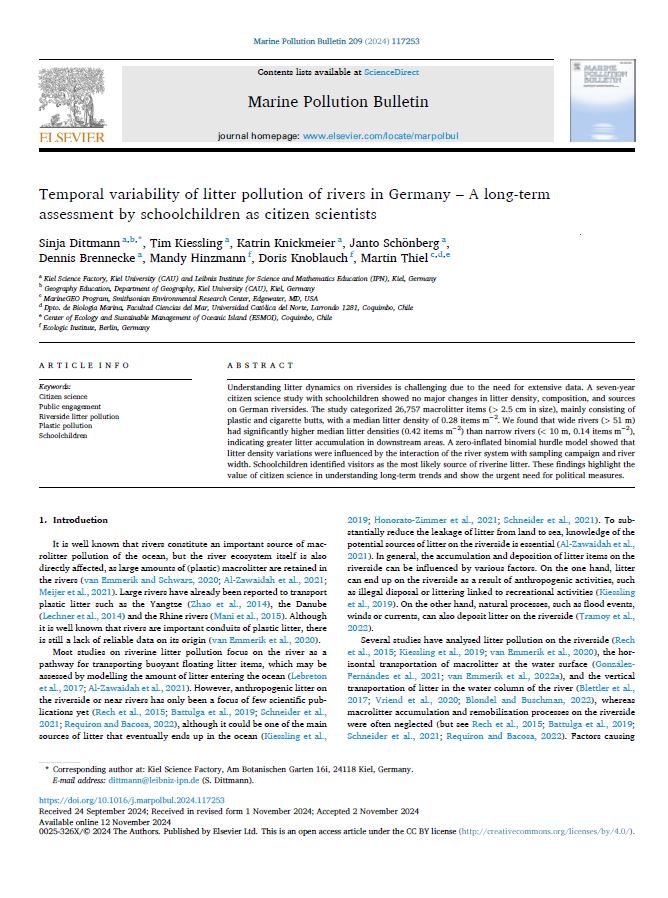
A seven-year citizen science study with schoolchildren on German riversides found stable litter density, mainly plastic and cigarette butts, with wider rivers showing higher litter levels, stressing the need for policy action.
In this article, we delve into the first zero draft of the treaty, offering a critical examination of its approach and potential shortcomings. Our analysis not only identifies key gaps in the draft's problem definition and scope but also underscores the urgent need for a more comprehensive and holistic strategy that addresses both upstream and downstream solutions, i.e. the whole life-cycle. For policymakers, environmental advocates, and stakeholders eager for a robust global response to plastic pollution, this open access article offers essential insights into the path forward.
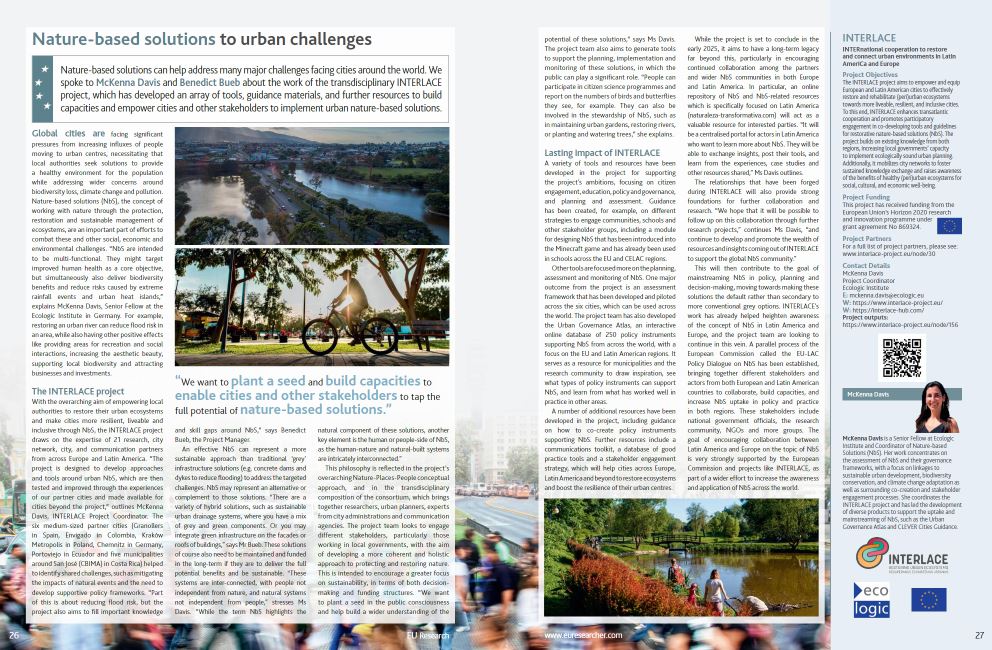
The INTERLACE project, funded by Horizon 2020, exemplifies innovative transdisciplinary approaches to tackling urban challenges through nature-based solutions (NBS). By fostering stakeholder engagement, developing practical tools, and supporting ecosystem restoration, the project empowers cities across Europe and Latin America to implement sustainable NBS. McKenna Davis and Benedict Buebfrom Ecologic Institute provided key insights into the project's progress and outcomes.
In recent discussions surrounding the Clean Industrial Deal, there has been growing recognition of the need to not only prioritize industrial transformation but also integrate social and environmental considerations. This approach is vital for ensuring that the green transition is inclusive, equitable, and sustainable in the long term. The blogpost, authored by members of the Think Sustainable Europe network, underscores that climate action must go hand-in-hand with social protection measures and environmental safeguards.
The notion of "not giving the AfD a platform" is a widespread conviction and practice. It has not prevented the AfD's successes. It has failed. Nils Meyer-Ohlendorf discusses what should happen next in the Tagesspiegel.
In this article, the authors, including Anthony Cox of Ecologic Institute, highlight there is little appetite among WTO members for modernizing multilateral subsidy rules at a time when many countries are introducing new forms of support that could potentially exacerbate existing policy disincentives for globally sustainable economic and environmental outcomes.
The article "Design of greener drugs: aligning parameters in pharmaceutical R&D and drivers for environmental impact" published in Drug Discovery Today explores the challenges and opportunities in developing pharmaceuticals that are not only safe and effective for patients but also environmentally sustainable. This open access article – written by a cross-disciplinary team with representatives of universities, regulators, research-based pharmaceutical companies and SMEs – identifies the most promising areas for action in pharmaceutical research and development. It specifically aims to bridge the scientific concepts used by the expert communities in both environmental science and pharmaceutical R&D.