The implementation of the Water Framework Directive is one of the main items in the field of environmental protection. As a main novelty, the Directive foresees the integration of economic aspects into water-related decision making. However, current practice in Germany does not always match the definitions and approaches for economic evaluation developed at EU level, as Benjamin Görlach and Eduard Interwies note in this article "What is the Value of Water? Assessing Environmental and Resource Costs in the Water Framework Directive."
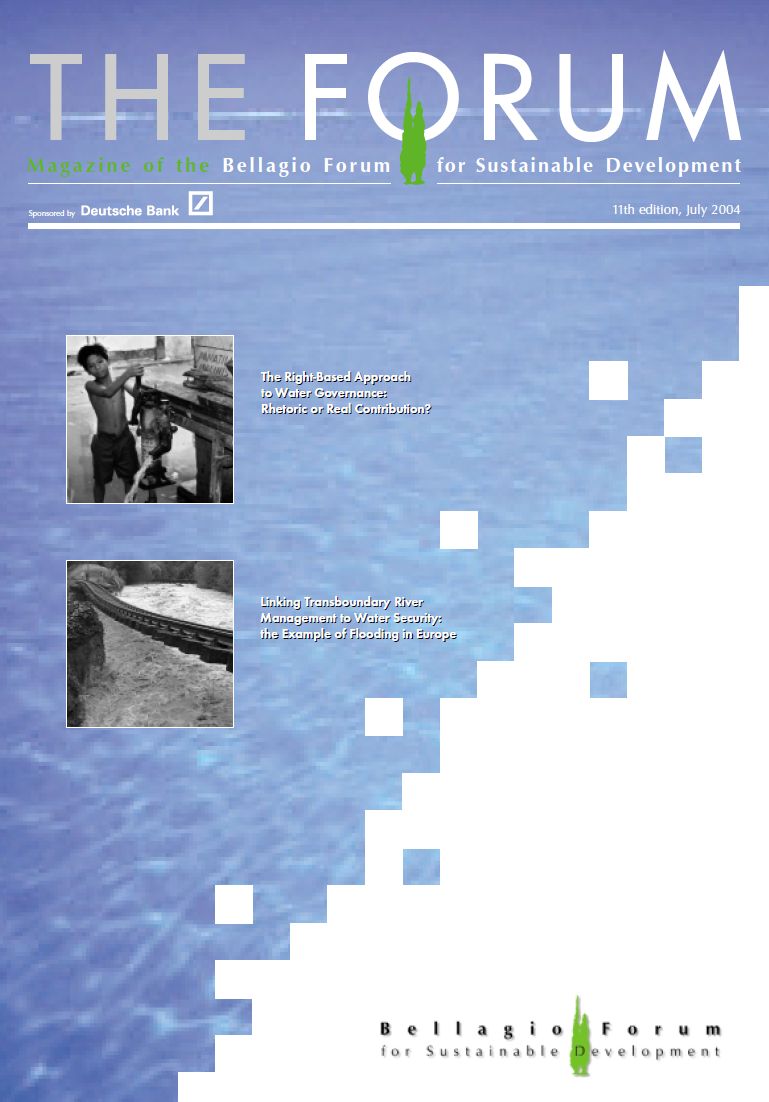
Between 1998 and 2004, Europe suffered more than 100 major flooding events, including the catastrophic floods along the Danube and Elbe rivers in the summer of 2002. In the wake of these events, the European Commission has embarked on the development of a European policy on flood risk management, resulting in a proposal for a floods Directive that was tabled in January 2006. This paper by Thomas Dworak and Benjamin Görlach tracks the development of the European approach to flood risk management and discusses future options for a European policy on floods.
The EC Water Framework Directive mandates that good ecological status should be reached in all water bodies in Europe by 2015. To this end, according to Article 11 of the Directive, programmes of measures shall be established for all river basins. The selection and combination of measures within these programmes should also take account of cost-effectiveness considerations. In an article for the Journal gwf Wasser / Abwasser, Benjamin Görlach, Nicole Kranz and Eduard Interwies present a possible methodology for this selection process, which was developed by Ecologic for the German Federal Environment Agency.
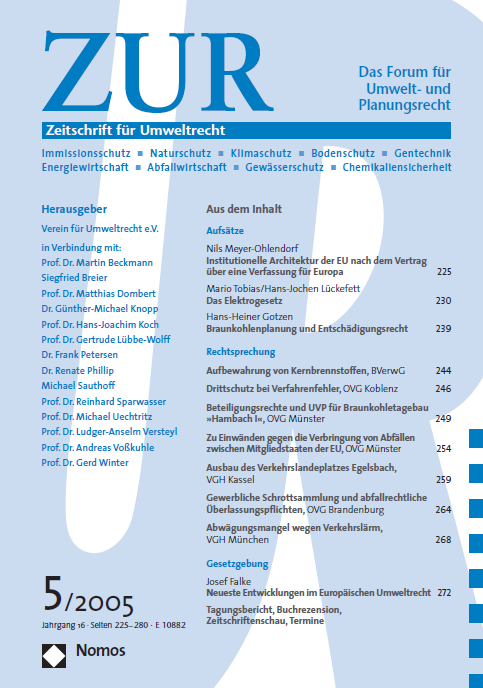
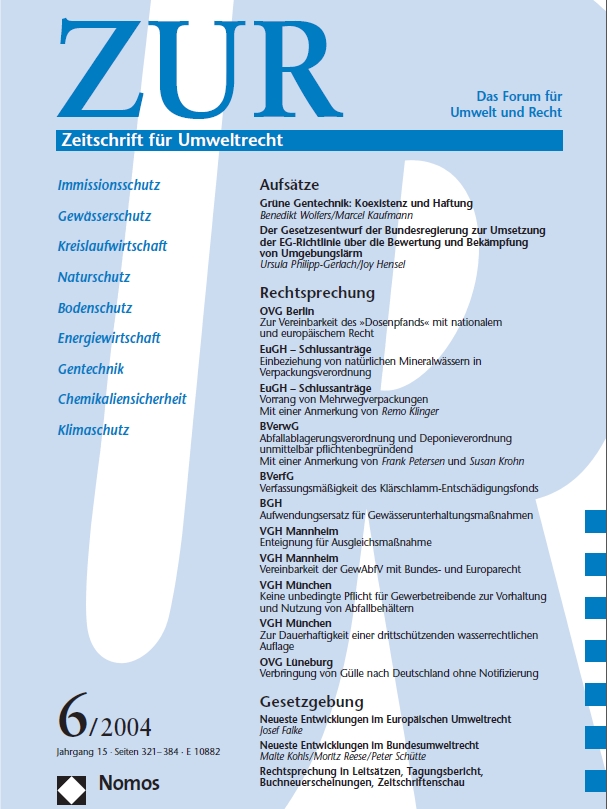
In his article in the "Zeitschrift für Umweltrecht," Nils Meyer-Ohlendorf (Ecologic Institute) analyzes what consequences the Treaty establishing a Constitution for Europe would have for environmental policy. This treaty was signed in 2004 but did not come into force as it was not ratified. The author focuses on the institutional architecture of the European Union, which would undergo some changes due to the treaty.
In this article, Camilla Bausch and Julia Rufin provide an overview of the content of the German energy law, as adopted by the German Parliament in 2005. The new energy law is based on European Directives. The authors focus their contributing article on the essential new provisions. A description of the future regulation of the energy market is provided, and the new rules concerning the unbundling of the energy sector are exposed. Furthermore, provisions that extend the requirements of European law are described.
The federal bill addressing non-discriminatory network access in the energy sector will significantly reform the existing legal framework for grid operators in Germany. A crucial aspect of the reform is the strengthening of rules for vertically integrated energy companies active in production and distribution, as well as grid operation. In her publication, Dr. Camilla Bausch critically analyses and evaluates unbundling rules for the electricity sector against the background of lawmakers' objectives – including promoting competition, reducing conflict of interest cases and quelling market distorting activities.
In the third issue of the Journal for European Environmental and Planning Law (JEEPL), Nicole Kranz, Benjamin Görlach and Eduard Interwies published an article on the selection of cost-effective combinations of measures according to Article 11 of the Water Framework Directive (WFD). The article highlights the results of the project "Basic principles for selecting the most cost-effective combinations of measures", conducted by Ecologic in 2003 for the German Federal Environmental Agency.
The National Allocation Plan (NAP) stipulates the rules for the allocation of allowances to the installations participating in emissions trading. The allowances are allocated on the basis of the actual CO2 emissions of the individual installations. To determine the quantity of emissions, data was gathered on a voluntary basis through a comprehensive data enquiry by the German Federal Ministry for the Environment. This article reports on the results of the data enquiry.
In this article, Sebastian Oberthür and Thomas Gehring argue that a World Environment Organisation (WEO) does not promise to enhance international environmental governance. The authors claim that the establishment of an international organisation alone in a policy field currently populated by regimes cannot be expected to significantly improve environmental governance because there is no qualitative difference between these two forms of governance institutions. This article does not address in detail or extent upon recent proposals for giving more importance to the UN Environment Programme (UNEP) or for upgrading it to a special UN organisation.
This article examines the potential impact of eastern enlargement on EU environmental governance. Whereas some observers see eastern enlargement as a potential threat to EU environmental governance, this contribution argues that it should be seen as an opportunity to intensify ongoing reform efforts. Ingmar von Homeyer from Ecologic Institute was the author of this article.
The transition to a sustainable development is a strategic aim of the EU. To this end, the European Council adopted during the meeting in Gothenburg 2001 a European Sustainable Development Strategy. The midterm review of the strategy is scheduled for next year (2005). How has the European Sustainable Development Strategy performed so far? In this article, Ecologic analyses both the relation between the Sustainable Development Strategy and the Lisbon process as well as the weaknesses of the strategy, and suggests a way forward.
In July 2004, the German Federal Cabinet adopted the draft amendment of the law governing non discriminatory network access (EnWG – Energiewirtschaftsgesetz). It transposes the EU Acceleration Directive for electricity and gas into German national law. Nicole Wilke and Camilla Bausch explain the essential elements of the draft amendment in an article.
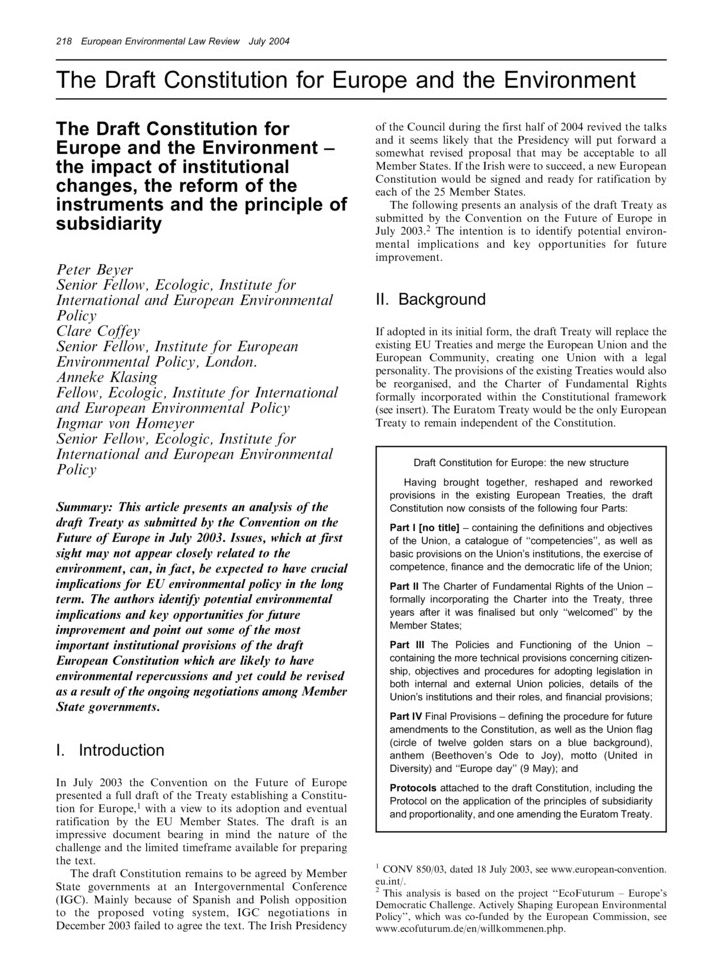
After extensive discussions and despite reasonable fears of failure, in June 2004 EU leaders finally adopted the Constitutional Treaty, which will replace the Nice Treaty. After signing the Constitutional Treaty in autumn 2004, Member States will have two years to ratify it. This article presents an environmental analysis of the draft Treaty as submitted by the Convention on the Future of Europe in July 2003.
This article focuses on the elements of the Water Framework Directive referring to transboundary water courses and analyses the current need for their improvement throughout Europe in order to mitigate the effects of flooding.
In the ZUR – Zeitschrift für Umweltrecht, Peter Beyer analyses the new European Directive on environmental liability. The liability for damages caused to the environment by emissions as well as accidents in the field of industrial productions and transportation of dangerous goods belongs to the issues which have been controversially discussed in politics for years, regularly brought up by spectacular accidents as in Baia Mare or the sinking of the Prestige off the Spanish coast.