A new paper by Öko-Institute and Ecologic Institute contributes to the upcoming discussion on the EU climate target for 2030 and the accompanying review of central policy instruments and governance structure. The paper highlights interlinkages between relevant processes at the European level and those under the Paris Agreement. An overview diagram visualizes the current timeline of these processes and helps to identify critical moments and windows of opportunity in the next few years, for raising EU ambition. Another figure helps to understand the key levers of the target setting.
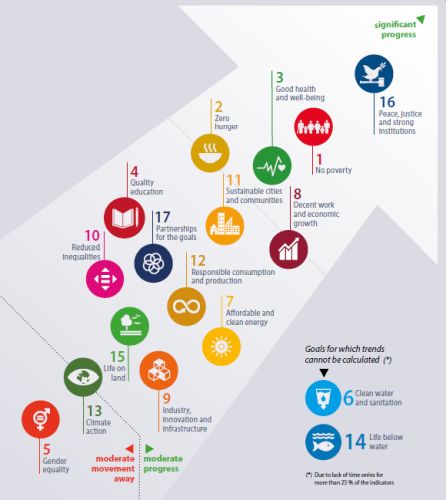
This brochure is a 'light' version of Eurostat's publication 'Sustainable development in the European Union – 2020 monitoring report on progress towards the SDGs in an EU context', conveying its main messages in a visual and concise way. The brochure provides an updated snapshot of the current situation concerning 100 indicators related to the 17 sustainable development goals (SDGs). It thus provides a snapshot of the key trends related to sustainable development in the European Union. Ecologic Institute's authors covered the chapters on SDG 2 (Zero Hunger), SDG 6 (Clean Water and Sanitation), SDG 7 (Affordable and Clean Energy), SDG 13 (Climate Action), SDG 14 (Life Below Water), SDG 15 (Life on Land) SDG 17 (Partnerships for the Goals). The publication is available for download.
This publication is the fourth of Eurostat’s regular reports monitoring progress towards the Sustainable Development Goals (SDGs) in an EU context. The monitoring report provides a statistical presentation of trends relating to the SDGs in the EU over the past five years ('short-term') and, when sufficient data is available, over the past 15 years ('long-term'). Ecologic Institute's authors covered the chapters on SDG2 (Zero Hunger), SDG 6 (Clean Water and Sanitation), SDG 7 (Affordable and Clean Energy), SDG 13 (Climate Action), SDG 14 (Life Below Water), SDG 15 (Life on Land) and SDG 17 (Partnerships for the Goals). The publication is available for download.
This research report by Ecologic Institute identifies ways in which Germany can improve international soil governance in the short, medium and long term. It begins with an inventory of existing international instruments and institutions relevant to soil governance at the international level. It assesses the actual and potential steering effects of international treaties such as the Convention to Combat Desertification, the Convention on Biological Diversity, the Paris Agreement on Climate Change and the climate regime as well as regional agreements. It also analyses the activities of FAO, UNEP, IPBES and the activities of the IPCC.
The ocean is a source of life for human beings. "Understanding human influence on the Ocean and the Ocean's influence on people" is at the core of ocean literacy. Supported by the European Commission, the EU4Ocean Coalition connects three large communities of organisations, projects, people and schools that contribute to ocean literacy and the sustainable management of the ocean: The EU4Ocean Platform is the hub for organisations and initiatives to connect, collaborate and mobilise efforts on ocean literacy.
This paper aims to explain to the failure of six carbon capture and storage (CCS) demonstration projects installed at coal power plants within the European Union. The projects were funded across six different members with varying suitability to coal-based CCS, which raises the question of whether common domestic factors can be identified that explain the failure of all projects. The perspective of Europeanisation is adopted to examine this question.
On 8 June 2020, the first Virtual Ocean Literacy Summit was organised on the occasion of the World Oceans Day. There was no better chance to celebrate the creation of the "EU4Ocean" coalition and its dedication to ocean literacy, together with Commissioner for Environment, Oceans and Fisheries, Virginijus Sinkevičius, and IOC-UNESCO. Because of the circumstances of the COVID-19 pandemic, we met virtually to officially announce and celebrate this launch and share ideas and perspective for the protection of our blue planet.
The goal of the KOPOS project is to establish regional supply structures in order to increasingly reconnect urban and rural areas and to practice environmentally friendly management. In the project regions of Freiburg i.Br. and Berlin-Brandenburg, KOPOS is investigating how cooperation between regional actors can help to build more regional supply structures and secure access to land for sustainable cultivation.
This report prepared by Valerie Fogleman with assistance of Ecologic Institute examines and analyses financial security for liabilities under the Environmental Liability Directive (ELD) in Member States in which it is voluntary and those in which it is mandatory (the Czech Republic, Ireland, Portugal, Slovakia and Spain). It focuses on insurance because the vast majority of Member States have not introduced mandatory financial security for ELD liabilities.
Ecologic Institute supports the Horizon 2020 project "Towards a Just, Ethical, and Sustainable Arctic" (JUSTNORTH) with Arne Riedel as an Ethics advisor.
The project examined the effects, processes and support options for implementing innovative infrastructure coupling. Current developments, the associated transformation processes including supporting and hindering factors as well as potential sustainability effects of coupled infrastructure solutions were examined. The focus is on innovative, i.e. not established, couplings (understood as niche innovations) in the transport, energy, water, wastewater, waste management and information and communication technologies (ICT) sectors. The present volume provides a summary of the results, which are available in three sub-reports.
The project examined the effects, processes and support options for implementing innovative infrastructure coupling. The present volume examines local innovation processes in four case studies. Especially when it comes to innovations, there are no standard solutions. The technical systems must be embedded in supportive organisational structures, be economically feasible and implementable, function in a social context and encounter a enabling political and legal framework. Local actors, especially public utilities, are able to take the new, often uncertain paths, if the right framework conditions are in place.
The project examined the effects, processes and support options for implementing innovative infrastructure coupling. The present volume examines development paths, success factors and barriers as well as the contribution of infrastructure couplings to sustainability transformation and design options. Implementation processes are often complex, breaking new ground and requiring the cooperation of actors in completely new constellations and responsibilities. Whether sustainability transformation is successful on the local level depends on numerous factors that can also be shaped on local level in a systematic way. Innovations promote new structures, networks, new behaviour and knowledge.
The project examined the effects, processes and support options for implementing innovative infrastructure coupling.The present volume analyses the effects of innovative couplings on performance, resilience, resource efficiency, and social and economic compatibility. A "sustainability check" with 26 criteria was developed and tested in an expert survey. Coupling infrastructures does not automatically lead to greater sustainability, but coupled infrastructure systems have the potential to contribute to resource conservation and security of supply. This requires a differentiated consideration of the effects on sustainability.
The measures imposed by Berlin to contain the coronavirus pandemic are characterised by a pragmatic approach that poses less constraints on personal freedom than the measures adopted in other cities and countries. And yet it seems to be working. Support for small local businesses, solidarity and medical preparedness are at the heart of this approach. In this article, Doris Knoblauch from Ecologic Institute elaborates on the situation in the city of Berlin during the corona crisis.