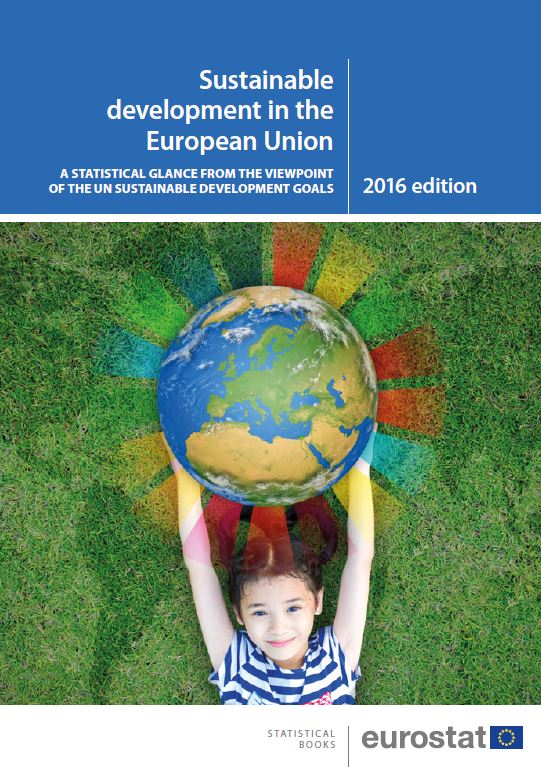
This publication has been issued by EUROSTAT and provides a snapshot of the current situation concerning a selected number of SDG-related indicators and accompanies the European Commission Communication on the next steps for a sustainable European future (22 November 2016). Ecologic Institute's authors covered the chapters on SDG2 (Zero Hunger), SDG 6 (Clean water and sanitation), SDG 7 (Affordable and clean energy), SDG 13 (Climate Action), SDG 14 (Life below water), SDG 15 (Life on land) SDG 17 (Partnership for the goals). The publication is available for download.
<p>The Ecologic Institute supports the German Ministry for the Environment, Nature Conservation, Building and Nuclear Safety (BMUB) in their preparations for the newly established G20 Climate Sustainability Working Group.</p>
On 18 November 2016, the ELEEP Network and the POCACITO project hosted an official COP 22 side event in Marrakech on the topic "Transatlantic Perspectives on Integrating Climate Mitigation and Adaptation in Cities".
The second BONUS Soils2Sea workshop in the Swedish case study region brought together project partners from BONUS Soils2Sea, as well as an engaged group of Polish and Swedish farmers, representatives from the community Mykanow, a representative from a fishing association, the Länsstyrelsen Skåne (The County Administrative Board Skåne), and Havs- och vattenmyndigheten (Swedish Marine and Water Authority). Highlights of the workshop were a film screening of a Soils2Sea documentary recently shot in Poland, presentations on the Tullstorp river restoration project, and a world cafe stakeholder discussion on different governance scenarios to regulate nutrients. The workshop was followed by a field trip to the Tullstorp river, where the different restoration measures and the recently created wetlands could be experienced hands-on.
The objective of this assignment is to provide country specific and up-to-date information and analysis on the main national policies and measures in the 28 Member States relevant for the climate and energy objectives set out in the Europe 2020 Strategy, as well as for the Energy Union targets.
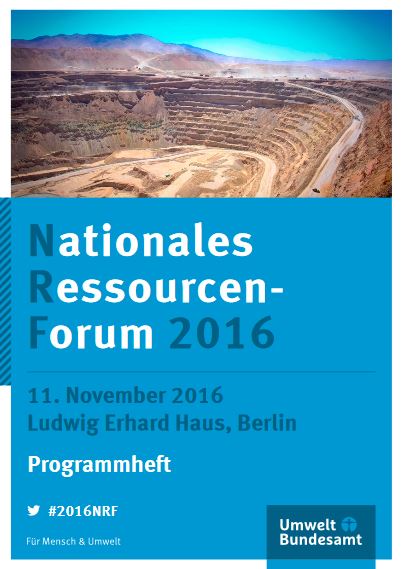
The Federal Environment Agency was hosting the 3rd National Resources Forum with support of Ecologic Institute on 11 November 2016. The conference took place in the "Ludwig Erhard Haus" in Berlin. The aim of the National Resources Forum (NRF) is to provide a national platform for discussion of the issue of sustainable resource use by focusing on the political and scientific debate on this subject.
Ecologic Institute coordinated the organisation of the National Resources Forum 2016. For these the programme brochure was developed and designed, to hand it over to participants. It contained information about the event agenda and schedule, speakers and a space for notes. The design of the brochure and the color scheme were based on the visual style of UBA. The NRF brochure is set on 32 pages. The A5 brochure was printed on recycled paper.
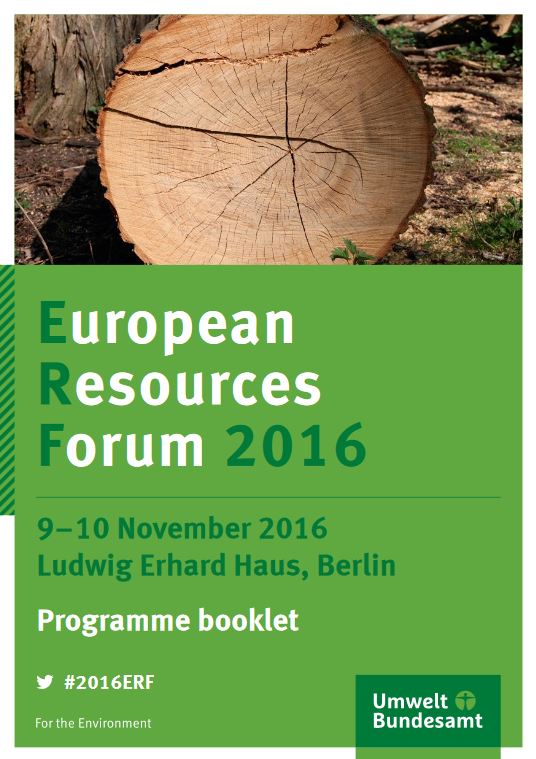
Ecologic Institute supported the Federal Environment Agency in organising the 3rd European Resources Forum from 9 until 10 November 2016. The conference took place in the "Ludwig Erhard Haus" in Berlin. The ERF addresses European decision-makers and experts from the fields of policy development, industry, academia, civil society and the media. Around 400 participants from over 32 countries participated in the conference.
Ecologic Institute coordinated the organisation of the European Resource Forum (ERF) 2016. For these the programme brochure was developed and designed, to hand it over to participants. It contained information about the event agenda and schedule, speakers and a space for notes. The design of the brochure and the color scheme were based on the visual style of UBA. The ERF brochure is set on 52 pages. The A5 brochure was printed on recycled paper.
Ecologic Institute supported the German Environment Agency in hosting the Conference "Decarbonization and Resource Efficiency – 100% Renewable Energy and more," which took place on 8 November 2016 at the "Ludwig Erhard Haus" in Berlin. The conference highlighted synergies and ways to minimize trade-offs between decarbonization and dematerialization policies.
This book, edited by Professor Carol Hager, Ph.D. and Ecologic Institute's Associate Professor Christoph H. Stefes, Ph.D. analyzes Germany's path-breaking Energiewende, the country's transition from an energy system based on fossil and nuclear fuels to a sustainable energy system based on renewables. The authors explain Germany's commitment to a renewable energy transition on multiple levels of governance, from the local to the European, focusing on the sources of institutional change that made the transition possible. They then place the German case in international context through comparative case studies of energy transitions in the USA, China, and Japan. These chapters highlight the multifaceted challenges, and the enormous potential, in different paths to a sustainable energy future. Taken together, they tell the story of one of the most important political, economic, and social undertakings of our time.
On 30 October 2016 Canada and the EU signed CETA. Ratification of the agreement will be the next step. A new study by the Ecologic Institute analyses the environmental implications of regulatory cooperation under CETA. The study finds that CETA establishes a comprehensive institutional framework for regulatory cooperation between Canada and the EU and sets primarily procedural obligations. CETA does not contain detailed obligations that predetermine specific outcomes of regulatory cooperation. Regulatory cooperation under CETA is voluntary. Regulatory cooperation under CETA has a focus on trade liberalisation and consistency of standards. It does not focus on enhancing environmental protection. The study is available for download.
This November, the latest climate report for Germany, titled "Climate Change in Germany: Development, Consequences, Risks and Perspectives", was published. For the first time, climate change in Germany has been assessed from an interdisciplinary and comprehensive perspective, taking all societal issues and sectors into account. The 126 authors covered issues such as already-observed and prospective changes, weather calamities and their consequences, risks for the future and options for the advancement of adaptation strategies. Dr. Grit Martinez of Ecologic Institute is co-author of the report's chapter on story line options for a transformative climate adaptive society in Germany. The climate report is available for download.