The Europe 2020 Strategy sets the goal for the European Union to become a smart, sustainable and inclusive community by 2020. The 27 EU Member States must provide the European Commission with National Reform Programmes (NRPs) demonstrating how they are implementing the Europe 2020 goals and targets. This study is a review of all 27 NRPs regarding the role of local and regional authorities (LRA). The study is available for download.
In this article, the authors provide for the first time a definition of the "Footprint Family" as a suite of indicators to track human pressure on our planet and under different angles. It builds on the premise that no single indicator per se is able to comprehensively monitor human impact on the environment, but indicators rather need to be used and interpreted jointly.
The pressure on land and natural resources is increasing worldwide. While there are many sectoral policies tackling different environmental problems, land use is not regulated in an integrated and overarching way. The discussion on sustainable biofuels and biomass highlights the continued lack of an effective and innovative framework to deal with complex land-use issues. The aim of the GLOBALANDS project is to identify existing land use policies and develop possible governance tools towards a more resource efficient and sustainable global land use.
At the International Water Association's Symposium on Anaerobic Digestion of Solid Waste and Energy Crops, Dr. Wolfgang Urban (Ecologic Institute) shared insights into "Experience and Future Perspectives of Biomethane in the Natural Gas Grid in Germany". After presenting the legal framework and economic circumstances of biogas feed-in, he outlined future challenges and introduced selected biogas feed-in projects in Germany. The presentation slides are available for download.
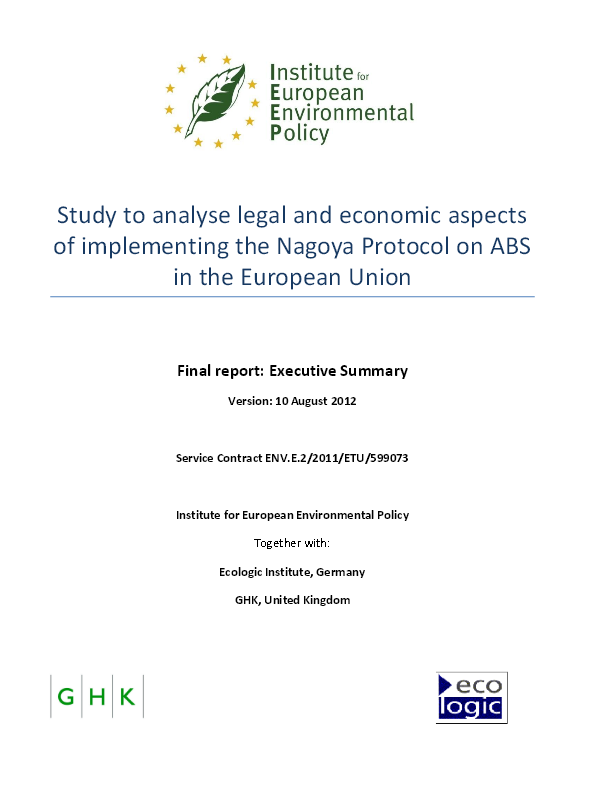
In 2010, the Conference of the Parties of the Convention on Biological Diversity (CBD) adopted the Nagoya Protocol on Access and Benefit-sharing. The Protocol sets forth rules on access to genetic resources. Among other purposes, research is a main driver of demand for genetic resources. Moreover, the protocol contains an obligation for Parties to ensure that the countries where the genetic resources are found and relevant indigenous communities in these countries are compensated for the use of genetic resources and related knowledge. Ecologic Institute is contributing to a study investigating the options for implementation of the Protocol at the EU level. The study is available for download.
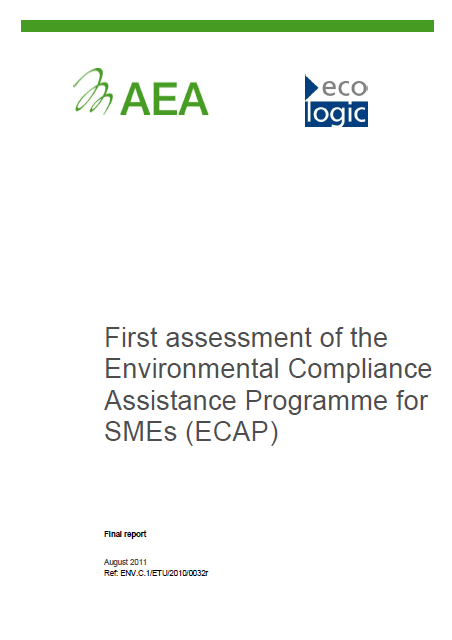
This is the final report for the first assessment of the Environmental Compliance Assistance Programme for SMEs (ECAP). The report is submitted by AEA and Ecologic Institute, the consultants appointed to conduct this evaluation.
From 22 to 26 August 2011 the Vereinigung für ökologische Wirtschaftsforschung (VÖW) organized a summerschool on "Sustainable Production Chains" together with the Humboldt University of Berlin. Part of the diverse programme for PhD and master students was a seminar held at the Leibniz Institute for Agricultural Engineering Potsdam-Bornim (ATB) on renewable energies with a special focus on bioenergy and biomass from agro-forest systems. In his presentation Timo Kaphengst, Coordinator for Biodiversity and Forest at Ecologic Institute, highlighted different sustainability challenges within the biomass production chain and presented current policy responses on EU and German level. The presentation can be downloaded.
In the summer term of 2011, Christiane Gerstetter and Doris Knoblauch, Fellows at the Ecologic Institute, taught a seminar on policy consulting at the University of Applied Sciences in Bremen. Some 35 students, enrolled in a bachelor’s programme, participated. The seminar consisted of a block of three units for a total duration of 32 hours for a full course credit.