In the first episode of the Green Deal – Big Deal? podcast we unpack the European Green Deal and discuss its importance with our guests Dr Hans Bruyninckx (European Environment Agency) and Dr Åsa Persson (Stockholm Environment Institute).
On the 4 April 2022 another online workshop on the socio-ecological transformation of the food system in Germany took place as part of the STErn project led by Ecologic Institute. The aim of the event was to discuss with 35 experts main behavioral drivers that are relevant for increasing diets that are more plant-based and declining the consumption of animal products. On this basis, policy options in Germany were evaluated and discussed.
The transition to renewable energies and persistent bottlenecks in the German transmission grid represent key challenges for the German electricity supply system in terms of the need for security of supply. A so-called capacity mechanism could be an important solution to this. On behalf of the four German transmission system operators (TSOs) Amprion GmbH, TenneT TSO GmbH, 50Hertz Transmission GmbH and TransnetBW GmbH, the foundations of a capacity mechanism for the German electricity market that is compatible with the European legal framework for the energy market and European state aid law are therefore to be developed. In an interdisciplinary research team led by Consentec, the Ecologic Institute is responsible for examining energy law issues in the project.
In this project, Ecologic Institute, Öko-Institut and Schnittstelle Boden develop legal options for revising the German Federal Soil Act and draft potential corresponding amendments. This is one of the objectives in the German Government's 2021 Coalition Agreement and the research is funded by the German Environment Agency.
The main element of this project was the implementation of the international expert workshop "Fostering applied research on the synergies between biodiversity and climate", which took place online between 8 and 9 June 2022. With around 30 leading scientists, 10 presentations of case studies and interactive break-out groups, this workshop enabled lively discussions and insights on opportunities for participatory research for the biodiversity-climate nexus.
Ecologic Institute and the University of Geisenheim will analyse the extent to which measures for strengthening biodiversity have been integrated in the application of urban development funding by German municipalities, and what good practice examples exist. Based on this research, municipalities will be informed about measures that are eligible for urban development funding which are effective in conserving or promoting biodiversity.
Nature-based solutions (NBS) are recognised as cost-effective tools to alleviate pressure during high rainfall events while producing wider societal and environmental benefits, but uptake is limited in practice due to lacking evidence. The NICHES project – Nature's Integration in Cities' Hydrologies, Ecologies and Societies – aims to fill this gap by adopting a holistic social-ecological-technical systems (SETS) approach to explore the potential of urban NBS as an alternative to the costly renewal of grey wastewater systems. Five global cities – Barcelona, Berlin, Boston, Sheffield, and Rotterdam – will be utilized to co-create knowledge and develop a shared understanding of restorative NBS that can be applied to avoid storm-water run-off and negative impacts for aquatic biodiversity.
The UNITED project report "Business Analysis of UNITED Pilots" provides a detailed business analysis of the various pilot projects. This analysis includes an assessment of the economic viability, SWOT and PESTEL analyses as well as a review of the financial aspects of the projects. The aim of the report is to assess the financial attractiveness and feasibility of multi-use concepts in European marine areas, with a particular focus on the synergies and challenges arising from the combination of different maritime activities.
On 21 May 2022, the Ocean Literacy Festival hosted numerous activities organised by the EU4Ocean Coalition members. The festival connected ocean literacy actors from Europe, and showcased the wide diversity of ocean literacy initiatives already in place. Ecologic Institute developed a social media video trailer to give the festival more visibility.
This paper examines the concept of an "extended" digital product passport from a socio-ecological perspective using the example of batteries for electric vehicles. It evaluates different approaches to data regulation and formulates policy recommendations for decision makers in Berlin. It is based on preliminary work from the project, in which in particular three ideal types of data regulation and a methodology for their scenario-based evaluation were developed.
The emission of plastics into the environment is growing worldwide. Since existing regulations are not sufficient to curb the problem, the ever-increasing plastic production and use must be reduced overall. A systemic approach is needed that holds all actors responsible who produce, use, recycle, dispose and trade in plastic products and packaging. Policymakers must drive forward the necessary paradigm shift and facilitate a debate on sufficiency in society as a whole.
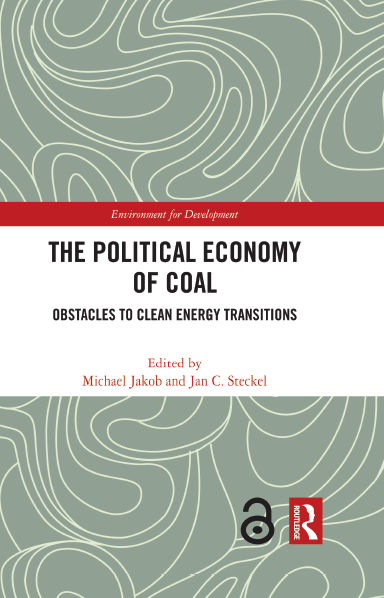
This insightful Handbook, by Dr. Michael Jakob, provides a comprehensive overview of the most recent developments in the academic debate on the numerous and complex linkages between international trade and climate change. Offering critical and empirically-based perspectives on the future of international trade policy, this timely Handbook is crucial reading for scholars, researchers and graduate students in political science, public policy and climate research. Policymakers will also benefit from its unique and insightful policy recommendations.
The consumption of dairy, eggs and meat causes damage to the environment in various places in the supply chain, such as climate change, eutrophication and the emission of harmful substances such as ammonia (which contributes to nitrogen problems) and particulate matter. The TAPP Coalition (True Animal Protein Price Coalition) requests a European-oriented policy proposals to pass on the price of dairy, eggs and meat so that it reflects the actual costs to society and to calculate these for economic and environmental effects for the EU-27 involving two case studies for Germany and France.
The European Green Deal and the EU Strategy on Adaptation to Climate Change recognise the need for further action in the field of quantitative water management and include priority actions to stimulate and foster resilience and sustainability. Under a new contract for the European Commission, Ecologic Institute is contributing to a study on water quantity management in Europe and supports the work of the task group on Water Scarcity and Droughts of the Common Implementation Strategy (CIS) of the WFD.
This paper discusses main behavioral drivers that are relevant for increasing diets that are more plant-based. The analysis of influencing factors aims to identify effective starting points where policy instruments can be applied in Germany to achieve changes in dietary patterns across the population as effectively as possible and to reduce the consumption of animal products. The result is a pre-structured collection of potentially effective policy approaches.