In May 2014, the 10th ICAP Training Course on Emissions Trading brought together experts from emerging economies and developing countries to learn about emissions trading as a tool for climate protection and to discuss the options of implementing such systems in developing countries. The session in Santiago was the tenth of its kind and continues a series of past ICAP events held in other cities including Berlin, The Hague, Beijing, Madrid, Dublin, and Istanbul. It was attended by 29 mid-career professionals from eleven countries. Benjamin Görlach and Pedro Barata led the course.
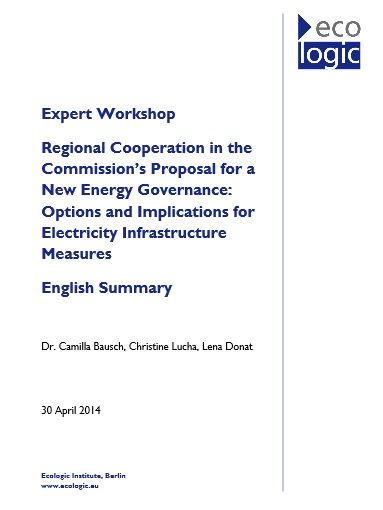
On 30 April 2014, Ecologic Institute hosted an expert workshop on the significance of the European Commission's proposed new energy governance, focusing on options and implications for electricity infrastructure measures. Twenty-one participants including policy makers as well as representatives of civil society, academia and business discussed possible requirements of, approaches to, and effects of such new measures through a set of structured questions and impromptu presentations. The summary is available for download.
Hsia, Renee Yuen-Jan et al. 2014: "The Association of Trauma Center Closures with Increased Inpatient Mortality for Injured Patients". The Journal of Trauma and Acute Care Surgery, Vol. 76, No. 4, 1048-1053.
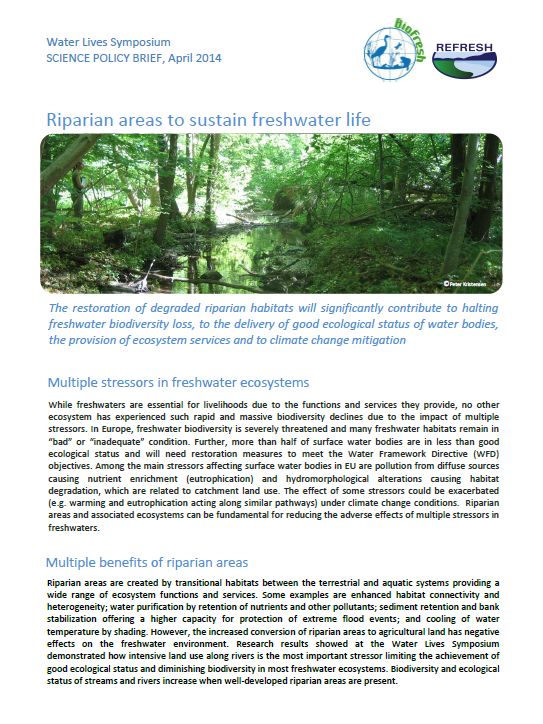
This science policy brief summarizes the results of the Water Lives policy symposium. The Water Lives science policy symposium was held on 29 and 30 January 2014 in Brussels and was organized by BIOFRESH and REFRESH projects.
What shape will the future governance framework of European climate and energy policy take? The proposal submitted by the European Commission at the beginning of this year raises more questions than it answers in this regard. Dr. Camilla Bausch and Christine Lucha of the Ecologic Institute invited experts to a workshop to discuss the meaning of the commission's suggestions with a particular view toward electricity infrastructure. All presentation slides are available for download.
The Ecologic Institute continues to be actively involved in the debate on the ongoing negotiations on the Transatlantic Trade and Investment Partnership (TTIP) and its environmental impact. On 23 April 2014, Max Grünig, Senior Fellow at the Ecologic Institute, participated as a panelist in a stakeholder forum on TTIP in Washington D.C. The presentation slides are available for download.
A policy brief written by Katharina Umpfenbach and colleagues for DG Environment summarises the most relevant scientific insights and analyses the implications for policy making. It highlights novel policy ideas for triggering changes in consumer behaviour. The policy brief is available for download.
During the 11th European IFSA Symposium Dr. Ana Frelih-Larsen, Senior Fellow at Ecologic Institute, outlined the existing mechanisms for soil protection in general and soil organic matter (soil carbon) specifically. She explained the requirements for better policies to protect soil organic matters. Sandra Naumann chaired the session. The presentation slides are available for download.
Frelih-Larsen, Ana; Sandra Naumann and Elizabeth Dooley 2013: Soil Management for Climate Change Mitigation and Adaptation. Framing and Integrating the Issue in the Evolving Policy Environment. 11th European IFSA Symposium – Farming Systems Facing Global Challenges: Capacities and Strategies. Heike Schobert et al. Berlin: IFSA Europe, Leibniz-Centre for Agricultural Landscape Research (ZALF), Humboldt-Universität zu Berlin.
<br />
On 1 and 2 April 2014, Christiane Gerstetter, Senior Fellow on the Ecologic Institute's legal team, gave two presentations in Brussels on investor-state dispute settlement (ISDS) in the Transatlantic Trade and Investment Partnership (TTIP). She concluded that including ISDS in TTIP would entail incalculable risks for environmental regulation that are not counter-balanced by benefits. She therefore recommended not to include ISDS provisions in TTIP. The presentations are available for download.