Participants at the CIRCASA closing event explored the strategic research agenda and took first steps towards an international research consortium on soil organic carbon.
To achieve the turnaround towards carbon neutrality, countries around the world need to take much more ambitious action in this decade. One of the key fields of action is the transition of the energy sector –from fossil to renewable fuels, while drastically reducing energy consumption. This paper discusses options how such action can be enhanced through multilateral cooperation.
To provide the G20 leaders with scientific advice, Think20 – a group of think tanks and academia from G20 countries – will work over the upcoming months on policy papers and recommendations.
This article by Doris Knoblauch and Hannes Schritt (both Ecologic Institute) is part of the anthology "Einfach weglassen? Ein wissenschaftliches Lesebuch zur Reduktion von Plastikverpackungen im Lebensmittelhandel" (Simply Omit? A Scientific Reader on the Reduction of Plastic Packaging in the Food Trade). It deals with the emergence of plastic packaging in Germany and its known environmental impacts. The authors demonstrate that there is a close correlation between the amount of plastic packaging produced and the gross domestic product (GDP) - which, interestingly, is stronger than the correlation between GDP and packaging overall. In this context, avoidance strategies and improvement options for the circular economy are discussed.
The discussion about plastic waste is anything but new for German municipalities. In fact, as early as the 1980s, numerous German municipalities were experimenting with plastic waste prevention regulations and waste prevention in general. A further impetus for plastic waste prevention was provided in the early 1990s with the discussions on the introduction of a nationwide packaging ordinance. After almost three decades of stagnation – including setbacks with regard to the expansion of return systems and the increase of single-use packaging – the issue of plastic prevention and packaging reduction in municipalities is now receiving renewed attention as a result of increased societal awareness and political regulations at EU level.
Plastics are all around us and make up an essential part of our daily lives. How much do we know about this material, its variety, the associated environmental problems and possible solutions? The quiz "Plastics in the environment - What do you know?" invites you to test your knowledge around the topic of plastics in five categories. Furthermore, the category "Questions for adults & children" contains questions suited for children.
With 2020 drawing to a close, Dr. Camilla Bausch was invited to contribute to "The World in 2021". This publication is an annual end-of-year publication by ISPI, a leading foreign policy think tank in Italy, on trends, crises and 10 key "questions" that are relevant for the upcoming year.
As part of a project to structure the energy law, Ecologic Institute contributed to a discussion paper on conceptual considerations on the concept of plant in the Renewable Energy Act . Based on the functions of the term "plant", the authors recommend a new conceptualization, according to which the current abstract term "plant" is replaced by energy carrier-specific terms "plant", which are first combined in a catalog to form a uniform term "plant". The discussion paper is available for download.
The Common Agricultural Policy (CAP) for the period 2023-2027 presents new opportunities to support the transition to sustainable agricultural production in Europe. In this project, Ecologic Institute together with a consortium led by Ecorys, supported the European Commission Directorate General for the Environment in their assessment of the new CAP Strategic Plans prepared by Member States.
The Climate Action Regulation (CAR aka Effort Sharing Regulation) regulates 57 % of the EU's greenhouse gas emissions. Consequently, the EU cannot achieve its new climate targets without major contributions from the sectors regulated by the CAR. This makes reforming the CAR one of the EU's most important legislative processes in 2021. There are various ideas about how to turn the CAR into a strong driver for achieving the EU's climate targets. This Ecologic Institute paper discusses these ideas, and makes proposals for reform.
A robust framework is a precondition for the EU to become climate neutral by 2050. Such framework includes, for example, enhanced gross reduction targets for 2030, emission budgets, independent scientific climate advisory bodies, phasing out fossil fuel subsides, and strong support to ensure a just transition in Member States. The spread between national targets from currently 0 % to 40 % should be scaled up, taking into account previous individual emission reduction performance and national capabilities.
Published by the Pontifical Academy of Sciences a new book deals with the reduction of food loss and waste globally. It includes an article that sums up results of the EU research project REFRESH, and in particular the work on policies to reduce consumer food waste, lead by the Ecologic Institute. The book is available for download.
This PIXI book was created in the context of "Plastics in the Environment", a research focus coordinated by the Ecologic Institute. It tells the story of Samia, Johann and their babysitter Tom, who discover a seagull tangled up in a plastic bag on a riverside. After the children have freed the seagull with the help of their babysitter, they explore the reasons for the bird's fate. Tom explains to them how plastic gets from land to sea, how long it remains in nature and how to avoid it in everyday life with simple decisions.
In the wake of Joe Biden's election as 46th President of the United States, Dr. Camilla Bausch contributed a blog post for the Global Public Policy Institute's Peace Lab on how multilateralism could help address the climate crisis. This is a timely contribution as it is complimentary to the current work on the German government's new White Paper on multilateralism. In her blog post, Dr. Bausch addresses a broad range of climate diplomacy topics, taking into account the role of Germany as well as the European Green Deal, the Paris Climate Agreement, the UN Agenda 2030, the dynamics within the G20 and the role of science.
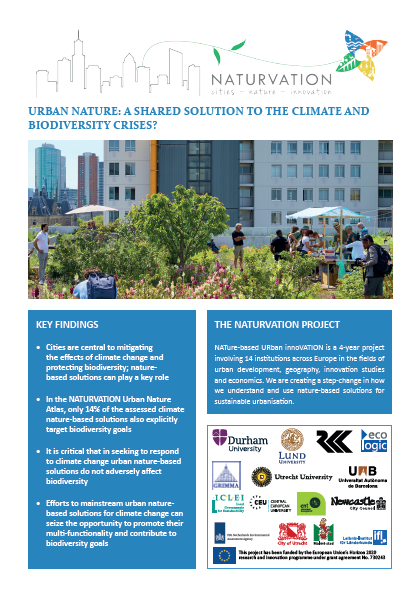
With around 75% of EU population living in urban areas, cites will play a key role in curbing greenhouse gas emissions, reducing vulnerability to impacts of climate change and building resilience. Multifunctional nature-based solutions can be a powerful tool to jointly address climate change mitigation and adaptation in urban areas. A number of innovative pilot projects introduced in Berlin in the last 20 years were able to demonstrate in practice how cities can save energy, cool down buildings, reduce urban heat island effect and sequester and store carbon by working with natural climate solutions.