This project will 1) identify good examples, new and innovative interventions to contribute to biodiversity and climate objectives of the CAP; 2) assess CAP Strategic Plan interventions that correspond to the biodiversity and climate ambitions in the four CAP Strategic Plans of Germany, France, Spain and Poland; 3) analyze whether these interventions correspond to the scientific evidence and whether they are relevant and sufficient; 4) consider co-benefits and trade-offs between different policy objectives.
Stephan Sina 2022: Stellungnahme zum Gesetzentwurf der Landesregierung für ein Hessisches Gesetz zur Förderung des Klimaschutzes und zur Anpassung an die Folgen des Klimawandels (Hessisches Klimagesetz - HKlimaG) – Drucks. 20/9276 –1. Berlin: Ecologic Institut.
On 23 November 2022, Dr. Stephan Sina, Senior Fellow at Ecologic Institute, participated as an expert in a hearing of the Hessian State Parliament's Committee for Environment, Climate Protection, Agriculture and Consumer Protection on the Government draft of a Hessian Act on the Promotion of Climate Protection and Adaptation to the Consequences of Climate Change. Together with about 40 associations and experts, he commented on the draft law and answered questions from members of parliament.
The panel addresses how to avoid negative psychological reactions and how to instead foster a sense of actorness, solidarity and empowerment. Civil society organisations, artists and cultural actors are in theory well placed to play an important role in mobilizing people against climate change by fostering opportunities for debate and participation.
The panel will broach the issue about the impact of climate change on countries, especially in the Global South, many of them former colonies still struggling with the socioeconomic consequences of colonial exploitation. The panel will also examine how cultural relations between states and societies could be an important component of international climate policy and transnational climate action.
The study aims to provide the European Parliament with an overview of the challenges faced by the agricultural sector regarding the evolution of climate extreme events in the European Union. It highlights existing solutions to help farmers mitigate the effects of extreme weather events and recover from climate-related disasters.
Ready4NetZero aimed to support small- and medium-sized cities in Poland, Romania, Hungary and Croatia in the development and implementation of local strategies to reach climate neutrality. To do so, the project created knowledge resources (written guidance) and provided training and capacity building activities (webinars, workshops, a study visit, an international conference) to equip municipal staff with capacities, knowledge, and networks to develop and implement local long-term climate strategies.
In this podcast's episode, Benjamin Görlach of the Ecologic Institute, describes how pricing and policy interact to foster a faster energy transition. Interviewed by Michael LaBelle, episode 66 covers everything from the EU's emission trading system, the dominance of electricity for transport and the 4i-TRACTION project – standing for innovation, investment, infrastructure and sector integration.
On 21 March 2023, the STErn project team discussed the recommendations for action of the STErn project with around 40 experts from politics, administration, science and practice. The event was opened by Matthias Koller (Federal Environment Agency) and Dr. Margareta Büning-Fesel (Federal Agency for Nutrition). The recommendations for action of the STErn project were explained, discussed and supplemented in small groups.
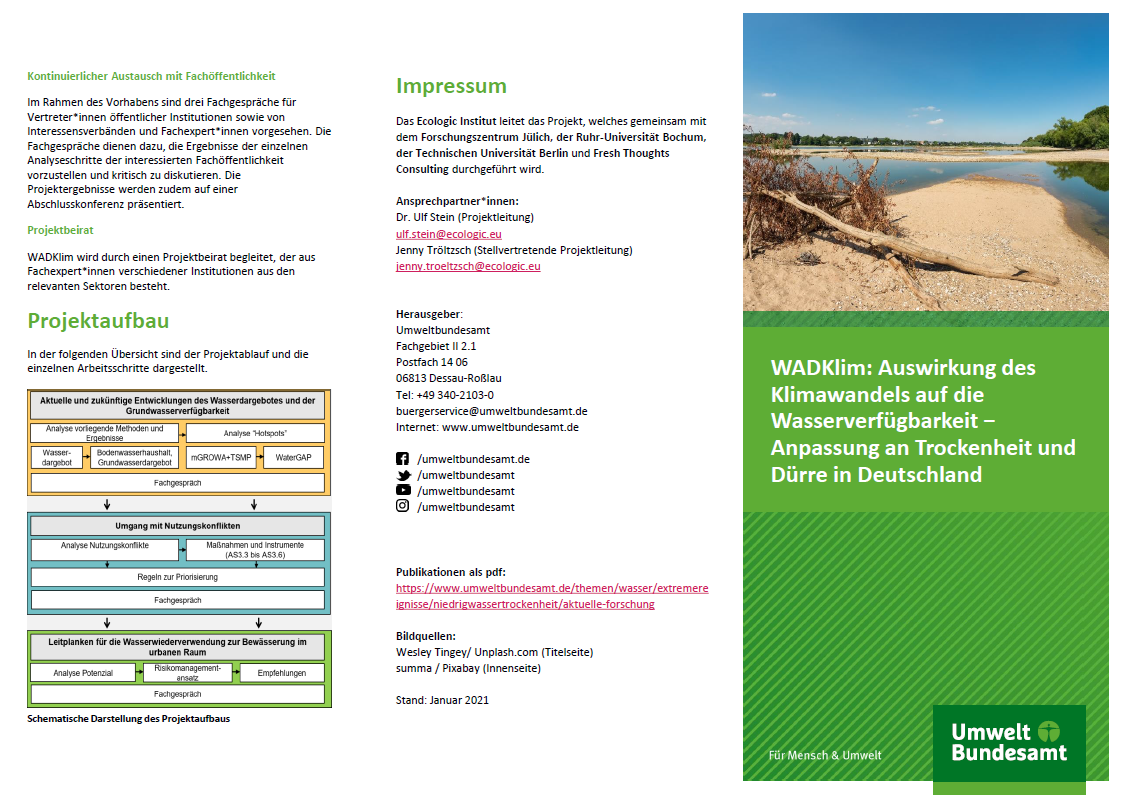
Diverse crop rotation, mechanical weed control, beneficial insects to protect crops: According to a study commissioned by BUND, standard practice in organic farming could also be used more often by conventional farmers. Aaron Scheid from the Ecologic Institute and author of the study in an interview with Deutschlandfunk radio about non chemical plant protection measures.
Healthy wetlands are acknowledged for being among the most effective sinks for carbon and for providing other valuable ecosystem services. In contrast, human-impacted wetlands represent a major source of greenhouse gases (GHG). Important research questions on the GHG abatement potential of wetland restoration and on management and restoration actions to maintain and promote the mitigation and adaptation capacity of European wetlands are still to be answered due to major data and knowledge gaps. The RESTORE4Cs project (a 3-year Research and Innovation Action funded by the EU) aims to fill this gap by assessing the role of restoration action in wetlands climate change mitigation capacity and for the provision of a wide range of ecosystem services using an integrative socio-ecological systems approach.
The overall goal of GOVAQUA is to identify, assess, develop and validate innovative water governance instruments and approaches to support and accelerate a transition towards sustainable and equitable water use in Europe. Such a transition is urgently required to reconcile water uses and environmental needs and to reach the aims of the EU WFD, the European Green Deal and the UN Sustainable Development Goals. GOVAQUA is a 4-year Research and Innovation Action (funded by the EU) that brings together 12 partners from across Europe.
BE Rural developed and piloted a new framework to help decision makers consider ecological limits when drafting regional bioeconomy strategies and roadmaps, and with this to contribute to Priority 3 of the EU Bioeconomy Strategy: "Understand the ecological boundaries of the bioeconomy".
The study for BUND provides scientific input for the discussion on more environmentally friendly crop protection in the future. It provides an overview of the potentials and barriers associated with alternatives to synthetic chemical pesticides, as well as approaches on the implementation of integrated pest management that have so far been given too little consideration. The study is available for download.