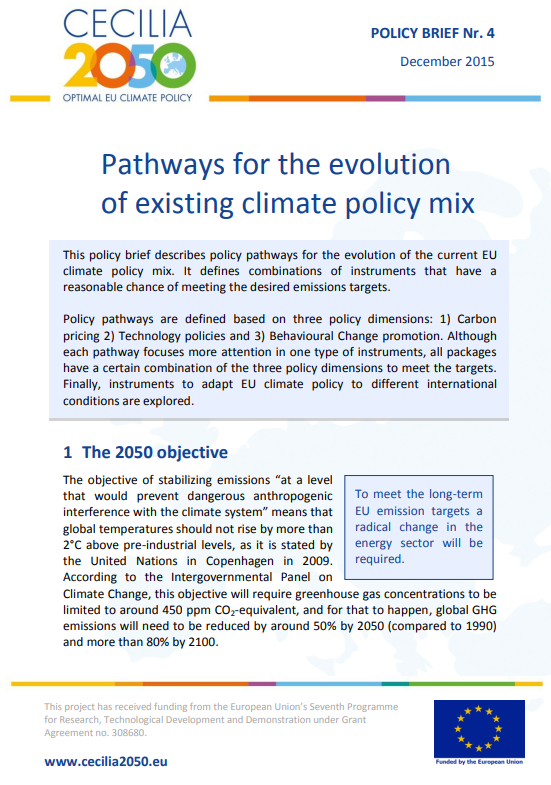
This policy brief describes policy pathways for the evolution of the current EU climate policy mix. It defines combinations of instruments that have a reasonable chance of meeting the desired emissions targets. Policy pathways are defined based on three policy dimensions: 1) Carbon pricing, 2) Technology policies and 3) Behavioural Change promotion. Although each pathway focuses more attention in one type of instruments, all packages have a certain combination of the three policy dimensions to meet the targets. Finally, instruments to adapt EU climate policy to different international conditions are explored.
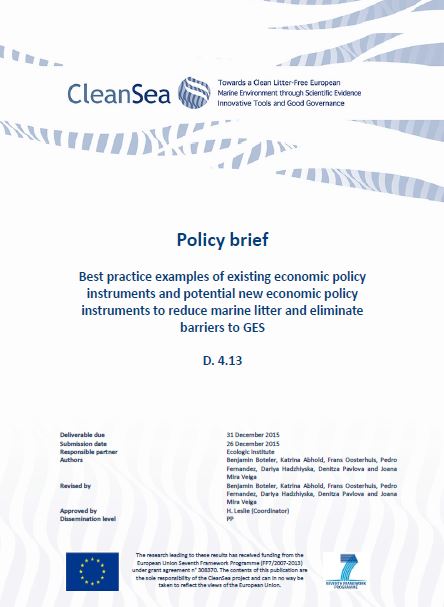
This CleanSea policy brief provides a critical review and assessment of potential measures to reduce marine litter. This brief focuses on existing economic instruments implemented in Europe. It points critical factors which influence the appropriateness and effectiveness of economic instruments. It also shows where the scope of current economic instruments could be expanded to explore their capacity to reduce marine litter. Such an evaluation of existing economic instruments to reduce marine litter is essential to furthering the necessary steps to achieve GES and sustainable marine ecosystem management. The policy brief is available for download.
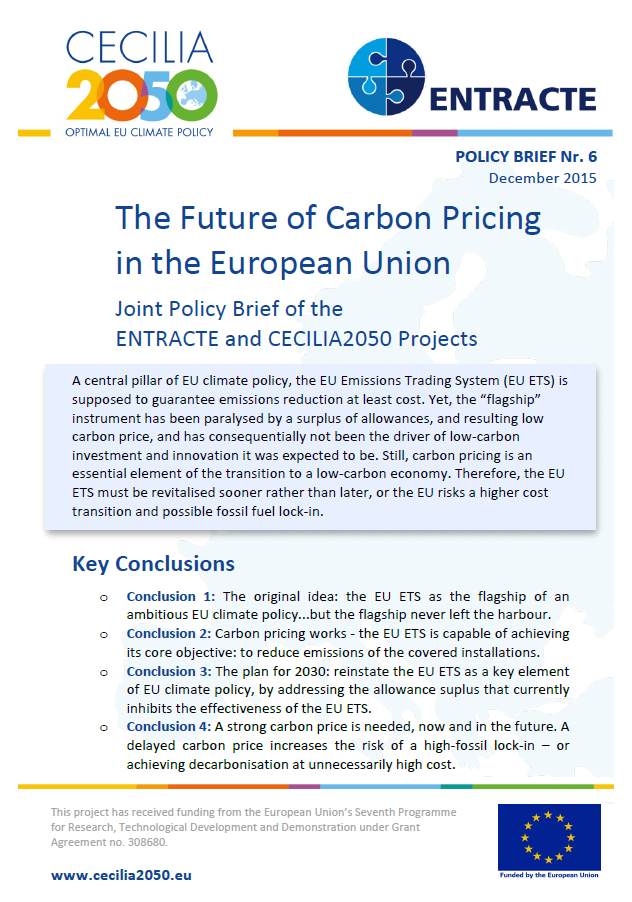
This policy brief presents insights on the historical and future role of carbon pricing in the EU. The findings discussed are drawn from research undertaken by the CECILIA2050 and ENTRACTE projects.
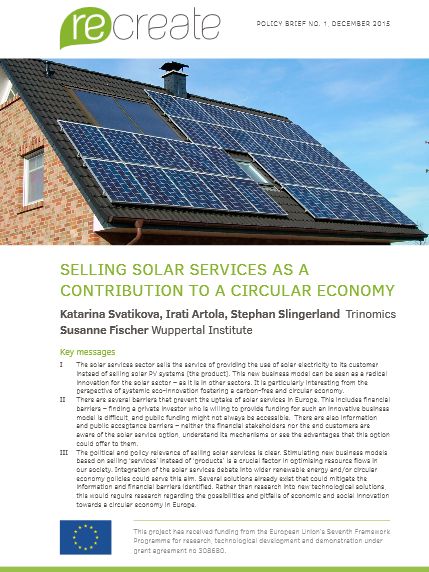
The solar services sector sells the service of providing the use of solar electricity to its customer instead of selling solar PV systems (the product). This new business model can be seen as a radical innovation for the solar sector – as it is in other sectors. It is particularly interesting from the perspective of systemic eco-innovation fostering a carbon-free and circular economy. The policy brief is available for download.
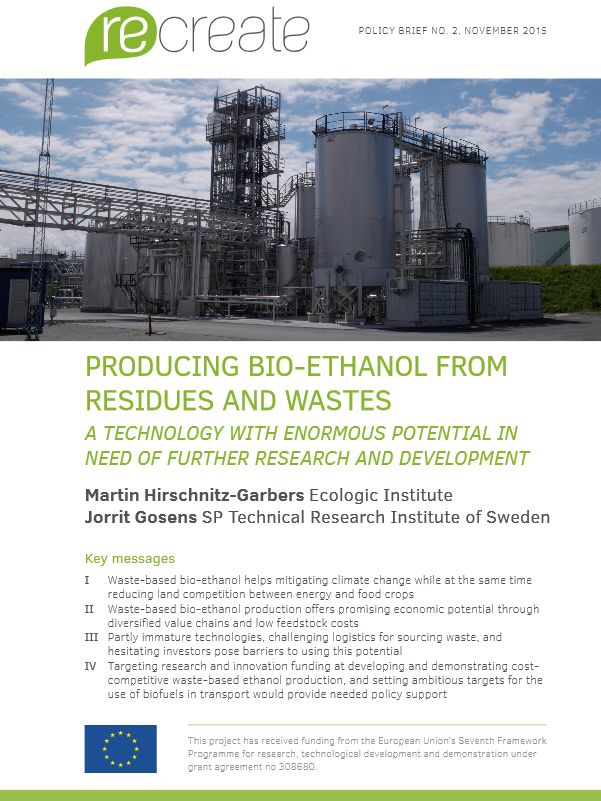
Waste-based bio-ethanol has the potential to both fight climate change and reduce land competition. However, in order to unlock its potential, support for research and development, as well as an enabling political framework, are needed. In this policy brief, Ecologic Institute's Dr. Martin Hirschnitz-Garbers and Jorrit Gosens explain the technology's need of further research and development. The policy brief is available for download.
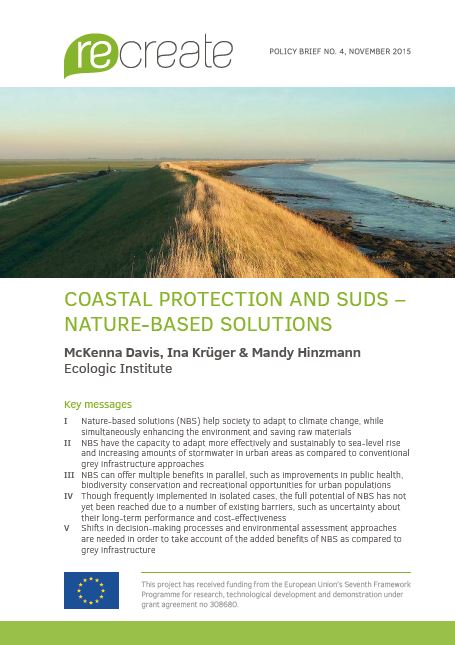
The RECREATE Policy Brief no.4 examines the case of Nature-Based Solutions (NBS) in two different application areas: (1) coastal protection and (2) urban drainage systems. It is based on one of the detailed narratives carried out for the RECREATE project. The RECREATE Policy Brief no.4 is available for download.
This policy brief summarises the insights conducted under the CECILIA2050 project on the international dimensions of EU climate policy. The aims of the research were to understand the economic and political interactions between EU policies and the rest of the world, assess the effectiveness of these measures and determine the legal and political feasibility of policy responses in regard to diminishing the risk of carbon leakage.
Both at the international level and in the European Union, governments are currently negotiating future approaches to mitigating global climate change. In both arenas, a key question is how the institutions will follow up on the implementation of agreed targets and measures. In this debate about appropriate governance tools, planning and reporting requirements occupy a central role. This policy brief by Ralph Bodle and Katharina Umpfenbach explores the relationship between the current and likely future reporting requirements under the United Nations Framework Convention on Climate Change (UNFCCC) and the EU's internal governance system. The policy brief is available for download.
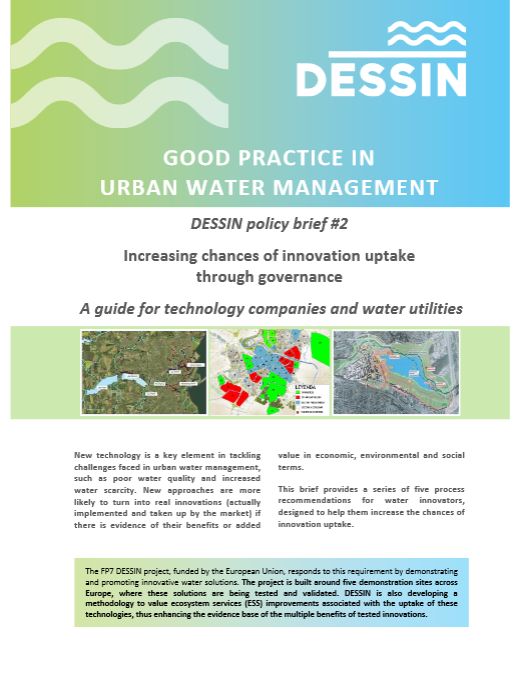
Within the European water research project "Demonstrate Ecosystem Services Enabling Innovation in the Water Sector (DESSIN)" a policy brief on governance factors conducive to innovation in the urban water sector was published. Rodrigo Vidaurre and Josselin Rouillard from Ecologic Institute, provide five key recommendations on the types of incentives and stakeholder management strategies that can be employed to encourage innovation uptake in urban water management. The policy brief is targeted to technology companies and innovators and available for download.
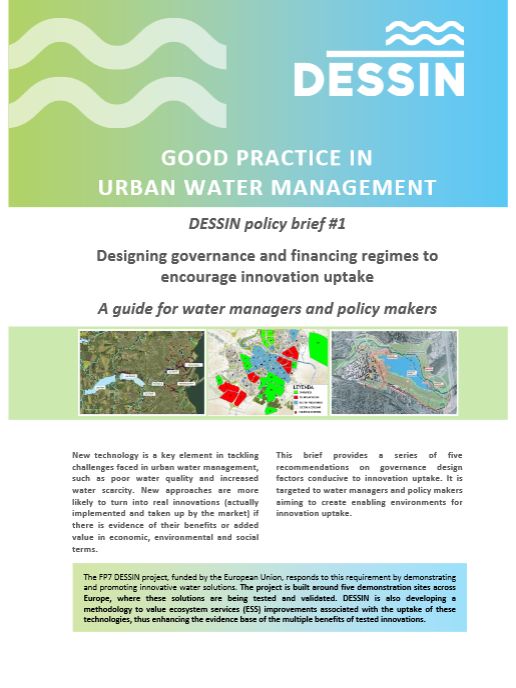
Within the European water research project "Demonstrate Ecosystem Services Enabling Innovation in the Water Sector (DESSIN)," a policy brief on governance factors conducive to innovation in the urban water sector was published. Josselin Rouillard and Rodrigo Vidaurre from Ecologic Institute, provide five key recommendations on policy frameworks, incentives and stakeholder management strategies that can be employed to encourage innovation uptake in urban water management. The policy brief is targeted to water managers and policy makers and is available for download.
Porsch, Porsch; Terri Kafyeke; Jiayi Yuan 2015: How to measure the Sustainable Development Goals in Central Europe? NETGREEN Policy Brief No. 2 / 4 August 2015 Deliverable D4.2
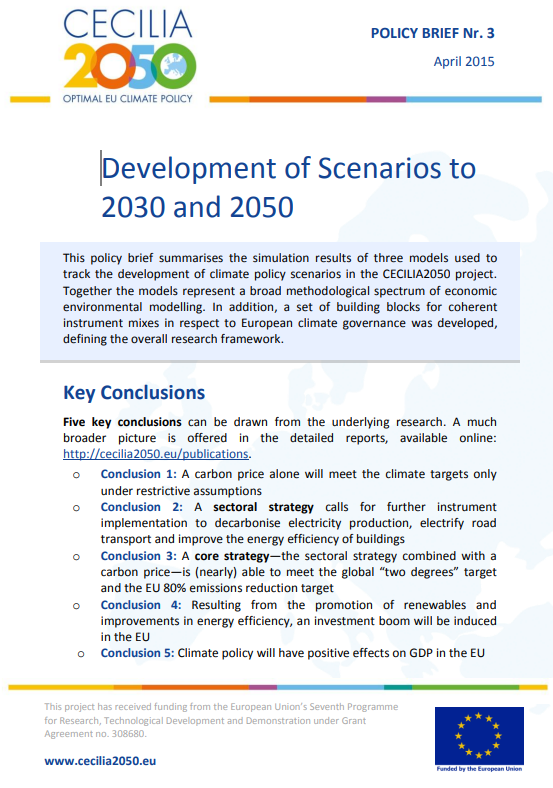
This policy brief summarises the simulation results of the three models used to track the development of climate policy scenarios in the CECILIA2050 project. In addition, the policy brief also draws insights from a study by Huppes and Huele (2014), which developed a set of building blocks for coherent instrument mixes in respect to European climate governance. Moreover, the policy brief is also based on a comparative analysis of the simulation results of the three models that was conducted by Drummond (2014).