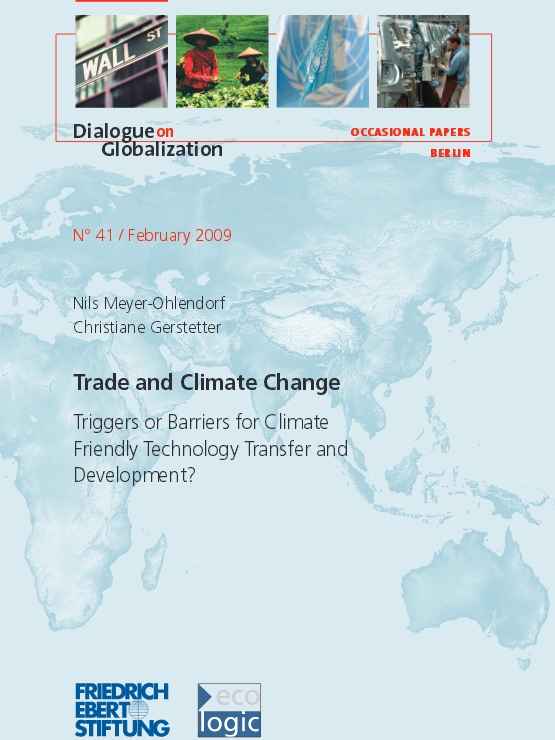
In their policy paper for the Friedrich-Ebert-Foundation’s Dialogue on Globalization section, Nils Meyer-Ohlendorf and Christiane Gerstetter of Ecologic Legal, shed light on the most important aspects of the relationship between trade and climate change policies. They investigate which trade-related policies should be adopted to combat climate change and review the compatibility of those measures with the law of the World Trade Organization (WTO). Particular attention is given to issues that are of relevance to developing countries. The first focus of the paper is on the transfer of climate-friendly technologies to developing countries.
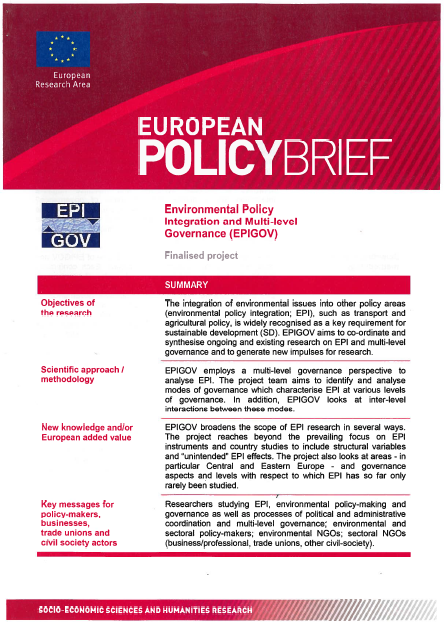
This European Policy Brief gives an overview of the results of the project "EPIGOV" which aims to co-ordinate and synthesise the research on environmental policy integration. The policy brief summarizes the objectives of the research, the scientific approach, as well as conclusions and impulses. Additionally, it provides key messages for policy makers, businesses, trade unions and civil society actors.
Martinez, Grit and Alexander Neubauer 2008: Identification and assessment of training needs, methods and activities for the wider use of environmental technologies in key sectors, Brussels.
This Policy Brief is intended to reflect the conclusions from the ETTAR (Environmental Technologies, Training and Awareness-Raising) project so far and develop policy recommendations based on these conclusions. The ETTAR project is a project under the 6th Framework Programme (financed by the European Commission) and deals with the promotion of environmental technologies in the freight transport sector. The Policy Brief has been agreed within the ETTAR team and is directed at stakeholders in the freight transport sector, such as policy makers, logistics associations and transport NGOs. The report is available for download.
The European Community has undertaken an ambitious program aimed at improving the sustainability of energy use across Europe. At the heart of this program are efforts by the European Union and its Member States to encourage the use of renewable sources of energy. Bioenergy has become a focal point in efforts to increase the use of renewable energy. This policy brief summarises the development and status quo of the EU bioenergy policy framework and links it to the current debate on sustainability of bioenergy.
This Ecologic Brief gives an overview of the main results and policy implications of the HarmoniCOP project. HarmoniCOP provides a comprehensive knowledge base for public participation in water management.
The use of public procurement policy to achieve sustainable development objectives has increased steadily over the past decade. Amongst the various "green procurement" initiatives, forestry is a sector which received much attention. However, unlike areas such as product safety or energy efficiency, the use of public procurement to enhance sustainable forest management (SFM) is extremely complex – largely because the elements of SFM are broad ranging, variable, and to some extent controversial.
With flooding in Central Europe once more headline news this spring and the loss of at least twelve lives across Austria, the Czech Republic, Germany and Slovakia, the proposal for a new Floods Directive from the European Commission in January 2006 seems like a timely intervention. Ecologic together with IEEP has produced a preliminary assessment of the Flood Directive proposed by the European Commission. It is intended as a policy briefing to help inform members of the European Parliament about the issues involved when discussing the proposal.
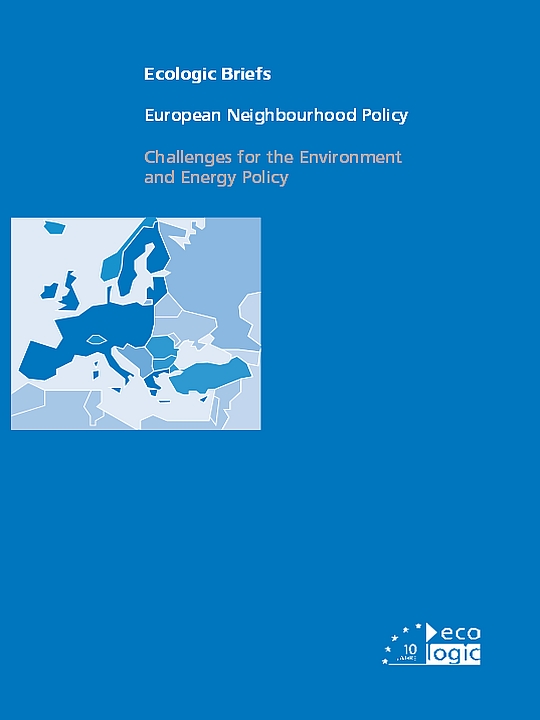
With the European Neighbourhood Policy (ENP), the European Union aims to redefine the relationships between itself and the new neighbours it acquired in the EU Enlargement of 2004. Economic integration remains at the heart of the ENP, but increased co-operation in the areas of environmental and energy policy is addressed as well. This Ecologic Newsletter by Sascha Müller-Kraenner examines this important issue and also surveys questions that the EU and its new neighbours will need to address together.
Nature protection policy and environmental measures within development and international cooperation play a central role in conflicts over resources. Since the mid-nineties, the topic of globalization was making all the headlines. Since September 2001, global security has dominated the international agenda. Against the background of this development, a special meaning is given to global environmental governance as well as the development of the concept of sustainability. A paper by Sascha Müller-Kraenner and Uwe Brendle.
Hansen, Wenke and Peter Beyer 2003: Incineration as recovery and disposal of waste: Analysis and interpretation of the judgements of the European Court of Justice C-458/00 and C-228/00. IEEP/Ecologic.
Beyer, Peter; Clare Coffey; Anneke Klasing 2003: Actively Shaping European Environmental Policy – Briefing Paper on the Draft Constitution for Europe. Ecologic Institute, IEEP, Berlin/Brussels.
What are the impacts of European infringement procedures regarding the non-compliance with nature conservation legislation on certain areas? And, to what extent can protected areas contribute to fulfill the requirements of the nature conservation legislation by means of sustainable management with appropriate financing?
The Laeken Declaration, convening the Convention on the Future of Europe, submitted a broad mandate to it, requesting it to reorganise the distribution of tasks between the EU and the Member States. However, the Convention did not consider reallocation of competencies, but rather concentrated on the task of ensuring transparency for the delimitation of competencies. Ecologic published a Brief that presents the system underlying the constitutional division of competencies, points out consequences of the system, and assesses them from an environmental point of view.