Related content for project "Plastic Pirates – German coast" (project ID 30020)
News
In 2026, the citizen science project “Plastic Pirates” celebrates its 10th anniversary. Since 2016, about 24,000 young people, together with teachers and youth group leaders, have collected valuable data on plastic pollution in German waters. To mark the anniversary, two new campaign periods will begin in autumn 2026 and spring 2027, inviting young people once again to take part in the citizen science initiative.
At the “18th Klett Geography Symposium: Plastic Planet or Blue Planet – It's in Our Hands", Mandy Hinzmann presented the “Plastic Pirates – German Coast” project. Plastic Pirates is a citizen science project in which young people work in groups to investigate (plastic) waste pollution in waterways using a standardised scientific method.
Doris Knoblauch from Ecologic Institute presented recent work from the Plastic Pirates – German Coast citizen science project at the 2026 conference of the European Citizen Science Association (ECSA) in Oulu (Finland). The conference brought together around 650 participants from across Europe and beyond to discuss the latest developments in citizen science research and practice.
During the first day of the PartWiss 2025 conference, Doris Knoblauch delivered a presentation on the Europe-wide citizen science project, 'Plastic Pirates – Go Europe', during the thematic session, 'Participatory Approaches to Shaping the Science-Policy Interface'. During her presentation, she explored the intersection of natural and social science methods within the project. Using studies of the North Sea and Baltic Sea coasts as an example, she showed how school classes in Kiel, St. Peter-Ording, Rostock and Flensburg had collected data on plastic pollution, before discussing the causes, responsibilities and possible solutions in focus groups.
Anthropogenic litter poses a growing threat to aquatic ecosystems worldwide. While the EU's Marine Strategy Framework Directive (MSFD) addresses this pollution as an environmental status indicator, the Water Framework Directive (WFD) lacks such a measure.The publication, jointly authored by researchers from the European Plastic Pirates initiative, illustrates how citizen science can address this issue by using existing litter data from related initiatives. Members of the author team included Doris Knoblauch and Mandy Hinzmann from the Ecologic Institute.
On 4 June 2025, children from Berlin's Schinkel Elementary School embarked on a new mission as part of the Citizen-Science Project Plastic Pirates Go Europe! – to investigate plastic waste by the River Spree. Together with Doris Knoblauch and Hannah Brunkhorst (both Ecologic Institute), the pirates explored the riverbank and made a few exciting discoveries.
This spring, the German Plastic Pirates are once again setting off to explore plastic pollution in our waters. From 1 May to 30 June 2025, school classes and youth groups are invited to take part in the sampling period. The investigation will focus on the German coasts and the river systems of the Elbe and Danube, including their tributaries.
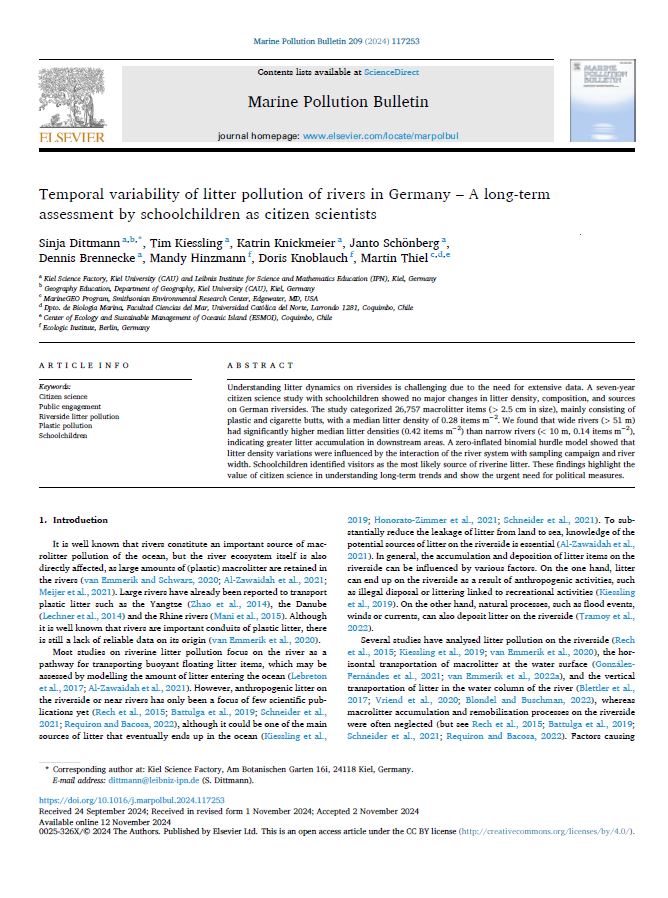
A seven-year citizen science study with schoolchildren on German riversides found stable litter density, mainly plastic and cigarette butts, with wider rivers showing higher litter levels, stressing the need for policy action.
On 4 April 2024, Mandy Hinzmann presented communication insights and best practices of the citizen science program "Plastic Pirates" at the European Citizen Science Conference in Vienna. The presentation highlighted that effective communication strategies are crucial for the success of citizen science initiatives.
This article illustrates the communication strategies that were successfully applied in the citizen science program Plastic Pirates in Germany. The program engages schoolchildren, teachers and youth groups in plastic pollution research. A variety of communication strategies have been implemented and continuously revised and adapted since the start of the program in 2016.
Since 2016, young people have been successfully researching and mapping plastic pollution in and around rivers in Germany. Now the expeditions are going into a new round: In the project "Plastic Pirates – German Coast", school classes and youth groups search for plastic waste on the coasts and the river system of the Elbe – including its tributaries such as the Havel, Mulde or Saale.