European Energy Security or Acquiescence?
A critical review of the 24 February 2026 United States-Central and Eastern Europe Joint Statement
- Publication
- Citation
Raffaele Piria, Hannah Lentschig, Ana-Maria Boromisa, Anca C. Sinea, Borbála Takácsné Tóth, Loyle Campbell and Sabrina Schulz: European energy security or acquiescence? A critical review of the 24 February 2026 United States-Central and Eastern Europe Joint Statement. Ecologic Institute, Berlin, 2026.
This paper reviews a secretive Joint Statement (JS) on Gas Supply Security to Central and Eastern Europe that was signed in Washington, D.C., on 24 February 2026 on the sidelines of meetings organised by the White House, its ‘National Energy Dominance Council’, and the ‘Donald J. Trump Institute of Peace’. Signatories comprise the US, eight EU Member States and four candidate countries.
Peculiarly, the full text has not been published by any signatory government.
The JS was signed four days before the US and Israel started their war against Iran. As a direct consequence of this decision, taken by the US administration without consultation with European partners, Europe faces a severe energy supply crisis and significant economic disruption.
This JS aligns with the Trump administration's ‘energy dominance’ doctrine. The US National Security Strategy defined “energy dominance” as a “top strategic priority”, explicitly framing the expansion of US energy exports as a means ”to project power". However, it is questionable whether the JS will support Europe’s energy security or instead foster fragmentation and entrenching dependency on its new dominant gas supplier, the US.
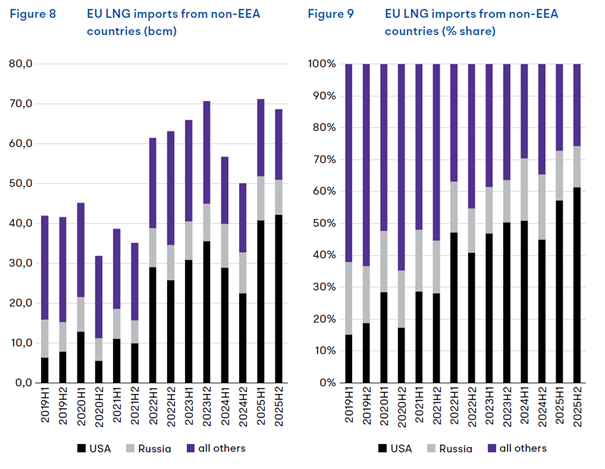
This critical review of the JS, co-authored by seven experts from think tanks in five Western and Eastern European countries, highlights its opacity and argues it is inconsistent with core European interests, including climate and energy security, (genuine) diversification, resilience and domestic renewables deployment. The paper shows the JS ignores affordability energy imports and ongoing US political coercion in Europe. It argues the JS misjudges energy realities by equating diversification with ‘more US LNG’, although the US is already Europe’s dominant gas supplier. Finally, it notes that, days after signing, the US broke its first commitment by triggering one of the most severe energy crisis Europe has faced.
It concludes with recommendations for policymakers in EU Member States that signed and did not sign the Joint Statement.
Contact

- Language
-
English
- Authorship
- Published by
-
Ecologic Institute, Germany - Year
- Dimension
- 12 pp.
- Project ID
- Keywords
Raffaele Piria, Kacper Szulecki, Hannah Lentschig and Louise van Schaik: Europe’s Selective Blindness on Gas: US LNG and the Limits of Supply Diversification. Clingendael, Ecologic Institute, Norwegian Institute of International Affairs, The Hague/Berlin/Oslo, 2026.