
Europe's Selective Blindness on Gas: US LNG and the Limits of Supply Diversification
- Publication
- Citation
Raffaele Piria, Kacper Szulecki, Hannah Lentschig and Louise van Schaik: Europe’s Selective Blindness on Gas: US LNG and the Limits of Supply Diversification. Clingendael, Ecologic Institute, Norwegian Institute of International Affairs, The Hague/Berlin/Oslo, 2026.
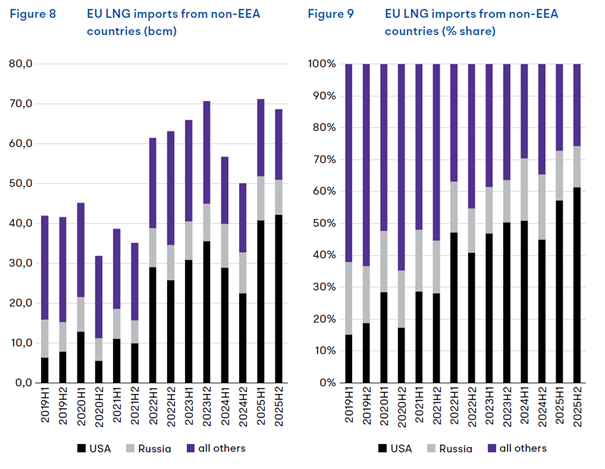
Based on a novel analysis covering the entire European Economic Area (EEA, notably including Norway), this policy brief shows that US gas imports into the EEA sharply surged in 2025. They now account for almost 40% of total EEA gas imports and nearly 60% of LNG imports. This trend exposes Europe to heightened geopolitical pressure, price volatility and the risk of stranded assets.
The European Parliament has recently approved a new regulation to phase out gas and oil imports from Russia, mandating “national diversification plans”. While phasing out Russian fossil fuels is strategically sound, the legal act narrows diversification to the mere elimination of Russian imports. Under this logic, importing 100% of gas from a single alternative country could be presented as success. This is not diversification, but its opposite and failure.
Accelerating the energy transition is the primary pathway to Europe’s energy security. This includes expanding domestic renewables, electrification, energy efficiency and sufficiency, as well as renewables-based feedstocks and hydrogen. In the short term, however, as long as Europe continues to rely on imported fossil fuels, genuine diversification across suppliers, routes and fuels remains essential. This must be complemented by adequate storage, protection of critical infrastructure, intra-EU solidarity mechanisms and robust emergency preparedness.
When revisiting the concept of diversification, the EU should classify Norway as a domestic supplier, reflecting economic and geopolitical realities. This policy brief applies this approach for the first time, offering a novel and clearer perspective on recent shifts in Europe’s gas supply portfolio.
Contact