© Hiroko Yoshii via Unsplash, 2026
One Ocean, no Borders
R. Andreas Kraemer on why Protecting the Ocean has to Start on Land
- Publication
- Citation
Kraemer, R. Andreas (2022). “El reto de la gobernanza oceánica: una oportunidad para la tierra.” In: Fàbregues, Francesc and Farrés, Oriol (coords.), Anuario Internacional CIDOB 2022. Barcelona: CIDOB, pp. 29–38
In “The challenge of ocean governance: an opportunity for the Earth” (pp. 29–38, published in Spanish; English title translated), R. Andreas Kraemer starts from a simple comparison. If the ocean were a country with its own statistics office, it would be the world’s fifth-largest economy and a member of the G7. It borders more than three-quarters of the world’s countries, is at war with none, and is by far the planet’s main bioreactor and climate regulator. Yet governments, he writes, do not care enough about it to protect it: the ocean is acidifying, overheating and rising, and global trade treats it as little more than a surface to cross.
The “territorial logic” problem
Kraemer’s central argument is that land-based rules do not fit a three-dimensional, constantly moving ocean. The UN Convention on the Law of the Sea, he argues, tries to extend rules devised between the 17th and 19th centuries to the sea and divides into state “territories” what is by nature indivisible. It also sits uneasily with traditional coastal communities, whose sustainable commons management is often treated as an aberration of property law. The result is a patchwork of overlapping, sector-based rules that do not create synergies; researchers have used the word “horrendogram” for this confusing map. His key conclusion is that effective ocean governance must prioritise regulating activities on land, supported by good governance of industry and the economy, and a reflection on lifestyles generally.
Clear causes, clear solutions
Kraemer argues that the list of pressing problems is short and the solutions are relatively clear: end the use of fossil energy as quickly as possible; protect and restore blue carbon ecosystems such as mangroves, salt marshes and seagrass beds; stop destructive bottom trawling and keep mining and fossil extraction off the seabed (“don’t touch the seabed!”); support traditional, small-scale fishing; and tackle land-based sources of pollution, from sewage and industrial effluent to plastics. He also notes that innovation and the opportunities of a sustainable “blue” economy are largely missing from the international debate, with offshore wind the main exception.
What 2022 delivered, and what is still missing
The article reviews the milestones of 2022: the One Ocean Summit in Brest, the UN Ocean Conference in Lisbon, negotiations on a High Seas Treaty and on a plastics treaty, the FAO’s International Year of Artisanal Fisheries and Aquaculture, and WTO talks on fisheries subsidies. In his view the tone is more encouraging than before, but political will remains weak, negotiations are slow, and monitoring and compliance are poor. What is needed, he concludes, is much more intensive political coordination, international cooperation and effective international rules and institutions, overcoming the “curse of consensus” through coalitions of the willing.
The Arctic Council as a model at risk
The argument closes with the Arctic Council, which Kraemer calls an imperfect but leading model for regional ocean governance: it focused on civil matters and involved Indigenous peoples in decision-making. Russia’s full invasion of Ukraine in February 2022 halted its work, and he warns that the world risks losing the best existing institutional model for governing a regional sea, which could be a starting point for the ocean as a whole. His closing message: humanity has only one ocean, and it needs to be protected and managed sustainably for the benefit of humankind, not destroyed by nationalism, greed and corruption.
Contact

- Language
-
Spanish
- Authorship
- Funding
-
Barcelona Centre for International Affairs (CIDOB), Spain - Published in
- Anuario Internacional CIDOB 2022
- Year
- Dimension
- 9 pp.
- Project
- Project ID
- Keywords
-
Ocean Governance, International Ocean Policy, Marine Environmental Protection, Sustainable Ocean Management, United Nations Convention on the Law of the Sea (UNCLOS), High Seas Treaty, Blue Economy, Blue Carbon Ecosystems, Marine Biodiversity Conservation, Ocean Climate Change Impacts, Sustainable Fisheries Management, Marine Pollution Prevention, Seabed Mining, International Ocean Cooperation, Arctic CouncilWorldPolicy Analysis, International Governance Assessment, Comparative Institutional Analysis, Literature Review, Environmental Policy Evaluation
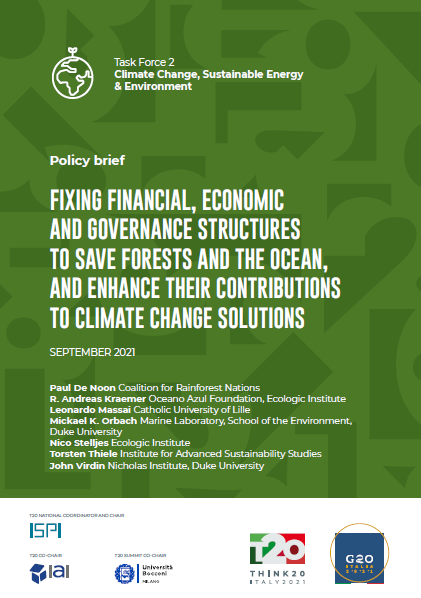
Noon, Paul De; Andreas Kraemer; Leonardo Massai et. al 2021: Fixing Financial, Economic and Governance Structures to Save Forests and the Ocean, and Enhance Their Contributions to Climate Change Solutions. T20 Policy Brief TF2 – Climate Change, Sustainable Energy & Environment.
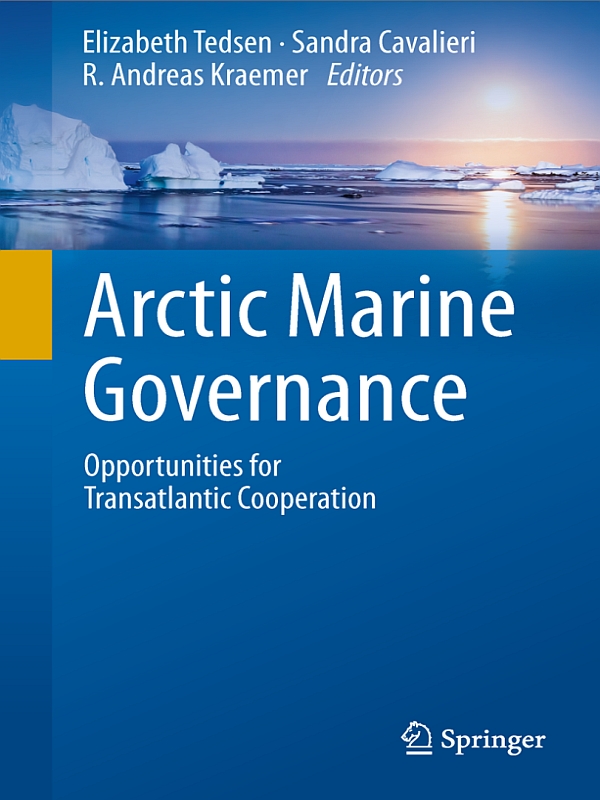
Tedsen, Elizabeth, Sandra Cavalieri, and R. Andreas Kraemer (eds.) 2014: Arctic Marine Governance. Opportunities for Transatlantic Cooperation. Heidelberg: Springer.
RISE UP for the Ocean
- Duration
-
-
- Funding