
© Christiane Hamann, 2026
Carbon Removals in the EU Emissions Trading System: Financing Without Undermining Climate Targets?
Parliamentary Breakfast at the German Bundestag
- Presentation
- Date
-
- Location
- Berlin, Germany
- Panel discussion
How can permanent carbon removals be financed through the EU Emissions Trading System without weakening incentives to reduce greenhouse gas emissions? Dr Nils Meyer-Ohlendorf addressed this question at a parliamentary breakfast held at the German Bundestag on 6 November 2026.
Around 25 representatives from parliamentary groups, the scientific community and civil society organisations gathered to discuss recent research findings and policy options for carbon dioxide removal. The event was held under the patronage of Helmut Kleebank, a Member of the German Bundestag (SPD).
Integrating Carbon Removals into EU Climate Policy
The discussion centred on a proposal put forward by the European Commission in July 2026 to use the EU Emissions Trading System (EU ETS) to finance permanent carbon removals. From 2031, revenue from the auctioning of additional emission allowances would be used to purchase certified removals generated through biogenic carbon capture and storage (BioCCS) and direct air carbon capture and storage (DACCS).
Nils Meyer-Ohlendorf presented the proposal and outlined possible approaches to integrating carbon removals into the EU ETS. A key question was how financing and support mechanisms could be designed without compromising the overriding priority of reducing greenhouse gas emissions.
Another focus of the event was climate overshoot – the temporary exceedance of the 1.5°C global warming threshold. Participants discussed the conditions under which carbon removals could help bring global temperatures back down over the longer term.
Nils Meyer-Ohlendorf contributes to the CDRSynTra2 research consortium, which provides scientific support and brings together findings from research conducted under the German Federal Ministry of Research, Technology and Space's (BMFTR) CDRterra research programme.
Contact

- Panel discussion
- Date
-
- Location
- Berlin, Germany
- Language
-
German
- Project
- Project ID
- Keywords
-
Carbon Dioxide Removal (CDR), Negative Emissions, BECCS, Carbon Removal Credits, EU ETS Reform, Climate Finance, Carbon Pricing, Negative Emissions Technologies, Climate Policy Instruments, Emission Allowances, Germany's Long-Term Strategy for Negative Emissions, Climate Neutrality, Climate Overshoot ScenariosGermany, Berlin, EuropeScience–Policy Dialogue, Policy Advice, Knowledge Transfer, Scientific Presentation, Parliamentary Dialogue, Science Communication
Meyer-Ohlendorf, N. (2026). CDRSynTra Policy Brief "Einheitliche Zertifizierung, umstrittene Regeln: Der neue EU-Rechtsrahmen für dauerhafte CO₂-Entnahme". Zenodo. http://doi.org/10.5281/zenodo.23527474
Fallasch, Felix et al. 2024: The EU Carbon Removal Certification Framework: Options for using certified removal units and funding mitigation activities. Interim Report. German Environment Agency: Dessau-Roßlau.
Böttcher, Hannes et al. 2025: Scientific support for the design of a certification framework for Carbon Dioxide Removals in the EU. Final report. German Environment Agency: Dessau-Roßlau.
Meyer-Ohlendorf, Nils (2023): Making Carbon Removals a Real Climate Solution. How to integrate carbon removals into EU Climate Policies. Berlin: Ecologic Institute.
Meyer-Ohlendorf, Nils, et al. (2023): EU 2040 Climate and Framework: The Role of Carbon Removals. Ecologic Institute, Berlin
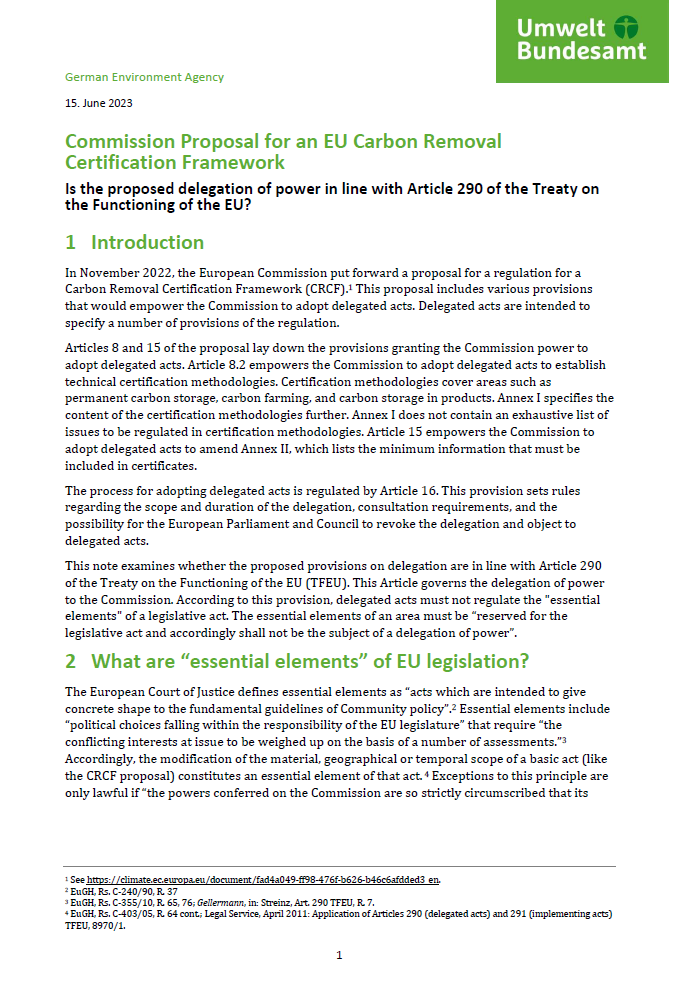
Meyer-Ohlendorf, Nils and Anne Siemons 2023: Commission Proposal for an EU Carbon Removal Certification Framework – Is the proposed delegation of power in line with Article 290 of the Treaty on the Functioning of the EU? Dessau-Roßlau: German Environment Agency.