The article "Design of greener drugs: aligning parameters in pharmaceutical R&D and drivers for environmental impact" published in Drug Discovery Today explores the challenges and opportunities in developing pharmaceuticals that are not only safe and effective for patients but also environmentally sustainable. This open access article – written by a cross-disciplinary team with representatives of universities, regulators, research-based pharmaceutical companies and SMEs – identifies the most promising areas for action in pharmaceutical research and development. It specifically aims to bridge the scientific concepts used by the expert communities in both environmental science and pharmaceutical R&D.
The webinar "Naturally resilient: anchoring nature-based solutions in municipal climate adaptation concepts" will discuss how nature-based measures can be meaningfully integrated into climate adaptation concepts and what challenges and opportunities exist in practice.
In this project Ecologic Institute supported the European Climate Foundation (ECF) in strengthening EU and Member State climate governance frameworks to better deliver on the EU's climate-neutrality objective. Building on more than a decade of collaboration, the project combined scientific analysis and targeted convening to help identify priority options for 'levelling up' national governance standards and to inform the upcoming revision of the EU Governance Regulation expected in 2025–2026.
The project aims to quantitatively assess the carbon storage potential of the North Sea and Baltic Sea in good environmental status according to the MSFD and in good ecological status according to the WFD. This assessment will provide clear recommendations on how natural climate protection in the seas can be improved and whether the current targets are sufficient from a climate protection perspective.
The infographic illustrates the key hydrological parameters that influence the water balance in ecosystems. The water cycle is illustrated, starting with precipitation through various phases such as evaporation, transpiration, surface runoff, seepage water movements and the recharge of groundwater. These processes are fundamental to understanding water cycles and their significance for the environment and climate. The visualization makes it clear how precipitation is filtered through the different earth layers and ultimately contributes to the replenishment of groundwater.
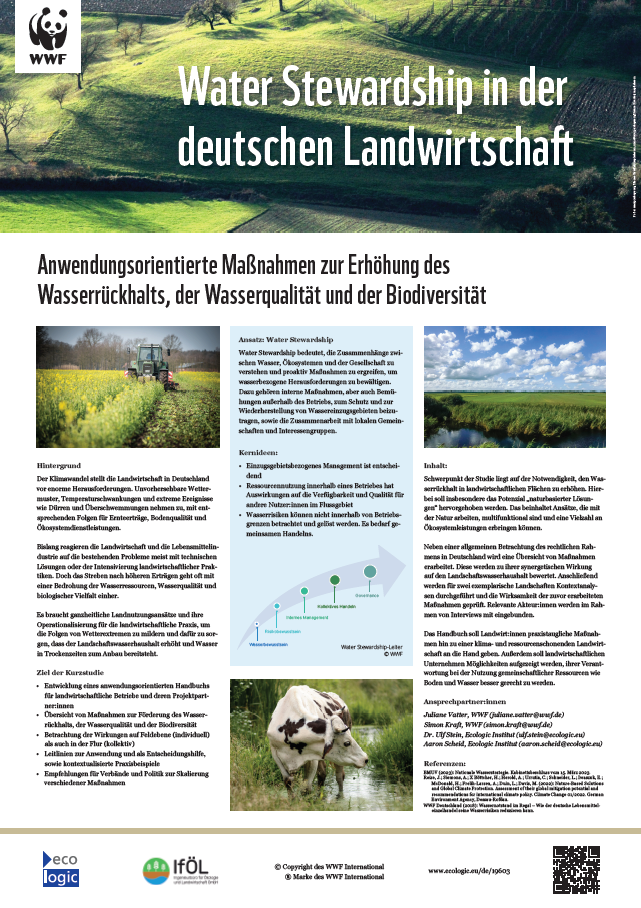
Due to climate change, water retention in landscapes is gaining increasing relevance alongside flood protection. Various measures can improve the landscape water balance or enhance the resilience of land ecosystems against extreme weather events caused by floods and droughts. The authors have compiled a catalog of 69 measures in the UBA project WADKlim. These measures mostly originate from good practices in water management, agriculture, and forestry in Germany and have been evaluated based on their local impacts and implementation-relevant conditions.
The Plastic Pirates start a new small project in the autumn of 2024. The new focus this time: the river system of the Danube! The second-longest river of Europe, stretching over 2.850 kilometers, starts in the Black Forrest, and flows through a total of 10 countries before emptying in the Black Sea. The river system includes many important tributaries, for example the Isar, Inn and Lech. The new project focused on the Danube is an addition to the ongoing analysis of the Elbe River System and the German coasts. Gaining further insights in plastic pollution of these water bodies will be the aim of the Plastic Pirates’ 2024 autumn campaign period.
The EU Biodiversity Strategy 2030 calls on cities to promote urban nature in the form of "Urban Nature Plans" for the protection of biodiversity, for climate protection and adaptation and for the quality of life in cities, and to set ambitious targets for this. This brochure transfers the approach of urban nature plans to the German context and offers concrete tips for implementation. This includes a checklist to determine the extent to which a municipality's existing plans already correspond to urban nature plans.
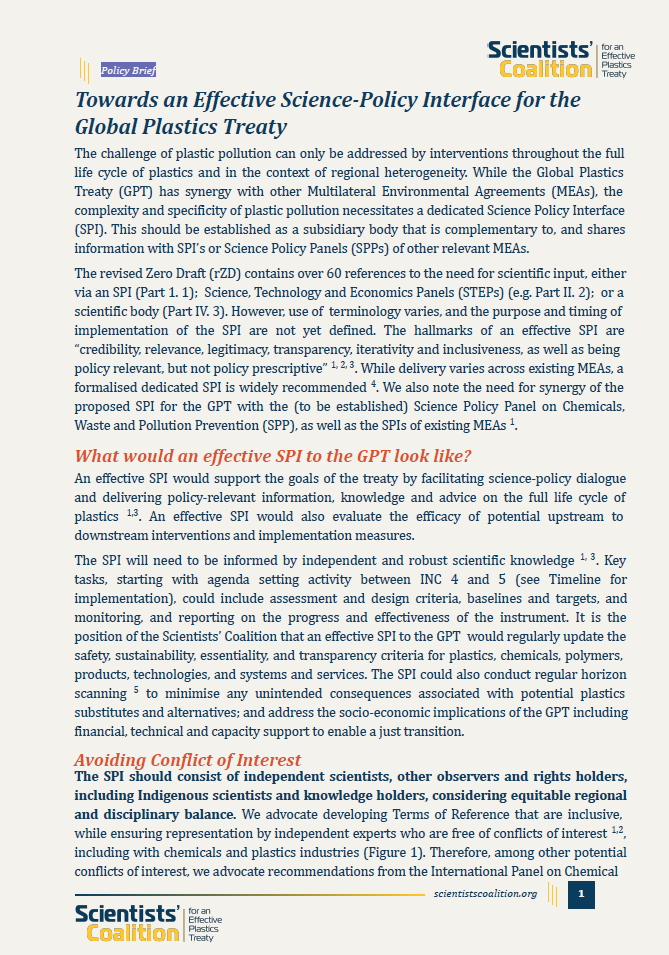
The fourth session of the Intergovernmental Negotiating Committee (INC-4) to develop an international legally binding instrument on plastic pollution, including in the marine environment, was held in Ottawa (Canada), from 23 to 29 April 2024. This session marked a crucial step in the global effort to address plastic pollution, with over 2500 participants from governments, academia, civil society organizations, private sector entities, UN entities, and international organizations. Linda Mederake attended the INC-4 negotiations in Ottawa on behalf of the Ecologic Institute, supported by the Konrad von Moltke Fund.
Ecologic Institute acts as partner in a consortium led by COWI on a framework agreement (FWA) to support the European Investment Bank's (EIB) Advisory Services on Lot 6: Bioeconomy. Ecologic Institute will provide a range of services within the framework contract, including for example thematic expertise on sector "Natural resources & natural capital management" and horizontal sub-sectors "Capacity building, knowledge creation and dissemination", "Provision of advice on regulatory matters" and "Climate action – adaptation".
Dr Stephan Sina, Senior Fellow at Ecologic Institute, took part in a panel discussion in the Bundestag as part of a workshop on environmental crime organised by Bündnis90/Die Grünen. In his keynote speech, he outlined the most important innovations of the amended EU Environmental Crime Directive and the challenges of its implementation in Germany. The panel discussion was chaired by MdB Lukas Benner. Other panellists were Katharina Lang (WWF) on the topic of illegal timber trade and journalist Marius Münstermann on the topic of illegal waste trade.
Dr Stephan Sina, Senior Fellow at Ecologic Institute, gave a presentation on prosecution under the amended Environmental Crime Directive at an information event organised by Green Legal Impact and Stop Ecocide Germany on the new EU environmental criminal law. He began by describing the special features of criminal prosecution in the environmental sector and the reason for the first-time inclusion of criminal prosecution provisions in the Directive. He then gave an overview of the regulations on resources and training, co-operation between authorities, the national strategy for combating environmental crime and statistical data. The presentation ended with examples of challenges and approaches to implementing the directive in Germany.
This report assesses the implementation status and quality of a selection of 11 provisions from 4 EU laws in 6 EU countries (Austria, Bulgaria, France, Germany, Poland and Spain). These 4 EU laws are Directive (EU) 2019/944 on common rules for the internal market for electricity (DIR), Regulation (EU) 2019/943 on the internal market for electricity (REG), Directive (EU) 2018/2001 on the promotion of the use of energy from renewable resources (RED) and Regulation (EU) 2022/2577 laying down a framework to accelerate the deployment of renewable energy (ACC).
Ecologic Institute is a UN-accredited voice for a global plastics agreement. But we lack funding for the next decisive round of negotiations in Busan (South Korea) in November 2024. By participating, we are contributing to counteracting lobbying and enabling delegates to be properly informed. In Ottawa, we are currently providing specialist information on the effects of plastic production and consumption. Your donation will enable us to strengthen independent science and continue this important work!