This article, which is co-authored by Senior Fellow Ingmar von Homeyer of the Ecologic Institute, introduces a special issue of the journal International Environmental Agreements on environmental policy integration (EPI) at the international level. Referring to the integration of environmental concerns into other, non-environmental policies, the concept of EPI has been applied at national and EU-level but has rarely been analysed in relation to the global arena.
Kraemer, R. Andreas; Max Gruenig; Dominic Marcellino 2009: Financial Sustainability of Water and Sanitation in Germany. in: Massarutto, Antonio (ed.): Financial Sustainability of Water and Sanitation Undertakings an Application to Italy, Germany and the US. Milano. 31-53.
<p>
The Indiana University European Union Center organized a full-day conference entitled "European Union Regulatory Policy: Lessons for Indiana." Dominic Marcellino gave a presentation on the development of EU energy and climate policy over the past decade, pointing out trends and possible future developments, and highlighting implications for Indiana.</p>
Deforestation is responsible for roughly one fifth of global carbon emissions, most of it in the tropical forests of the developing world. At the Copenhagen climate talks, negotiators discussed a potential new mechanism to compensate nations for keeping their forests intact. The article by Duncan Brack and Katharina Umpfenbach looks at these REDD proposals (Reducing Emissions from Deforestation and Degradation), arguing that carbon finance alone might not be enough to stop deforestation – unless part of it is spent upfront on improving forest governance.
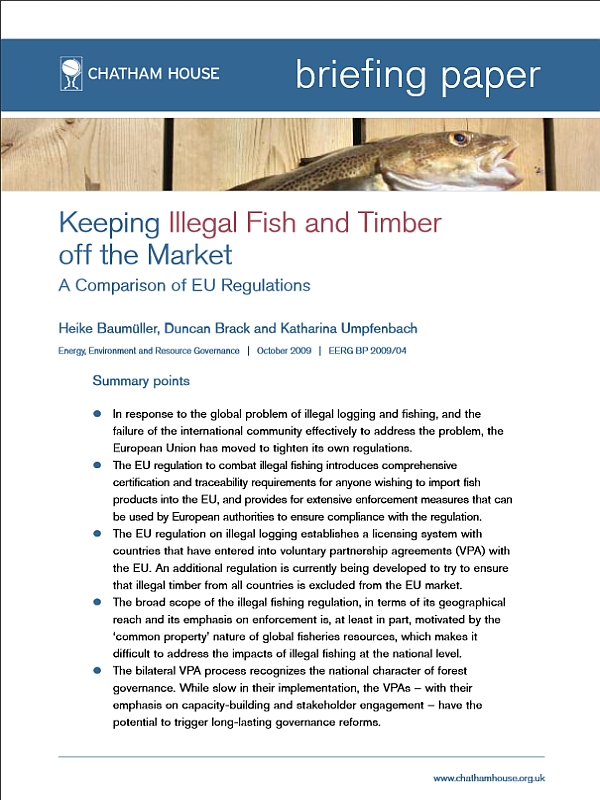
Illegal fishing and logging, and the international trade in illegally sourced fish and wood products, cause enormous environmental and economic damage. Consumer countries contribute to the problem by importing fish and timber without ensuring legality – a problem the EU tries to address with two new regulations. In this briefing paper, Duncan Brack, Heike Baumüller and Katharina Umpfenbach compare the recently adopted EU regulations on illegal fish and timber products. The authors contrast the very different approaches and highlight areas that might need further strengthening.
Winkel, Georg; Timo Kaphengst; Sophie Herbert et al. 2009: EU policy options for the protection of European forests against harmful impacts. Albert-Ludwigs-University Freiburg, Institute of Forest and Environmental Policy/Ecologic Institute, Berlin.
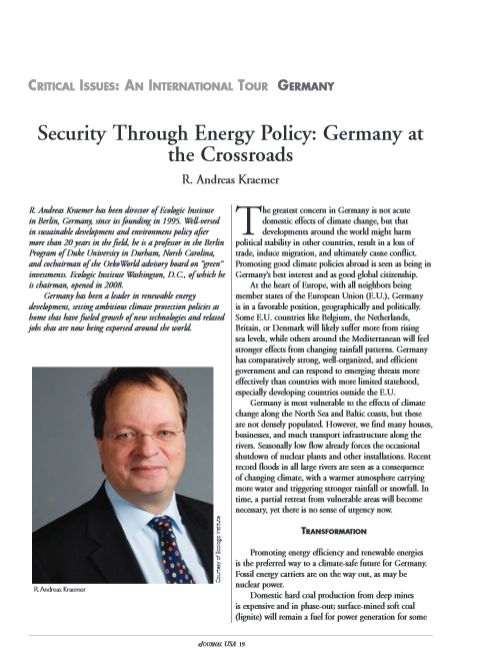
The greatest concern in Germany regarding climate change is that developments around the world might harm political stability in other countries, result in a loss of trade, induce migration, and ultimately cause conflict. In this article, R. Andreas Kraemer from the Ecologic Institute describes how Germany deals with this issue by proactively developing new energy solutions, setting effective energy policies domestically, and promoting good climate policy abroad.
Non-timber forest products (NTFPs) can be an important source of income for rural inhabitants of Laos. One such NTFP, which has been promoted by the government of Laos, is the paper mulberry tree (Broussonetia papyrifera (L) Vent). This study was performed to understand the factors influencing the commercialisation of paper mulberry bark in Oudomxay province (Northern Laos) and to investigate the potential of the paper mulberry tree as a source of steady income.
In the North polar region, key nations of the world will answer the key question: Will confrontation or cooperation reign in the Arctic of Tomorrow. R. Andreas Kraemer of Ecologic Institute sketched the future as keynote panellist at the Arctic Future Forum of the Friedrich Ebert Foundation and the Rideau Institute in Ottawa, ON, on 29 September 2009. The Forum focused on security and arms control, climate change and energy. The key findings and a summary report of the Arctic Future Forum in Ottawa, ON, on 29 September 2009 is available download.
Ribeiro, M., Losenno, C., Dworak, T., Massey, E., Swart, R., Benzie, M., Laaser, C. 2009. Design of guidelines for the elaboration of Regional Climate Change Adaptations Strategies. Study for European Commission - DG Environment - Tender DG ENV. G.1/ETU/2008/0093r. Ecologic Institute, Vienna.
The sharing of benefits from the use of genetic resources between the traditional users and cultivators of such resources and those that wish to use them for commercial or research purposes is a major issue under the Convention on Biological Diversity (CBD). In this book chapter, Christiane Gerstetter of Ecologic Legal develops recommendations for provider countries on how to implement the CBD requirement that benefits should be shared fairly and equitably.
This article explores options for linking emissions trading systems. Combining markets could have many positive benefits (including reducing the costs of compliance), but there are drawbacks. In the short term, however, direct bilateral linkages will be difficult, and achieving the EU-objective of OECD-wide emissions trading by 2015 is therefore ambitious. International negotiations will overcome some of the barriers to linkages and expedite the integration of carbon markets. Michael Mehling of the Ecologic Institute in Washington, DC co-authored this article.
Linking emissions trading schemes has currently attracted much interest as a means of reducing compliance costs, expanding market size and liquidity, and reducing price volatility. The US and Canada are developing federal emissions trading systems, and Mexico is developing an emissions cap for its cement and oil sectors. Strong economic ties imply that linking the systems could become desirable. Linking systems can have both positive and negative implications, but once the decision has been made, framework and policy harmonization is vital to establish and maintain a successful link. Michael Mehling of the Ecologic Institute in Washington, DC co-authored this article.
Environmental policy-makers and stakeholders from the non-governmental, academic and private sectors from 19 countries gathered in Berlin from 27 July to 7 August 2009 in the first ICAP Summer School for Emerging and Developing Countries. The intensive two-week training event, designed and organised by the Ecologic Institute on behalf of and in collaboration with the International Carbon Action Partnership (ICAP), provided insights into the complexities of emissions trading systems to enable participants' countries to harmonise their environmental policies for full participation in a future global carbon market. A second summer school will be held in the Netherlands in 2010.
On 5-12 July 2009, the second transatlantic Farmer-to-Farmer exchange brought together farmers, foresters, journalists and policy-makers from the United States and Germany to discuss the role of agriculture in future climate policies. On their trip through Ohio and Pennsylvania and ending in Washington DC, the group of 30 participants visited several farms applying climate friendly agricultural practices, as well as biofuel and algae processing facilities. One topic of major concerns was possible ways to off-set GHG emissions by industry through mitigation activities in agriculture. Moreover, participants intensively exchanged knowledge and experiences in different bioenergy applications.