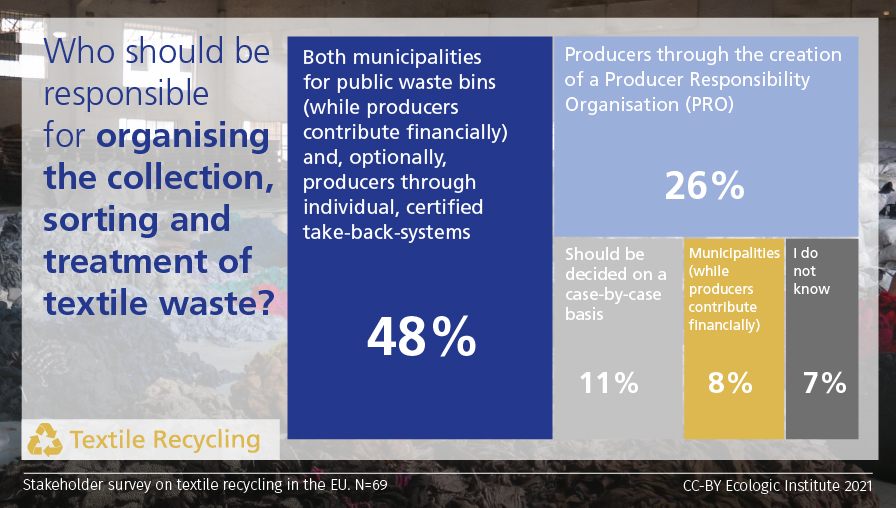
This infographic visualizes results of the survey "Fostering textile fibre recycling in Europe – pointers for policy action", conducted by Ecologic Institute in 2021. It is licensed under a Creative Commons CC-BY license.
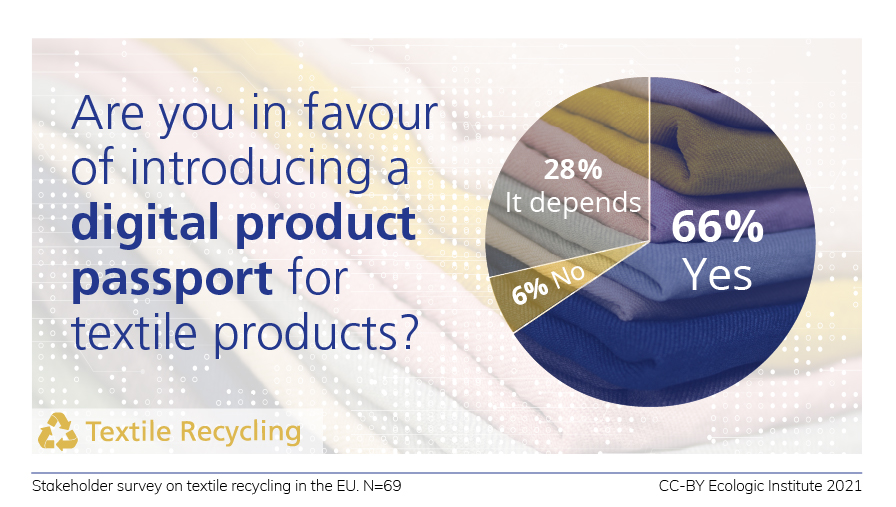
This infographic visualizes results of the survey "Fostering textile fibre recycling in Europe – pointers for policy action", conducted by Ecologic Institute in 2021. It is licensed under a Creative Commons CC-BY license.
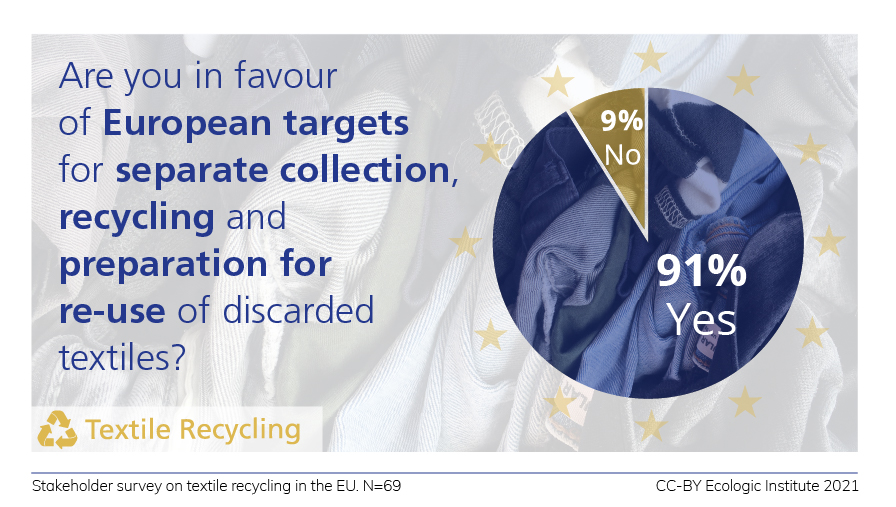
This infographic visualizes results of the survey "Fostering textile fibre recycling in Europe – pointers for policy action", conducted by Ecologic Institute in 2021. It is licensed under a Creative Commons CC-BY license.
The purpose of this webinar series is to discuss the challenges that power grid operators and electricity producers face in Germany and the United States with a changing climate and policy and investment measures for adaptation and resilience. The goal is to share knowledge and best practices, foster transatlantic dialogue and connections, and to think critically about how best to safeguard critical energy infrastructures.
Day 2 (Monday, 13 December 2021) will shift the perspective to policy and discuss the role of policymakers and policy solutions to facilitate adaptation in the electricity sector.
This podcast of the European network of think tanks "Think Sustainable Europe" is discussing the main outcomes of the climate negotiations at COP26 in Glasgow. The climate conference and its outcomes were received with a range between careful optimism and disapppointment on the little progress. Following the invitation of the Institute for European Environmental Policy (IEEP), one of Ecologic Institute's climate negotiation experts, Arne Riedel, joined Michael Nicholson (IEEP) and Philip Glas (IISD) for the exchange.
The purpose of this webinar series is to discuss the challenges that power grid operators and electricity producers face in Germany and the United States with a changing climate and policy and investment measures for adaptation and resilience. The goal is to share knowledge and best practices, foster transatlantic dialogue and connections, and to think critically about how best to safeguard critical energy infrastructures.
Day 1 (Thursday, 9 December 2021) will focus on the risks that climate change poses to the electricity sector and best practices for adaptation and resilience.
This EEA technical report was authored by Ecologic Institute and aims to improve the knowledge base on different realities of national protected area management. Based on a semi-structured survey conducted in 12 Member States, the report showcases individual national approaches and practices, as well as challenges and successes in the management of protected areas.
As part of this study, stakeholder feedback from the European textile sector was gathered on bottlenecks and enablers for textile-to-textile recycling. Overall, the participating stakeholders distinctly signaled to be open and prepared for ambitious policy approaches. Next, policy options were developed aiming to enhance textile recycling as part of a circular textile economy in the EU.
This background report examines European Green Deal policies from a resource nexus perspective, identifying relevant challenges and opportunities associated with particular transition pathways foreseen in the European Green Deal. The background report functions as a supporting document to the EEA briefing on these topics entitled "Applying a 'resource nexus' lens to policy: opportunities for increasing coherence". A brief overview of the European Green Deal as well as the resource nexus is included in this introduction to familiarise all readers with the relevant concepts.
The report "Governance Analysis for Planning and Implementation of Urban NBS" presents insights from a governance analysis conducted in the six INTERLACE partner cities: CBIMA (Costa Rica), Chemnitz (Germany), Envigado (Colombia), Granollers (Spain), Metropolia Krakowska (Poland), and Portoviejo (Ecuador). The analysis examines existing governance structures, policymaking and implementation practices, as well as challenges and enabling factors for advancing Nature-based Solutions (NbS) in urban areas.
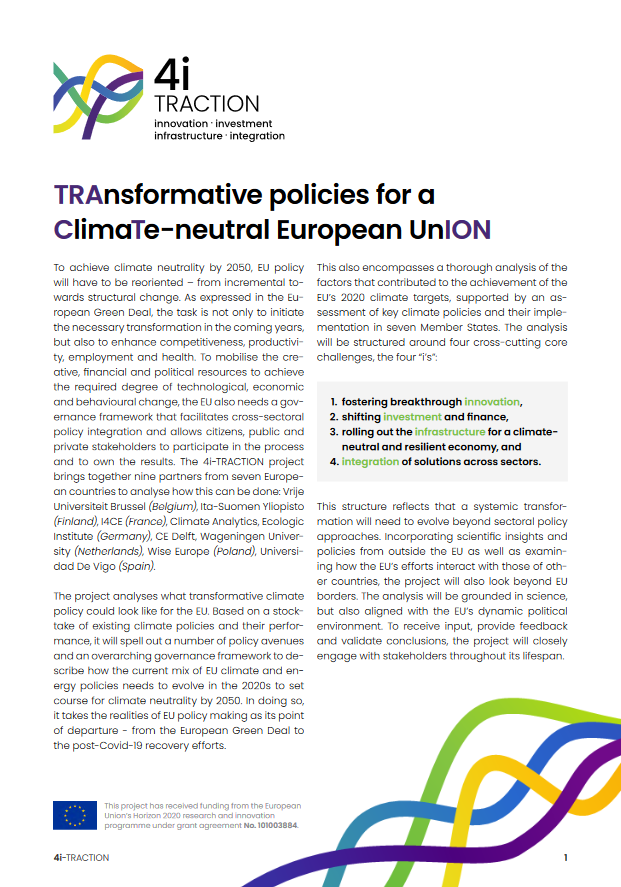
This project flyer summarizes the key features of the project and introduces the four "i's": innovation, investment, infrastructure and integration. The flyer also summarizes the six work packages and their main thematic focus. Ecologic Institute designed a programme flyer as part of the visual identity for the project "Transformative Policies for a Climate-neutral European Union (4i-TRACTION)".
The COACCH project (CO-designing the Assessment of Climate CHange costs) has proactively involved stakeholders in the design and delivery of research, as part of a collaborative co-production process. To do this, it developed a set of success factors for successful co-design and developed a protocol (process) for implementation. This was implemented for the project, through the use of working group and deep engagement stakeholders. This deliverable reports on the lessons from this co-creation approach.
Rural regions in Southeastern and Eastern Europe are facing multiple challenges such as a rural exodus, aging populations, a declining industrial base and low innovation performance. As such, they are particularly vulnerable to the negative impacts of climate change. In response to this, stakeholders in the five BE-Rural regions developed bioeconomy strategies and roadmaps for enhanced rural development. This publication presents short summaries of the regional strategies and roadmaps focusing on the regional context in terms of available natural resources, the social, economic and political context, the strategy development process and the priorities outlined in the strategies.
As the source of 10% of the EU's greenhouse gas emissions and a major carbon sink, agriculture offers significant potential to mitigate climate change. This on-farm agricultural climate mitigation is referred to as carbon farming. On behalf of the European Parliament, Ecologic Institute with support from IEEP investigate the potential of carbon farming to mitigate emissions in the EU and how to effectively incentivise farmers to act. Ahead of two key EU Commission policy proposals in December 2021 (the 'Carbon Farming Initiative' and 'Carbon Removals Certification Mechanism'), this study summarises existing knowledge on carbon farming options, business models, challenges, and evaluates funding and policy opportunities to support its uptake. The report is available to download.