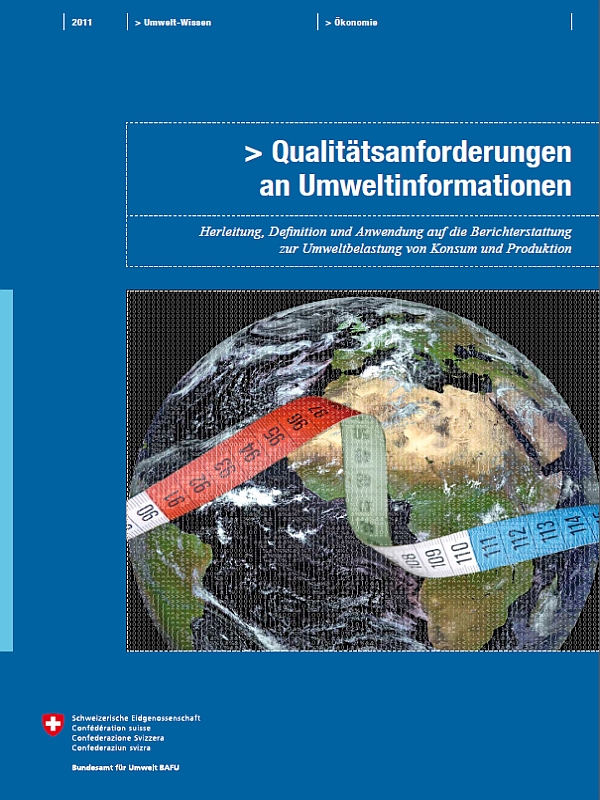
Although there are many information and data on the environmental and climate impact of consumption and production, it is difficult to evaluate their role and their connections in the overall picture. In this study, different quality requirements for environmental information are defined and compared by using the concept of the "True and Fair View."
In this paper, Sascha Müller-Kraenner, one of the founders and a Partner of Ecologic Institute, investigates the nature of the European Union’s relations to third countries with regard to renewable sources of energy and the options available for further developing those relations in order to more effectively exploit the potential of renewable energy. While the EU has the potential to cover its electrical power needs from renewable sources alone, cooperation with third states in the use of renewable energy sources will play an important role – as can be seen in the large-scale Desertec project.
As one of its key features, the Kyoto Protocol introduced market mechanisms in order to achieve climate targets at lowest cost. Instruments like emission trading, the Clean Development Mechanism and Joint Implementation have established markets for emission reductions worldwide. These instruments owe their existence to the Kyoto Protocol. However, the current commitment period of the Kyoto Protocol expires in 2012, and the prospects for an immediate successor agreement remain bleak. The 16th edition of Climate Talk discussed what this situation entails for the market mechanisms, and what measures the affected firms can take to deal with the uncertain outlook.
Do the National Renewable Energy Action Plans concerning Member States' goals for 2020 address the long-term restructuring of electricity generation? Do they consider possibilities for European cooperation? Dr. Stephan Sina and Katharina Umpfenbach of the Ecologic Institute examined these questions in their analysis of the German Renewable Energy Action Plan commissioned by the European Green Foundation.
From 15 to 16 October 2009, the Center for Foreign Trade Law of the Westphalian Wilhelms University in Münster hosted its 14th Foreign Trade Law Day, focusing on energy and climate change. At this conference, Benjamin Görlach, economist for the Ecologic Institute, delivered a presentation entitled "Economic Instruments between Kyoto and Copenhagen: quo vadis Climate Protection?" This presentation is now available as an article in the conference volume.
The Yearbook Ecology 2010 has been published at the beginning of September 2009. Ecologic Institute is one of the institutes supporting the yearbook and contributed three chapters on ecological transformation, water and oil to this year's edition.
<p>
<strong>We celebrate 15 years of Ecologic Institute in Berlin:</strong><br />
15 years of enthusiasm in science and policy, in dialogue, with ideas, and the will to shape the future. For a better environment.</p>
Dr. Camilla Bausch and Benjamin Görlach of the Ecologic Institute and Dr. Susanne Dröge of the German Institute for International and Security Affairs hosted the 16th Climate Talk at the end of August 2010. The evening’s theme was: US climate policy after a hot summer - from "Yes we can" to"Sorry – we tried"?
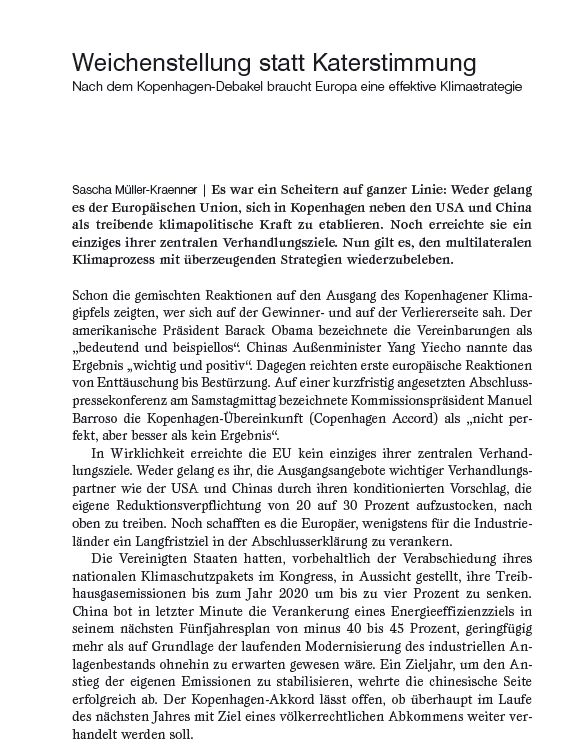
"Nobody wanted anything from Europe, nobody needed to negotiate with Europe." This is how Sascha Müller-Kraenner summarizes the role of the European Union at the Copenhagen climate summit. In his article "After Copenhagen – A new start for Europe’s climate diplomacy," published in "Jahrbuch Ökologie 2011," Ecologic Institute's advisor and co-founder analyzes the new distribution of power at international climate negotiations.
Lawyer Anke Rostankowski, who works as an Associate at Ecologic Institute, contributed to the latest commentary on the German Renewable-Energy-Heat-Law. This issue of the renowned commentaries EEWärmeG: Erneuerbare-Energien-Wärmegesetz of the Beck Verlag deals with the legal and technical experiences that have been gained with the law.
Dr. Camilla Bausch and Benjamin Görlach (Ecologic Institute) along with Dr. Susanne Dröge German Institute for International and Security Affairs, Stiftung Wissenschaft und Politik hosted the 15th Climate Talk in June 2010 on ‘Research on Geoengineering’ and the necessary framework for or limitations of such research activities. Ralph Bodle (Ecologic Institute), Elmar Kriegler (Potsdam Institute for Climate Impact Research) and Friederike Herrmann (Environment Protection Agency, UBA) opened the discussion with key statements on the issue.
Under the title "Setting the Course for the Future, not Nursing a Hangover – After the Copenhagen Debacle, Europe Needs an Effective Strategy for Climate Negotiations", Sascha Müller-Kraenner, Senior Policy Advisor at the Ecologic Institute, suggests options for the future external climate policy of the European Union. The article (in German) is available exclusively online from Internationale Politik, Germany's leading foreign policy magazine.
Today, the loss of biological diversity has already reached alarming proportions, proportions which climate change is not expected to reach for several decades. Despite this, climate change continues to dominate political debates, whereas biodiversity is still seen as an issue of secondary importance. In this publication, Sascha Müller-Kraenner, Senior Policy Advisor of Ecologic Institute, summarizes why a political and institutional reassessment of biodiversity is so necessary.
At the EU level, there is great need for legal reforms concerning the liability of enterprises for violations of human rights and environmental norms abroad. This is the result of a study co-authored by Christiane Gerstetter, Fellow Ecologic Legal and pro bono lawyer for the European Center for Constitutional and Human Rights.
European cultural landscapes are significantly shaped by human activities and provide a multitude of ecological services which benefit human society. In an article published in the May 2010 issue of "Natur und Landschaft", the concept of ecosystem services is evaluated in regard to its limits and potentials to analyse conflicts between land use and nature conservation.