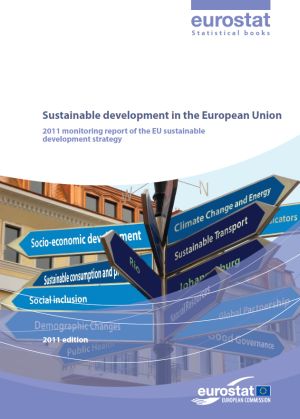
<p>Every two years the European Sustainable Development Strategy is being put to the test. With its monitoring report, the European Statistical Office Eurostat presents EU data on the development of the sustainability indicators. In a consortium with the Vienna University of Economics and Business, INFRAS and the Institute for Public Policy Research, Ecologic Institute drafted these monitoring reports for the European Sustainable Development Strategy 2009 and 2011 on behalf of Eurostat.</p>
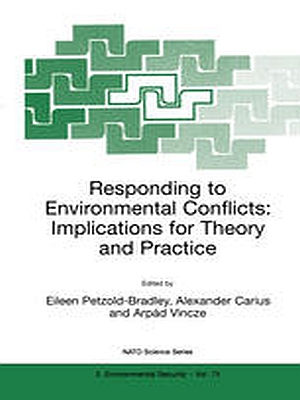
Documenting the results of a NATO Advanced Research Workshop held in Budapest on 21 to 23 January 1999, the book "Responding to Environmental Conflicts: Implications for Theory and Practice" provides an overview of environment and security challenges, addresses methods for assessing environmental security and their application in case studies, and presents views on the role of international and environmental institutions in preventing and dealing with environmental conflicts.
In January 1999, Ecologic conducted the workshop on "Responding to Environmental Conflicts: Implications for Theory and Practice". The aim was to discuss how to prevent environmental conflicts using approaches in different policy fields. In particular, non-governmental ways to tackle the complex dynamics of this type of conflict were considered.
The aim of this project is to support the Federal Ministry of Agriculture, Forestry, Environment, and Water Management (BMLFUW) in the preparation of a programme of measures in context of the EU - Water Framework Directive (WFD). The work includes determining the methodology for the identification of exemptions under Article 4.4 – 4.7.
<p>
"Emerging Stronger from the Recession to Tackle the Challenges of Social Cohesion and Sustainable Development" was the theme of an expert workshop convened by the European Commission (DG Employment) in Brussels on 9 September 2009. Ecologic Institute contributed a background paper, and R. Andreas Kraemer was invited as keynote speaker on "Taking Advantage of the Crisis: Synergies between Environmental Policy and Social Inclusion".</p>
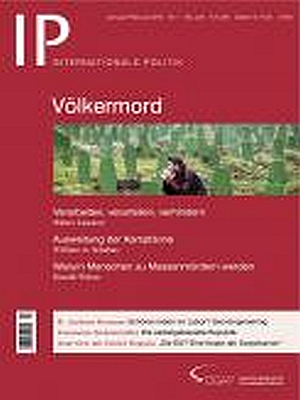
The debate about geo-engineering is unstoppable. Strong interests push for research and experimental application. Geo-engineering is a play for time, at best, but always also a dangerous deviation from emission reduction and climate change adaptation. Properly conducted, the debate can help clarify the design of international institutions, argue R. Andreas Kraemer and Ralph Czarnecki of the Ecologic Institute in an article in Internationale Politik, Germany's leading foreign policy magazine.
Global change holds many risks for European mountain regions. Melting glaciers, changes in permafrost and vegetation, as well as political, economic and cultural globalisation present dangers for mountain populations. Numerous research projects have produced valuable findings to ensure sustainable development in European mountain regions. Mountain.TRIP starts where these projects stop: translating research findings into useful information for practitioners.