© Ökovision consortium, 2025
Ökovision Ethical Investment Fund Focusing on Small and Mid-sized Businesses
Strictly Sustainable Investment: 30 years of success with Ökovision
- Project
- Duration
-
-
The Investment Committee, the independent body of the Ökovision Classic Fund, with clear ethical, social and ecological criteria, the pioneer among sustainable investment funds with very good performance, was dissolved at the end of 2025 after more than 30 years and over 100 intensive meetings by the asset management company Ökoworld. This also marked the end of a long-standing project by the Ecologic Institute.
The committee was independent of the management company "with regard to the appointment of its members and its working methods and decision-making" (Ökovision Profile 1993; Prospectus 1996–2025). The members themselves determined the committee's rules of procedure and its working and decision-making processes, and recruited new members for the committee as needed and when opportunities arose. They were able to further develop the social, ecological and other ethical investment criteria for the fund, keep them up to date, organise workshops and invite experts, and commission their own research, for which a modest annual budget was available. This independence ensured that greenwashing was not tolerated in the Ökovision Fund and Ökoworld.
The diverse committee consisted of 11 experts and activists from various fields of sustainability, each contributing perspectives from different areas of society. The members were deeply rooted in society and academia, with strong networks, professionally committed to various charitable causes, critical but benevolent towards capital markets, and keen to redirect capital flows and transform supply chains away from prevailing unsustainable business practices towards greater sustainability. The diverse expertise of its members and their external perspectives on the financial world were key to the success of the committee, the Ecovision Fund and, ultimately, the Ecoworld company.
Members of the investment committee from the very beginning included R. Andreas Kraemer (co-chair, 1995–2025) and Sebastian Büttner (1995–2016), both founders of the Ecologic Institute, as well as long-time partner Christine Jasch (1995–2025). Later, long-standing Senior Policy Advisor Christine Füll (2014–2023) and alumna Christiane Gerstetter (2016–2024) also served as members.
A deep commitment to strong sustainability united the committee members and was detailed in a set of criteria for evaluating companies and countries, which were further differentiated and nuanced over the years with increasing experience and new sustainability challenges. Examples of this include criteria on the use of stem cells and nanotechnologies, on supply chain links with repressive regimes around the world, on digitalisation with its potentially destabilising algorithms, and on artificial intelligence and quantum technology.
Ökovision and its investment committee thus retained a pioneering role at the interface between new technologies, business models and sustainability issues. Some of the members brought the challenges and dilemmas of the committee discussions to the attention of academia or the world of policy institutes, NGOs and think tanks. Ökovision thus contributed to the development of sustainability science and policy-making.
Winners of the future were sought and found: companies with responsible procurement and environmentally and socially compatible products, processes, services and business models that actively promote a transition to a fairer and more sustainable society through their successful economic activities and public engagement.
The vision behind this was specified in concrete terms using positive criteria. These describe what is expected of companies: a value proposition that also addresses social challenges. These criteria were used to search for the positive, for development, for the vision in every company. Strict negative criteria were used to exclude anything that did not fit into a fair and sustainable society.
On the basis of detailed company profiles, each individual company was examined to see whether it was not only doing the right thing (e.g. producing meaningful products), but also doing it in the right way, taking efficiency, sufficiency and transparency into account. It was a search for and discovery of the positive, the development, the will to transform, the vision within the companies.
Impact through engagement: Contact was made with the companies. Not only to ask questions, but also to point out challenges that had not yet been recognised. This engagement by the investment committee ultimately led to Ökoworld's policy of actively using voting rights to accelerate the transformation of companies towards greater sustainability.
You learn from your mistakes: The Investment Committee also considered how companies respond to mistakes, whether they deal with them openly, learn from them and avoid repeating them. Companies did not have to be perfect, but they did have to be on the right track, and the bottom line had to be right. One focus was therefore on trends and goals: What is a company planning to do, how does it want to transform itself? What goals does it set itself, and is it making progress? The bar is raised over time. Each company was reviewed again by the investment committee after three years at the latest.
The work of the committee was strictly separated from both the portfolio management of Ökoworld in Luxembourg and the sustainability analysts in Hilden. While the research team in Hilden provided the basis for the committee's discussions and decisions in the form of expertly prepared company profiles, the fund management in Luxembourg accepted the selection made by the committee, the ‘investment universe’, but was free to decide whether and when to buy and sell company shares. This mutual independence or division of tasks was a fundamental principle of the Ökoworld philosophy and central to its success as a model for other sustainability funds.
People at the centre: the focus was always on human rights and working conditions in supply chains, workers' rights even in countries with increasingly autocratic regimes, the treatment of employees and customers, equality in the workplace, and the impact of companies on society and policy-making. The Ökovison Fund was also created by people; the investment committee made its decisions in direct discussions, a discourse with dynamic weigthing of the arguments. This requires empathy, attitude and tolerance – something that no computer-based expert system can achieve.
Convincing performance: For 30 years, Ökovision generated an annual return of 5% after deduction of all costs, which over time amounted to a cumulative net increase of 312% to 412%, i.e. four times the capital invested in 1996. And this with comparatively low volatility, as befits a fund that should be suitable for fiduciary investments.
More importantly, however, Ökovision was far ahead of its competitors in all aspects of serious, strong sustainability.
The historical context also includes memories of Oliver Förster, the ‘sneaker banker’ from Ökobank in Frankfurt am Main, and Alfred Platow, the 'social worker of money' at Versiko, later Ökoworld in Düsseldorf, in whose circles the concept of ethical-ecological funds as a financial instrument was developed. The first draft of the investment criteria came from Klaus Odenthal of Versiko. At that time, fair trade and environmentally friendly production were considered costly extras for niche markets and, in the world of bankers and asset managers, as obstacles to returns. However, this narrow and short-term view has been overcome, and global capital flows are increasingly being directed towards sustainable industries and investments, most clearly evident in the global shift from fossil fuels to renewable energy systems. Through its work, the independent investment committee of the Ökovision Fund has also contributed to this.
Contact
- Funding
-
Ökoworld Asset Management (Ökoworld), Luxembourg - Partner
-
Ecologic Institute, Germany - Team
- Duration
-
-
- Project ID
- Keywords
-
ethical investment, green investment finance, sustainable asset management, corporate social responsibility, sustainable production and consumption, leadership in business, green finance, consumer policy, OekoWorld, Fortis Banqueglobal
Ecologic Institute 2022: Fifty shades of green: sustainable finance and the EU taxonomy. Podcast. Online: https://youtu.be/RurmWMUwrJQ?si=Wc0kwFDmzXtOUf-i
Ecologic Institute, detektor.fm 2022: EU-Taxonomie: Ein guter Schritt für mehr Nachhaltigkeit? Knowledge for Future – Der Umwelt-Podcast. 21 December 2022. Online: https://detektor.fm/politik/knowledge-for-future-eu-taxonomie
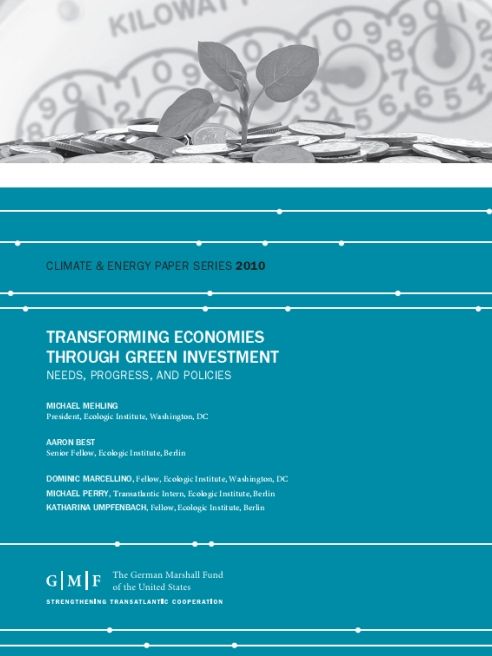
Mehling, Michael et al. 2010: Transforming Economies through Green Investment: Needs, Progress and Policies. [GMF Climate & Energy Paper Series 2010]. Washington DC: German Marshall Fund of the United States.
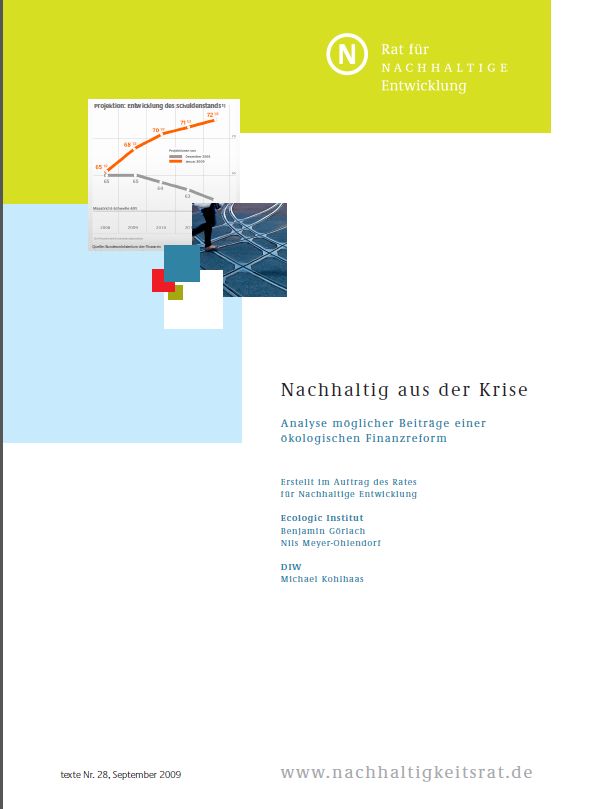
Görlach, Benjamin; Nils Meyer-Ohlendorf; Michael Kohlhaas 2009: Nachhaltig aus der Krise. Analyse möglicher Beiträge einer ökologischen Finanzreform.