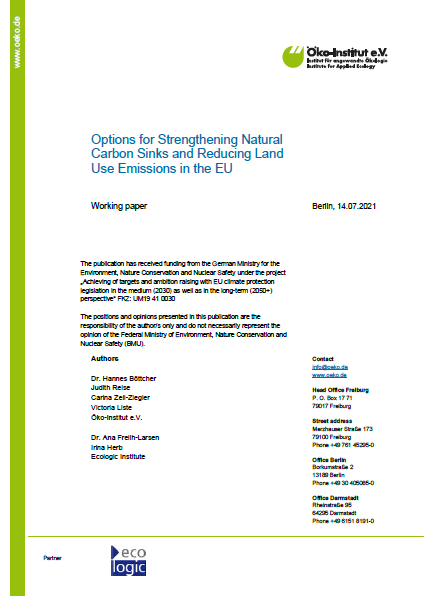
Options for Strengthening Natural Carbon Sinks and Reducing Land Use Emissions in the EU
Working paper
- Publication
- Citation
Böttcher, Hannes et. al. 2021: Options for Strengthening Natural Carbon Sinks and Reducing Land Use Emissions in the EU. Working paper. Freiburg, Berlin: Oeko Institute, Ecologic Institute.
The European commission is pursuing a zero emission target by 2050. The special report of the IPCC shows that in many scenarios the atmospheric concentration of GHG will exceed the necessary limits in order to meet the temperature target. In consequence, this will require not only net-zero but net negative emissions. Thus, carbon sinks play a crucial role in reaching the targets. Here, the land-use sector has a special position as it creates GHG emissions and provides Co2 removals at the same time. Its contribution to GHG neutrality in the future requires a long-term net-negative balance of both terms.
The working paper by Öko-Institut e.V. and Ecologic Institute demonstrates the complexity involved in assessing and managing mitigation potential of carbon sinks in the land-use sector in the EU. This complexity also means that many different policy areas and instruments have a direct bearing on the state and future development of carbon sinks. The working paper ends with four identified messages and required steps to translate the results into policies.
In order to identify and assess options for strengthening natural carbon sinks and reducing land use emissions in the EU, this working paper conducts analysis of EU and National Inventory Reports and Common Reporting Framework tables as well as scientific literature. Selective expert interviews were carried out. The options were selected by their mitigation potential, ensuring the availability of larger scale assessments in literature and representing across land-use categories. This included both rather well documented options such as increasing forest area and restoration of forests and organic soils, and comparatively new options, like protection and restoration of marine ecosystems.
The seven mitigation options explored represent the wide range of opportunities that exist to mitigate climate change and generate benefit for other ecological and societal targets. All mitigation measures will to some degree require substantial management changes, and they are in direct or indirect conflict with each other or different land uses such as expanding settlements in terms of demand for land.
The study demonstrates the complexity involved in assessing and managing carbon sinks in the land use sector in the EU. This complexity also means that many different policy areas and instruments have a direct bearing on the state and future development of carbon sinks. Environmental and socio-economic co-benefits are largely underrepresented in available assessments. The future sequestration potential depends heavily on the ability to withstand climate risks. Therefore, policies on maintaining and enhancing sinks should proceed cautiously to ensure that mitigation potential of carbon sinks is not overestimated and to avoid overreliance on carbon sinks as a climate mitigation strategy.
Contact