
Photo: Canva.com
Legal Personhood for Sea Ice
An interview with Arne Riedel on new approaches to protecting the Arctic
- Presentation
- Date
-
- Location
- Berlin, Germany
- Interview
-
Rebecca Stegmann (FAZ)
Arctic sea ice is disappearing rapidly – with consequences for ecosystems, global climate processes and the people living in the region. At the same time, economic activities in the Arctic are increasing, including shipping, fisheries and resource extraction.
In the science section of the Frankfurter Allgemeine Sonntagszeitung, Arne Riedel, a lawyer at Ecologic Institute and expert on Arctic governance, commented on current debates about the protection of Arctic sea ice. The article explores new legal ideas for protecting the Arctic – including the discussion of whether nature, such as Arctic sea ice, could be granted its own rights.
New ideas for protecting the Arctic
The debate builds on international developments in which natural entities have been recognised as legal subjects. In some countries, rivers, forests or lagoons already have legal rights and can therefore be protected more effectively. The idea behind this approach is that if nature is recognised as a legal subject, its interests – such as the protection of its ecosystem – can be represented more effectively in legal processes.
A “patchwork” of existing regulations
In the article, Arne Riedel explains how the protection of the Arctic is currently regulated in legal terms. He describes the existing framework as a “patchwork of international and national approaches”. These include the International Maritime Organization’s Polar Code, which has set safety requirements for shipping in polar waters since 2017, as well as international agreements to prevent unregulated fishing in the central Arctic Ocean. National measures also play a role, such as protected areas for particularly sensitive sea-ice regions.
New international instruments
Further progress may result from new international agreements. In early 2025, the UN High Seas Treaty entered into force. For the first time, it allows the establishment of protected areas in international waters – including in the central Arctic Ocean. However, the procedures for deciding on such protected areas still need to be worked out in detail.
Open questions regarding the rights of nature
Whether Arctic sea ice could actually be granted its own rights remains uncertain. In addition to political challenges, practical questions arise, such as who would represent such rights and before which courts they could be asserted.
Climate protection remains decisive
Regardless of new legal approaches, global climate protection remains crucial for the future of Arctic sea ice. Rising temperatures are causing the ice to shrink steadily – with far-reaching consequences for the Arctic ecosystem and beyond.
Contact

- Event
- Interview
-
Rebecca Stegmann (FAZ)
- Date
-
- Location
- Berlin, Germany
- Language
-
German
- Keywords
-
Arctic governance, polar law, international maritime policy, marine conservation, protection of Arctic ecosystems, governance of international waters, natural rights, international environmental policy, environmental law relating to the seas, Arctic climate policyArctic, Arctic Ocean, Central Arctic, polar regions, international waters, EuropePolicy analysis, legal analysis, governance analysis, scientific policy evaluation, analysis of international agreements
Implementing Legislation for the BBNJ Agreement
- Duration
-
-
- Funding
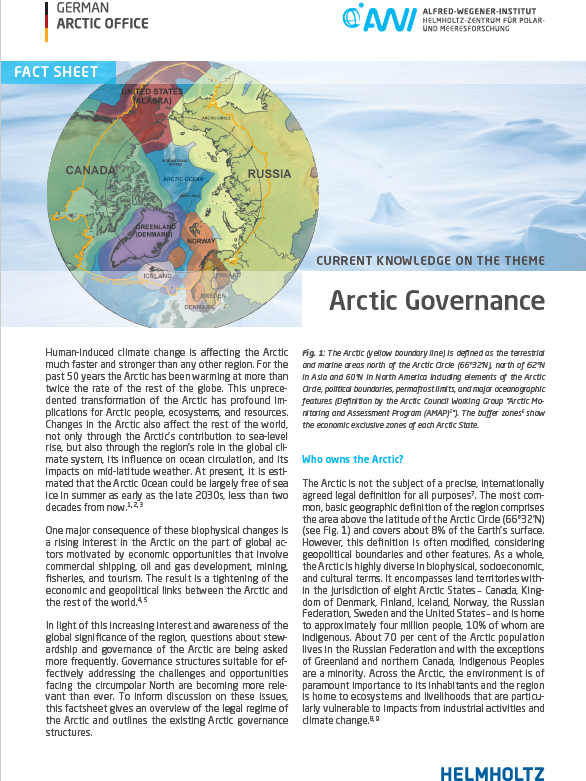
Alken, K., Smieszek, M., Riedel, A., Rachold, V., Grosfeld, L. 2020: Arctic Governance. Current Knowledge on the Theme. Fact Sheet by German Arctic Office at the Alfred Wegener Institute, Helmholtz Centre for Polar und Marine Research, Potsdam.
Dynamic Protection and Adaptive Management – Arctic marine protection facing climate change (DynArc)
- Duration
-
-
- Funding
-
Federal Agency for Nature Conservation (BfN), Germany
Interview:Klimakrise: So ändert sich die Arktis
- Date
-
- Location
- Berlin, Germany