
Co-production of Climate Services
Lessons from Policy to Practical Actions
- Presentation
- Date
-
- Location
- online
- Speech
The fifth edition of the Climateurope2 Webstival once again brought together a diverse community of experts, practitioners, and policymakers to discuss the further development of climate services in Europe. A key highlight was the session on co-production of climate services, held on 15 April 2026. Dr. Grit Martinez contributed with a keynote presentation titled "Co-production of Climate Services: Lessons from Policy to Practical Actions".
Climate services between science and policy
Climate services operate at the intersection of science and policy. They are fundamentally science-based, drawing from disciplines such as climate science and meteorology, and grounded in observations, models, and data analysis. Policy frameworks strongly shape them, determining how scientific knowledge translates into practical applications. Both domains must interact to achieve their full impact.
Standards as a link between knowledge and implementation
This interaction is also reflected in the standardisation of climate services. While standards are largely developed through scientific processes, they are formalised and implemented through policy instruments. Policy thus acts as a bridge between knowledge and action by providing guidance, rules, and principles for decision-making. A key challenge remains to ensure that standards are applicable across different policy contexts and local decision-making environments.
Why co-production matters
Dr. Martinez emphasised that co-production is a key approach to addressing this challenge. It is inherently context-sensitive and goes beyond the mere provision of data. Instead, it focuses on aligning knowledge with real-world decision-making processes and governance structures. Co-production involves a wide range of actors, from scientists and policymakers to stakeholders and end users. Governance-sensitive design, which considers legal, institutional, and social conditions, is a crucial prerequisite for effectively applying climate knowledge.
Insights from practice: survey results
A 2024 survey conducted in 13 European countries, including Germany, France, Spain, and Sweden, gave useful insights into current practice. The results show that climate information is already being used, with more respondents indicating they use it “often” or “occasionally” than not at all. At the same time, a relatively high number of non-responses points to existing uncertainties and knowledge gaps. Many actors are already involved in the use and development of climate services, indicating active co-production processes. Key motivations for engagement include:
- Training and capacity building
- Co-creation
- Development of practical tools and products
Standards in practice
The survey also highlights strong recognition of the importance of standards for climate mitigation and adaptation. Around half of respondents are aware of standardised approaches in their work environment. However, awareness and application of specific standards, such as ISO 14091:2021 and ISO 14092:2020, remain significantly lower. This indicates a gap between general awareness and practical implementation.
Key takeaways from the session
- Climate information is already actively used.
- Significant knowledge gaps and uncertainties remain.
- Standards are widely recognised as important.
- Key stakeholder groups are involved in co-production processes.
- Co-production enhances trust, shared understanding, and usability.
An interactive discussion with participants from science, policy, and European authorities further deepened these points and once again highlighted the importance of collaboration.
Contact

- Event
-
Climateurope2 Webstival: Fifth edition, Climate Services Standardisation: Emerging Developments in AI and Co-Production
- Organizer
-
Barcelona Supercomputing Center (BSC-CNS), Spain Euro-Mediterranean Centre on Climate Change (CMCC), Italy The Royal Netherlands Meteorological Institute (KNMI), Netherlands Swedish Meteorological and Hydrological Institute (SMHI), Sweden Marine Information Service (MARIS), Netherlands Republic Hydrometeorological Service of Serbia (RHMZ), Serbia University of Bremen (UBremen), Germany German Climate Computing Center (DRKZ), Germany Helmholtz-Zentrum hereon (hereon), Germany Fraunhofer-Gesellschaft zur Förderung der angewandten Forschung (Fraunhofer-Gesellschaft), Germany Technical University of Denmark (DTU), Denmark LGI Consulting (LGI), France the climate data factory (tcdf), France World Meteorological Organization (WMO), International WSB University in Poznań (WSB), Poland Wageningen University (Wageningen UR), Netherlands Deltares, Netherlands Center for the Promotion of Science Center for the Promotion of Science (CPN), Serbia Technische Universität München (TUM), Germany EIT Climate-KIC, International Ramboll Management Consulting (REH), France Ramboll Management Consulting (RMC), Belgium webLyzard technology, Austria European Centre for Medium-Range Weather Forecasts (ECMWF), International Deutsches Institut für Normung (DIN), Germany DNV, Norway Ecologic Institute, Germany - Speech
- Date
-
- Location
- online
- Language
-
English
- Project
- Project ID
- Keywords
-
Climate adaptation, climate services, climate risks, evidence-based policy, decision support, climate data integration, resilience strategies, adaptation planning, climate governance, knowledge integration, climate policy advice, user-centred approach, impact-oriented research, climate information systems, transformation processesEuropeCo-design, stakeholder engagement, participatory approaches, transdisciplinary research, mixed methods, survey analysis, qualitative interviews, quantitative data analysis, case study analysis, policy analysis, governance analysis, best practice approaches, capacity building, monitoring and evaluation
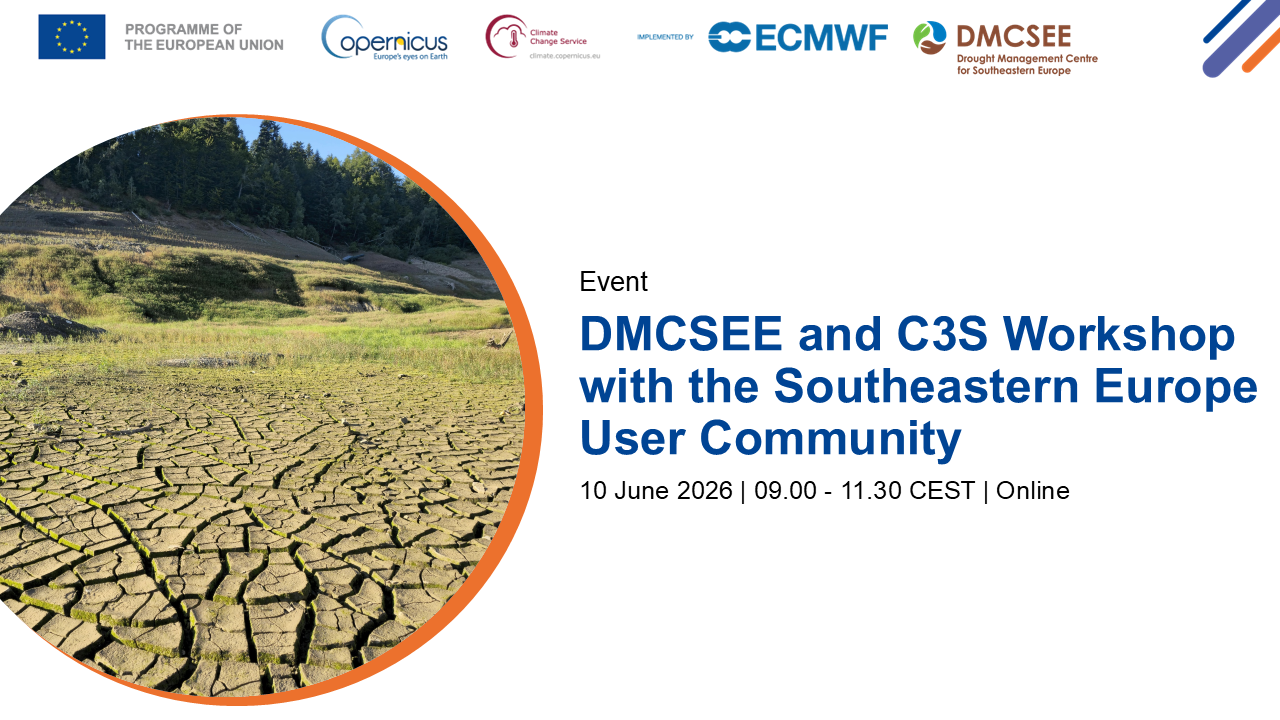
Digital Event:DMCSEE and C3S Joint Workshop with the Southeastern European User Community
- Date
-
- Location
- online
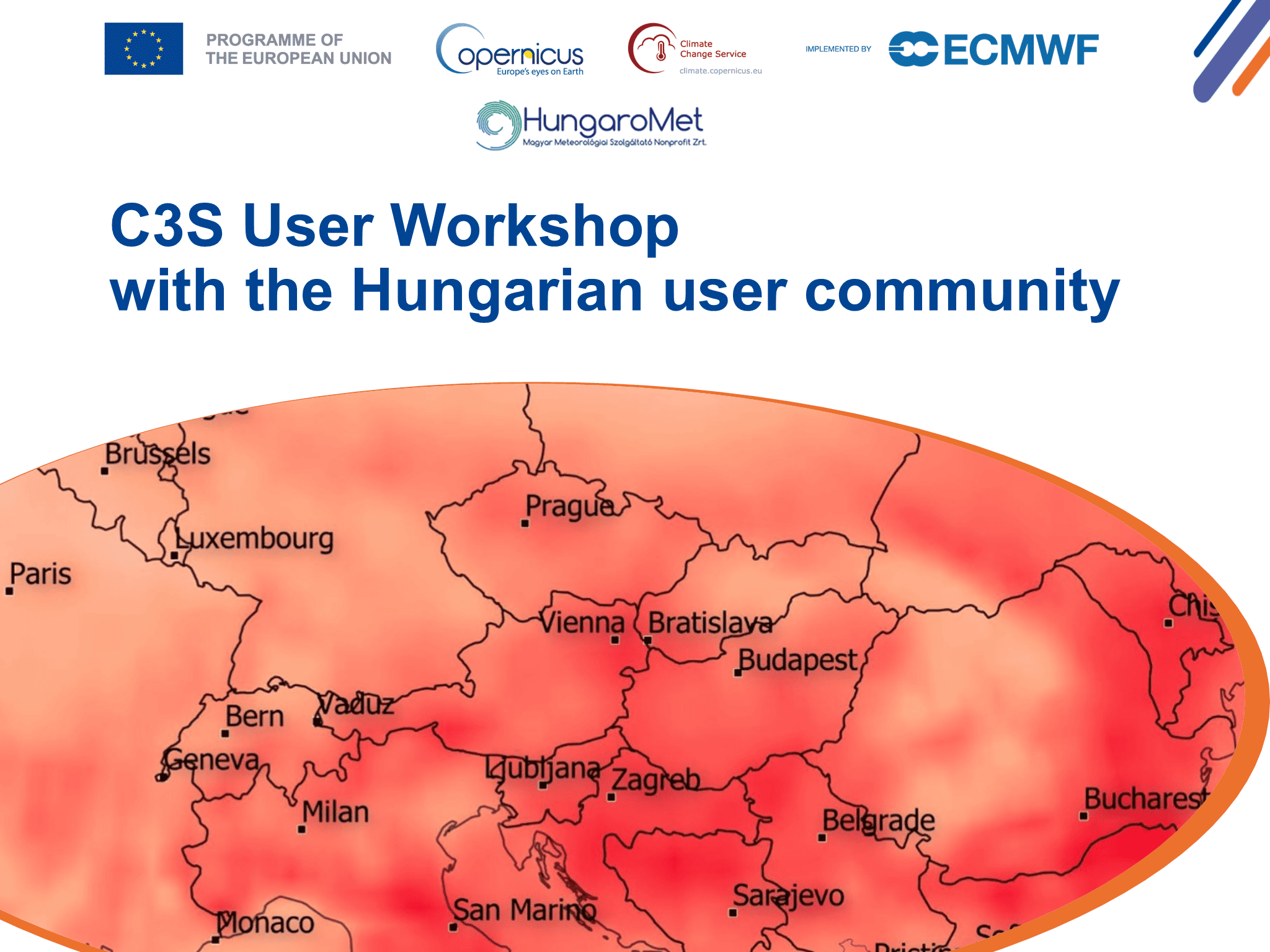
Workshop:C3S User Workshop with the Hungarian User Community
- Date
-
- Location
- Budapest, Hungary
Enhancing User Intelligence: Targeted User Uptake for C3S
- Duration
-
-
- Funding
-
European Centre for Medium-Range Weather Forecasts (ECMWF), International
McGlade K.; Tröltzsch J.; Burgos Cuevas, N.; Tarpey, J., Peña, N.; Tangney P.; Strout, J.M.; van der Horst, S.; Van Veldhoven F.; Mysiak, J.; Endendijk, T.; Winter, G.; Brolsma R. (2025). D3.5 Guidelines for climate service tools. Deliverable of Horizon 2020 project REACHOUT.
Tarpey, J., McGlade, K.; Tröltzsch, J.; Burgos Cuevas, N.; Peña, N.; Zorita Castresana, S.; McCullagh, D.; Strout, J.M.; van der Horst, S.; Boon, E.; Goosen, H.; Staccione, A.; Mysiak, J.; Endendijk, T.; Winter, G.; Rooze, D.; Wright, S.J.; Langendijk, G.; Czachowska, A. (2025). D3.7 Guidelines for climate service tools. Deliverable of Horizon 2020 project REACHOUT.
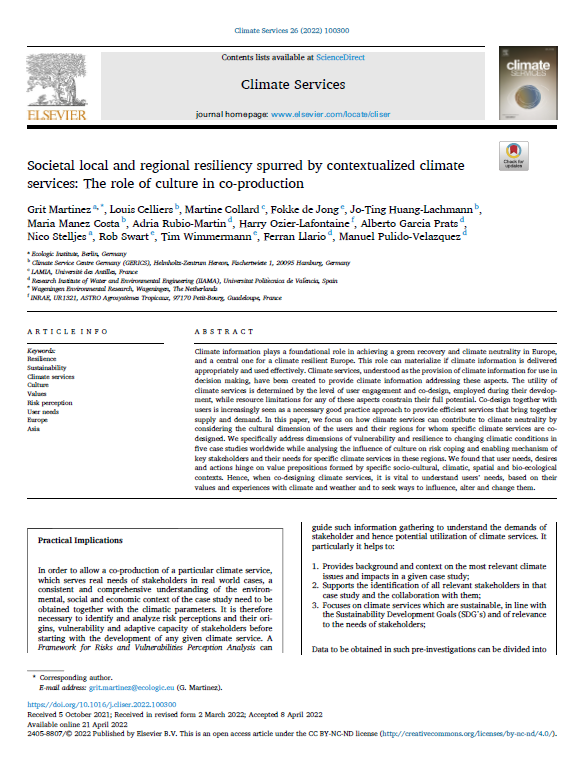
Martinez, G., Celliers, L., Collard, M., de Jong, F., Huang-Lachmann, J.-T., Manez Costa, M., Rubio-Martin, A., Ozier-Lafontaine, H., Garcia Prats, A., Stelljes, N., Swart, R., Wimmermann, T., Llario, F., Pulido-Velazquez, M. (2022). Societal local and regional resiliency spurred by contextualized climate services: The role of culture in co-production. Climate Services, 26, 100300. https://doi.org/10.1016/j.cliser.2022.100300
Swart, Rob et al.: Reframing climate services to support municipal and regional planning, Climate Service (2021). https://doi.org/10.1016/j.cliser.2021.100227
Innovation in Climate Services Provision (INNOVA)
- Duration
-
-
- Funding
-
Federal Ministry of Education and Research (BMBF), Germany

Speech:Equitability in and of Climate Services
- Date
-
- Location
- online