
Systemic and Complex Risk Governance for Europe’s Preparedness and Sustainability
Environmental risk drivers and transformative governance responses in Europe
- Publication
- Citation
Durrant, L.J., Bognar, J., Tremblay, L.L., Best, A., and Iwaszuk, E. (2026). ‘Systemic and Complex Risk Governance for Europe’s preparedness and sustainability’. Institute for European Environmental Policy & Ecologic Institute
Europe faces a growing challenge: environmental risks are becoming more interconnected, more difficult to anticipate and harder to manage through conventional sector-based governance. Climate change, biodiversity loss, pollution, land degradation and resource pressures can interact with economic, social, technological and political dynamics, creating cascading and compounding effects across society.
The report Systemic and Complex Risk Governance for Europe’s Preparedness and Sustainability examines how these risks affect Europe’s resilience, preparedness and long-term sustainability. Commissioned by the European Environment Agency (EEA), the report was prepared by the Institute for European Environmental Policy (IEEP) and Ecologic Institute. It supports the EEA’s work on systemic environmental risk governance and contributes to current EU policy discussions on preparedness, climate resilience and sustainability.
Understanding systemic environmental risks
The report focuses on systemic and complex risks stemming from the triple planetary crisis – climate change, biodiversity loss and pollution – alongside land and resource degradation. These risks do not remain confined to one place, sector or policy field. A disruption in one system can amplify vulnerabilities elsewhere, with consequences to food security, energy systems, ecosystems, financial stability, public health and social wellbeing.
The report shows that risks across these systems are strongly connected. Water, land, ecosystem services and infrastructure dependencies repeatedly emerge as pathways through which risks spread. This means that competitiveness, resilience and preparedness cannot be treated as separate policy agendas; they increasingly depend on whether institutions can recognise and govern interdependencies across systems.
Methods and key outputs
The report identifies and characterises systemic environmental risks, explores how they interact across societal systems, and analyses governance approaches that can respond to them. It introduces risk constellations as a practical way to discuss complex risk interactions. This approach allows experts and policymakers to map drivers, magnifiers and impacts at a manageable scale while still keeping sight of the wider system in which risks unfold. The report also explains an innovative risk playing card methodology that helps experts prioritise systemic environmental risks, build risk constellations and map cascading and compounding interactions across key societal and ecological systems.
The report includes 20 risk fiches documenting selected systemic environmental risks in terms of drivers, affected systems, impact pathways, magnitude, likelihood, uncertainty, timescale, geographical scope, unequal impacts and links to other risks. It also includes system network diagrams showing cascading and compounding risk dynamics as well as case study analysis of governance responses across different levels and contexts.
Findings for governance and preparedness
A central finding is that systemic environmental risk governance requires methods that simplify complexity without distorting it. As risks become more interconnected, experts and institutions face what the report describes as a “complexity ceiling”: it becomes harder to maintain a clear overview of how risks interact and where intervention is needed. The report therefore highlights the need for practical tools that help decision-makers understand risk pathways before crises escalate.
The report identifies three broad governance priorities:
- Environmental dependencies should be addressed more explicitly in industrial, energy and food-system policies.
- Cross-system institutional capacity and coordination need to be strengthened.
- Anticipatory governance capacities should be reinforced through tools and methods that help institutions act under uncertainty.
Preparedness depends not only on better information, but also on clearer responsibilities, stronger institutional capacity and governance arrangements that can work across sectors, scales and time horizons.


Contact

- Language
-
English
- Authorship
- Credits
The authors gratefully acknowledge the inputs from the panel of interdisciplinary experts that provided their time and expertise to the report. They also like to thank Lorenzo Benini and Henrik Larsen at the European Environment Agency for their input, feedback, and continued support and trust. Finally, the authors acknowledge the work and contributions of Irene Chiocchetti, Elisabet Nadeu, Laure-Lou Tremblay, Isabella Wedl, and Krystyna Springer.
- Funding
-
European Environment Agency (EEA), International - Published by
-
Institute for European Environmental Policy, Brussels (IEEP), Belgium Ecologic Institute, Germany - Year
- Dimension
- 273 pp.
- Project
- Project ID
- Table of contents
-
Click to show full table of contents
- Keywords
-
systemic risk, complex risk governance, environmental risk, climate risk, biodiversity loss, pollution, land degradation, resource degradation, preparedness, resilience, EU policy, governance in complexity, risk constellations, cascading risks, compounding risks, food systems, energy transition, financial systems, ecosystems, water stress, drought, ecosystem servicesEurope, EEA countries, EU, Netherlands, France, Poland, Spain, IrelandTargeted literature review, risk database, risk fiches, expert workshops, risk prioritisation, risk constellations, system network diagrams, case study analysis, semi-structured interviews, governance framework analysis, system network diagrams
Burgos Cuevas, Natalia et al. (2025): Moving from interconnected crises to systemic solutions. Resource efficiency, nature-based solutions, and systemic transformation as responses to the complexity of the triple planetary crisis. Fact sheet. German Environment Agency: Dessau-Roßlau. https://doi.org/10.60810/openumwelt-8102.
Felthöfer, C., Knoblauch, D., & Best, A. (2025). The interconnected challenges of climate change, biodiversity loss and environmental pollution: Drivers, interdependencies and impacts of the triple planetary crisis (Fact sheet). German Federal Agency. https://doi.org/10.60810/openumwelt-8070
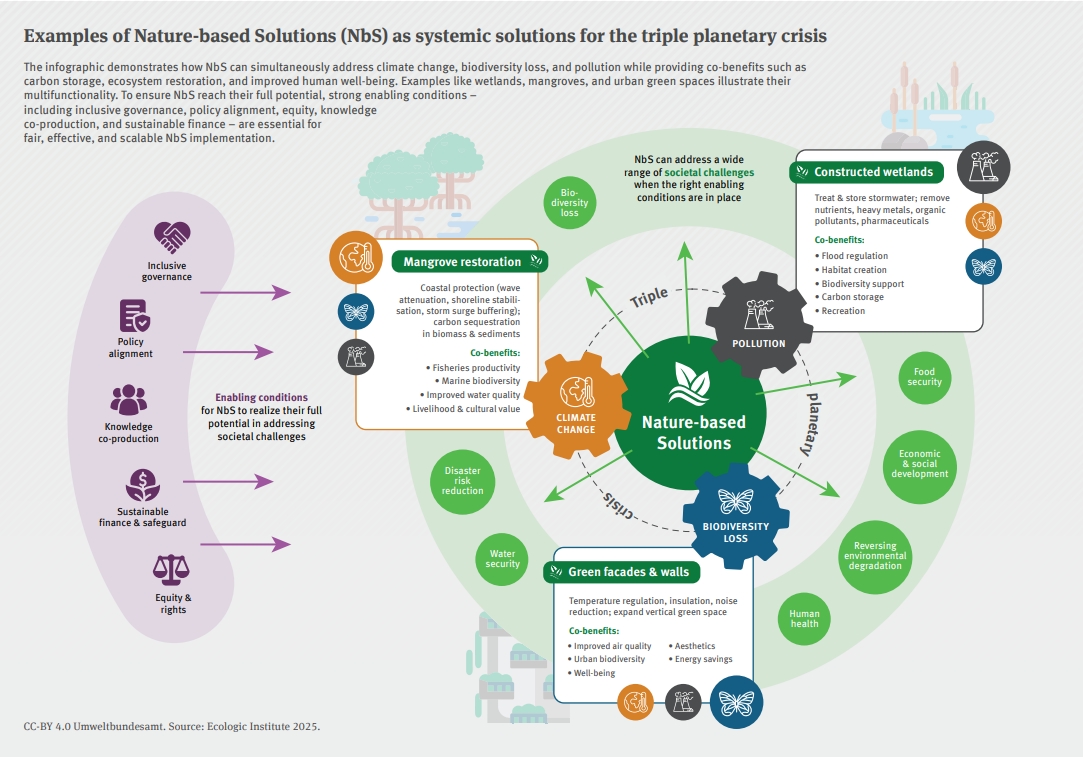
Umweltbundesamt 2025: Examples of nature-based solutions as systemic solutions for the triple planetary crisis. Infographic.