
© Ecologic Institute, 2025
Integrated Approaches to the Triple Planetary Crisis
Reports, fact sheets and infographics on drivers, impacts and pathways for action
- News
- Date
-
- Location
- Berlin, Germany
Climate change, biodiversity loss and environmental pollution rank among the most pressing global challenges of our time. The research project "Challenges for International Climate Protection in the Face of the Global Triple Crisis", commissioned by the German Environment Agency (UBA), now presents a series of reports, fact sheets and infographics that systematically analyse these challenges as a single, interconnected crisis.
The publications examine the shared drivers and feedback loops of the triple planetary crisis, highlight social and ecological risks, and identify integrated policy approaches that can create synergies between climate action, biodiversity conservation and the reduction of environmental pollution.
The overview below summarises the key findings of the individual publications and situates them thematically.
The Triple Planetary Crisis as a Systemic Challenge
Key findings of the project demonstrate that climate change, biodiversity loss and environmental pollution are driven by shared underlying causes, including unsustainable production and consumption patterns, overexploitation of natural resources, land-use change and structural inequalities. Through reinforcing feedback loops and cascading effects, the three crises exacerbate one another, increasing risks to ecosystems, human health and socio-economic stability.
The report "The Interconnected Challenges of Climate Change, Biodiversity Loss and Environmental Pollution" provides a systematic analysis of the drivers, interdependencies and impacts of the triple planetary crisis. It shows why sector-specific, isolated measures are insufficient and why integrated and socially just strategies are required to respect planetary boundaries and strengthen long-term resilience.
Unequal Impacts and Social Dimensions
The analyses reveal that the impacts of the triple planetary crisis are unevenly distributed across regions and social groups. Particularly affected are Most Affected People and Areas (MAPA), including Indigenous communities, women, young people, low-income populations, migrants and countries of the Global South. Despite their high levels of exposure, these groups often have limited political influence and constrained adaptive capacities.
These social and distributive dimensions are examined in particular in the fact sheet "The Interconnected Challenges of Climate Change, Biodiversity Loss and Environmental Pollution”. It highlights the close interlinkages between ecological crises and social inequalities and demonstrates why integrated responses must systematically incorporate considerations of social justice.
International Experience with Integrated Policy Approaches
How integrated strategies are implemented in practice is explored in the report "Integrated Approaches to Addressing the Triple Planetary Crisis: Country Best Practices". Based on case studies from Brazil, Colombia, Japan, New Zealand, Panama, Rwanda and Sweden, the report analyses how climate, biodiversity and pollution policies are aligned within national strategies.
The findings show that many countries are already pursuing integrated approaches, for example through nature-based solutions, circular economy strategies or ecosystem-based planning. At the same time, significant implementation barriers persist, particularly with regard to institutional coordination, financing, data availability and administrative capacity. The report therefore underscores the importance of coherent governance frameworks and better-aligned policy and financing systems.
From Interconnected Crises to Systemic Solutions
The interim report "Moving from Interconnected Crises to Systemic Solutions" develops an integrated analytical framework that centres on three mutually reinforcing pathways:
- governance of resource use based on efficiency, sufficiency and equity,
- the targeted scaling-up of nature-based solutions (NbS) to restore ecosystems, reduce emissions and curb environmental pollution,
- and systemic transformations of governance structures, markets and societal values to strengthen resilience and social justice.
The analysis concludes that the triple planetary crisis can only be effectively addressed through systemic, cross-sectoral and equity-oriented approaches.
Two Fact Sheets: From Crisis Analysis to Systemic Pathways
The project's key findings are synthesised in two complementary fact sheets, which offer distinct but interlinked perspectives on the triple planetary crisis.
The fact sheet "The Interconnected Challenges of Climate Change, Biodiversity Loss and Environmental Pollution" analyses the causes, interdependencies and impacts of the crisis. It explains why climate change, biodiversity loss and environmental pollution must be understood as a systemically interconnected challenge shaped by shared drivers such as resource use, land-use change and structural inequalities. Clear and accessible infographics illustrate feedback loops, cascading risks and impacts on ecosystems, human health and socio-economic stability.
Complementing this analysis, the fact sheet "Moving from Interconnected Crises to Systemic Solutions – Resource Efficiency, Nature-based Solutions, and Systemic Transformation as Responses to the Complexity of the Triple Planetary Crisis” focuses on pathways for action. It shows that addressing the triple planetary crisis requires systemic, cross-sectoral and justice-oriented strategies, combining resource efficiency, nature-based solutions and systemic transformation into a coherent response commensurate with the scale and urgency of the challenge.
Key Findings Visualised: Fact Sheets and Infographics
In addition to the reports, fact sheets and an infographic series have been developed to visually convey the central drivers, feedback loops, impacts and solution pathways of the triple planetary crisis. The infographics include:
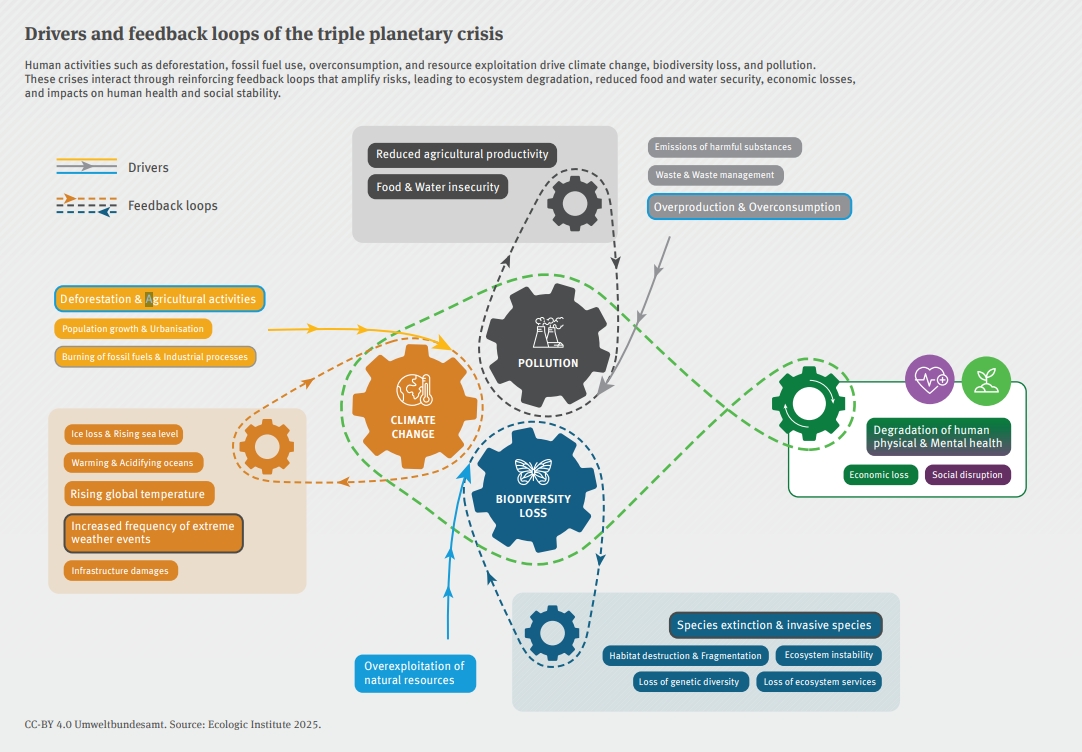
- Drivers and feedback loops of the triple planetary crisis
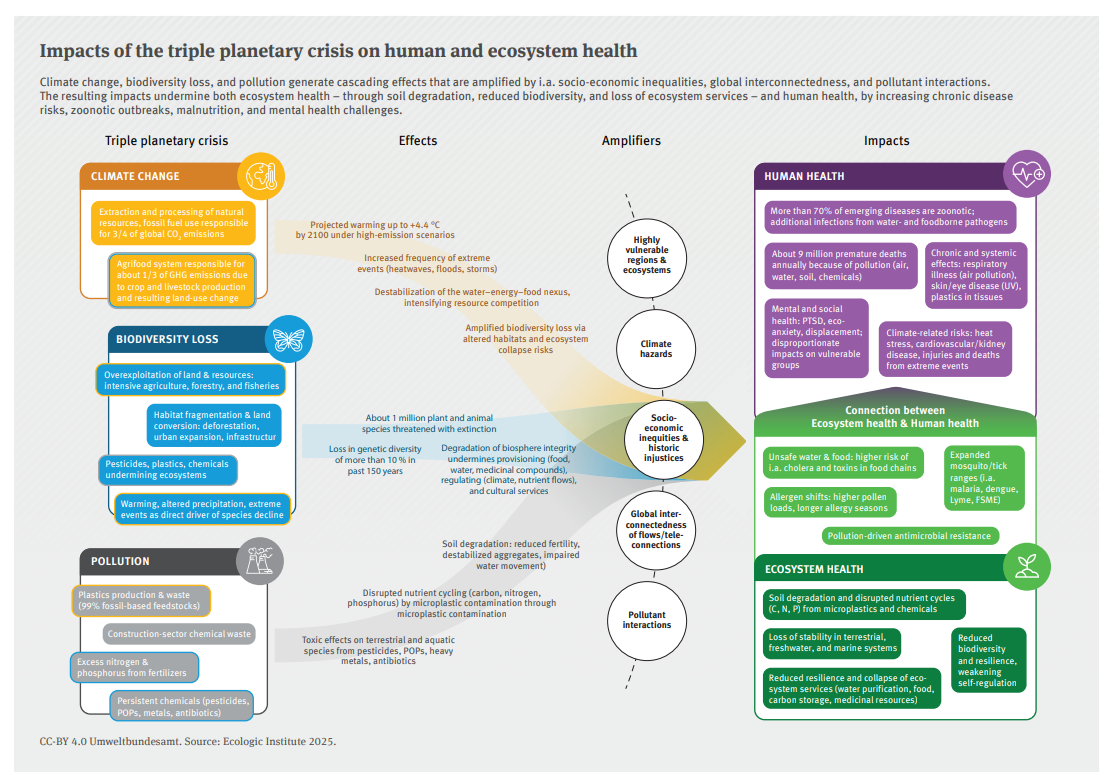
- Impacts of the triple planetary crisis on human and ecosystem health
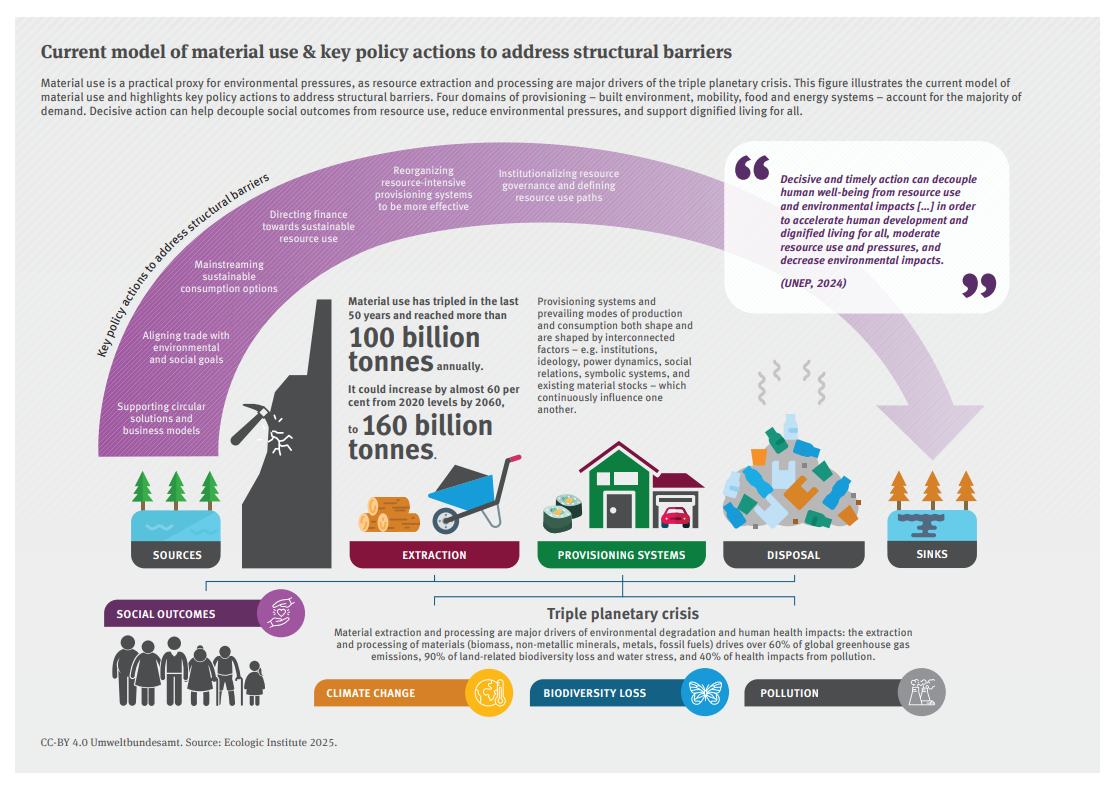
- Current model of material use & key policy actions to address structural barriers
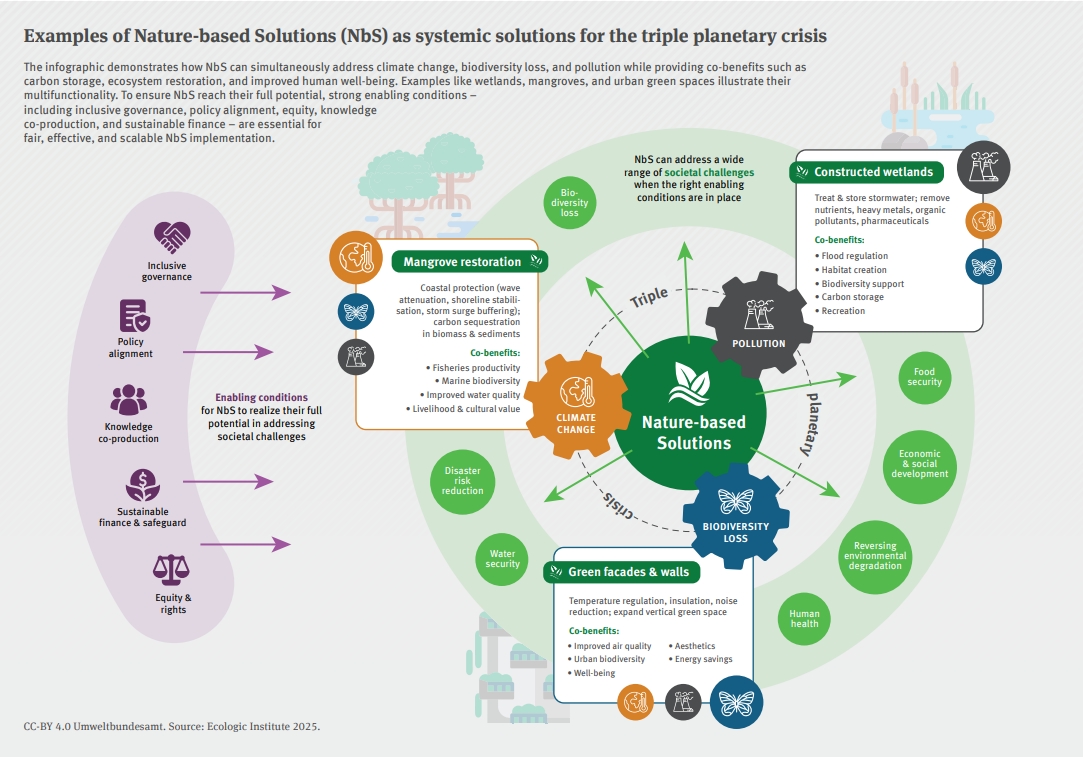
- Examples of nature-based solutions as systemic solutions for the triple planetary crisis
They provide a clear overview of systemic risks and integrated policy options, supporting informed decision-making in policy, research and practice.
Contribution to International Environmental and Climate Policy
The project’s findings make an important contribution to advancing integrated approaches in international environmental and climate policy. They support the alignment of climate action, biodiversity conservation and pollution reduction within existing global frameworks such as the Paris Agreement and the 2030 Agenda for Sustainable Development, thereby strengthening the negotiating positions of Germany and the European Union at the international level.


Contact

- Funding
-
German Environment Agency (UBA), Germany - Team
-
Natalia Burgos CuevasYannick Heni
- Date
-
- Project
- Project ID
- Keywords
-
triple planetary crisis, climate change, biodiversity loss, environmental pollution, planetary boundaries, ecological resilience, ecological tipping points, sustainable development, systemic environmental crises, environmental governance, integrated environmental policy, cross-sectoral approaches, synergies between climate protection and biodiversity, environmental and climate policy, social inequality, Most Affected People and Areas, MAPA, human health and the environment, socio-economic impacts, international environmental policy, sustainable transformation, international climate policy, international environmental policy, global environmental governance, United Nations, UN Environment Programme, UNEP, Paris Agreement, Agenda 2030, Sustainable Development Goals, SDGs, G7, G20, indigenous communitiesGermany, Europe, Brazil, Colombia, Japan, New Zealand, Panama, Rwanda, Sweden, Global South, small island statesIntegrated analysis, systemic analysis, cross-sectoral analysis, policy analysis, comparative country analysis, case study analysis, governance analysis, feedback loop analysis, planetary boundaries analysis, institutional coherence assessment, policy strategy analysis, qualitative analysis, interdisciplinary research approach, nature-based solutions, NbS, circular economy, resource-efficient policy approaches, sufficiency, efficiency, systemic transformation, ecosystem-based approaches
Knoblauch, D., Felthöfer, C., Heni, Y., Burgos Cuevas, N., & Best, A. (2025). The Interconnected Challenges of Climate Change, Biodiversity Loss and Environmental Pollution: Drivers, Interdependencies and Impacts of the Triple Planetary Crisis. Interim report, Climate Change 82/2025. German Federal Agency. https://doi.org/10.60810/openumwelt-8107.
Burgos Cuevas, Natalia et al. (2025): Moving from interconnected crises to systemic solutions. Resource efficiency, nature-based solutions, and systemic transformation as responses to the complexity of the triple planetary crisis. German Environment Agency: Dessau-Roßlau. https://doi.org/10.60810/openumwelt-8108.
Iwaszuk, E.; Spantzel, T.; Kroos, F.; Knoblauch, D. (2025): Integrated Approaches to Addressing the Triple Planetary Crisis: Country Best Practices. Lessons learned from Brazil, Colombia, Japan, New Zealand, Panama, Rwanda and Sweden. Policy paper. Climate Change 81/2025, German Environment Agency: Dessau-Roßlau. https://doi.org/10.60810/openumwelt-8106
Burgos Cuevas, Natalia et al. (2025): Moving from interconnected crises to systemic solutions. Resource efficiency, nature-based solutions, and systemic transformation as responses to the complexity of the triple planetary crisis. Fact sheet. German Environment Agency: Dessau-Roßlau. https://doi.org/10.60810/openumwelt-8102.
Felthöfer, C., Knoblauch, D., & Best, A. (2025). The interconnected challenges of climate change, biodiversity loss and environmental pollution: Drivers, interdependencies and impacts of the triple planetary crisis (Fact sheet). German Federal Agency. https://doi.org/10.60810/openumwelt-8070
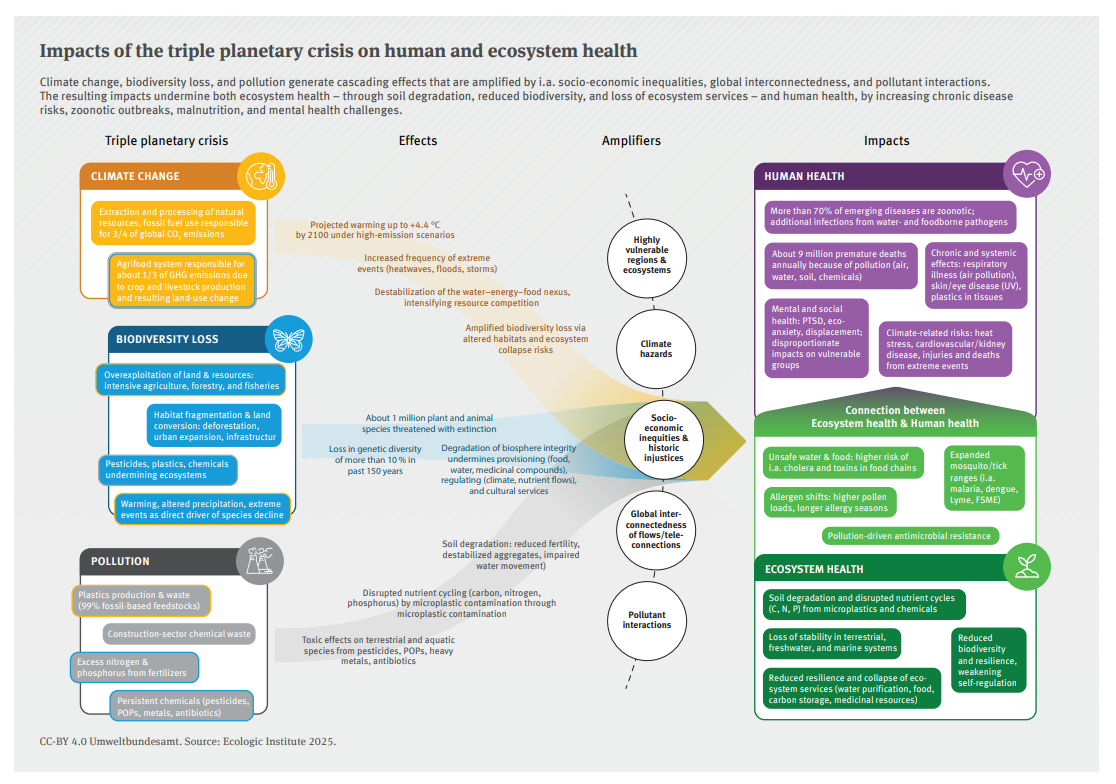
Impacts of the Triple Planetary Crisis on Human and Ecosystem Health
|CC-BY 4.0 Umweltbundesamt. Source: Ecologic Institute 2025.
Umweltbundesamt 2025: Impacts of the Triple Planetary Crisis on Human and Ecosystem Health. Infographic.
Umweltbundesamt 2025: Examples of nature-based solutions as systemic solutions for the triple planetary crisis. Infographic.
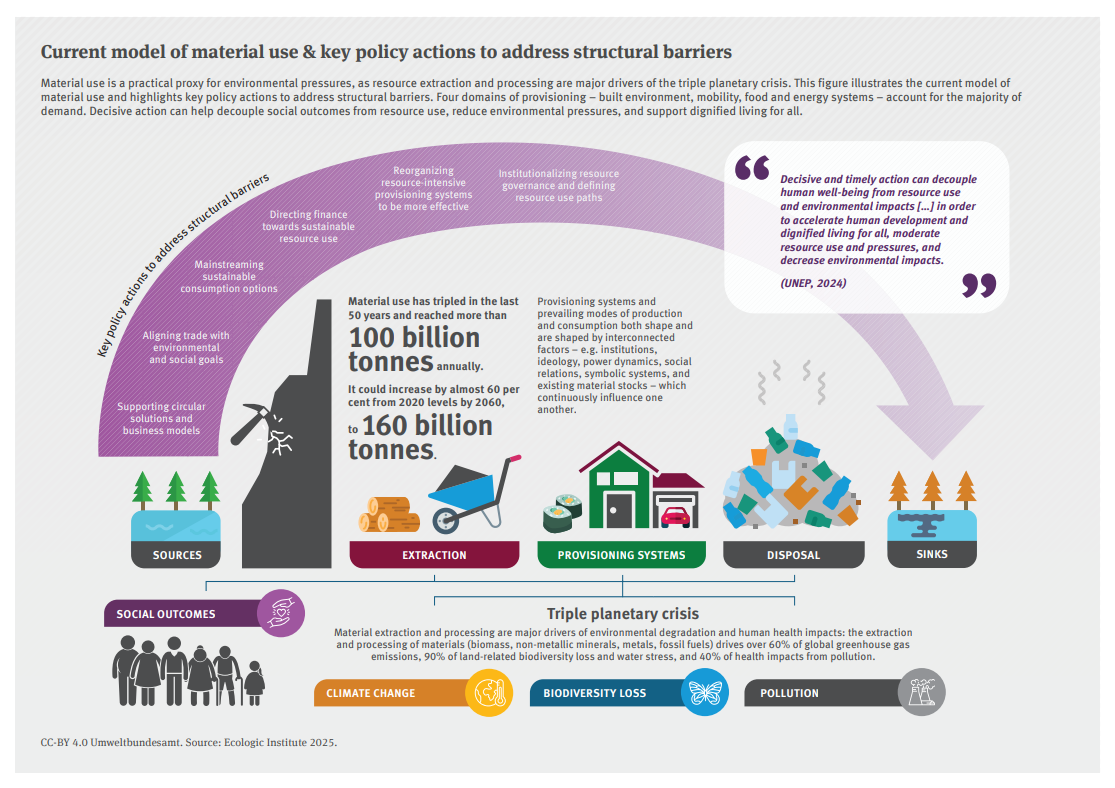
Current model of material use & key policy actions to address structural barriers
|CC-BY 4.0 Umweltbundesamt. Source: Ecologic Institute 2025.
Umweltbundesamt 2025: Current model of material use & key policy actions to address structural barriers. Infographic.
Umweltbundesamt 2025: Drivers and feedback loops of the triple planetary crisis. Infographic.