© IEEP, Ecologic Institute, 2026
Systemic and Complex Risk Governance for Europe’s Preparedness and Sustainability
Environmental risk drivers and transformative governance responses in Europe
- Project
- Duration
-
-
Europe’s sustainability transitions are unfolding in a period of increasing uncertainty. Climate change, biodiversity loss, pollution, land degradation, geopolitical instability and social inequalities can interact in ways that create cascading and compounding risks across society. These risks do not remain confined to individual sectors. They can affect food systems, energy and industry, ecosystems, public health, economic stability and financial systems at the same time.
Environmental Crises as Interconnected Systemic Risks
This project, commissioned by the European Environment Agency (EEA), and jointly implemented by the Institute for European Environmental Policy (IEEP) and Ecologic Institute, supports a better understanding of systemic and complex environmental risks and how they can be governed. The project contributes to Europe’s evolving policy agenda on resilience, preparedness and sustainability, including discussions linked to the EU Preparedness Strategy and the forthcoming European Climate Resilience and Risk Management Framework.
Risks Across Energy, Economic and Food Systems
The project examined how environmental risk drivers linked to climate change, biodiversity loss, pollution and environmental degradation interact across four key systems: energy transition and industrial transformation; resilient and competitive economic and financial systems; secure and sustainable food systems; and resilient ecosystems, nature protection, climate resilience and restoration.
Risks Across Energy, Economic and Food Systems
The work focused on identifying and characterising key systemic environmental risks affecting Europe, mapping how risks cascade and compound across societal and ecological systems, assessing implications for EU priorities, including competitiveness, resilience, preparedness and social fairness and analysing governance frameworks and illustrative European case studies that respond to systemic risks.
Participatory Methods for Analysing Complex Risk Constellations
The project used participatory methods to explore complexity with experts. Online workshops brought together specialists from research, policy and practice to prioritise risk drivers, develop “risk constellations” and examine how risks propagate across systems. These discussions were translated into system network diagrams and narrative pathways, including the role of water stress, drought, ecosystem degradation, land use change, pollution and biodiversity loss in shaping wider risks to Europe’s resilience and sustainability.
Innovative “Risk Playing Cards” for Systemic Risk Assessment
An innovative methodology developed and applied in the expert workshops was the use of risk playing cards, which translated environmental risk drivers from the literature review into concise, workshop-ready items showing both the affected system and the underlying risk driver. The cards supported structured, game-based expert engagement by helping participants prioritise systemic risks, build risk constellations and explore cascading and compounding interactions across food, energy, economic, financial and natural systems.
Ecologic Institute: Mapping and Characterising Systemic Environmental Risks in Europe
Ecologic Institute was part of the project consortium led by the IEEP. Ecologic Institute established the analytical foundation of the project by identifying, mapping and characterising systemic and complex risks stemming from climate and environmental change. This included developing the risk framing, conducting the targeted literature review and a prioritisation of environmental risk drivers and preparing a set of 20 systemic environmental risk fiches. Ecologic Institute also contributed to the overall methodology development, expert engagement, case study development, synthesis and final reporting across the project.
Contact

- Funding
-
European Environment Agency (EEA), International - Partner
-
Institute for European Environmental Policy, Brussels (IEEP), Belgium Ecologic Institute, Germany - Team
- Duration
-
-
- Project ID
- Keywords
-
systemic risk, triple planetary crisis, complex risk governance, environmental risk, climate risk, biodiversity loss, pollution, land degradation, resilience, preparedness, EU policy, European Environment Agency, risk constellations, cascading risks, compounding risks, governance in complexity, food systems, energy transition, financial systems, ecosystems, water stress, drought, ecosystem servicesEurope, EEA countries, EU, Netherlands, France, Poland, Spain, IrelandTargeted literature review, risk database, risk fiches, expert workshops, risk prioritisation, risk constellations, system network diagrams, case study analysis, semi-structured interviews, governance framework analysis
Knoblauch, D., Felthöfer, C., Heni, Y., Burgos Cuevas, N., & Best, A. (2025). The Interconnected Challenges of Climate Change, Biodiversity Loss and Environmental Pollution: Drivers, Interdependencies and Impacts of the Triple Planetary Crisis. Interim report, Climate Change 82/2025. German Federal Agency. https://doi.org/10.60810/openumwelt-8107.
Burgos Cuevas, Natalia et al. (2025): Moving from interconnected crises to systemic solutions. Resource efficiency, nature-based solutions, and systemic transformation as responses to the complexity of the triple planetary crisis. German Environment Agency: Dessau-Roßlau. https://doi.org/10.60810/openumwelt-8108.
Iwaszuk, E.; Spantzel, T.; Kroos, F.; Knoblauch, D. (2025): Integrated Approaches to Addressing the Triple Planetary Crisis: Country Best Practices. Lessons learned from Brazil, Colombia, Japan, New Zealand, Panama, Rwanda and Sweden. Policy paper. Climate Change 81/2025, German Environment Agency: Dessau-Roßlau. https://doi.org/10.60810/openumwelt-8106
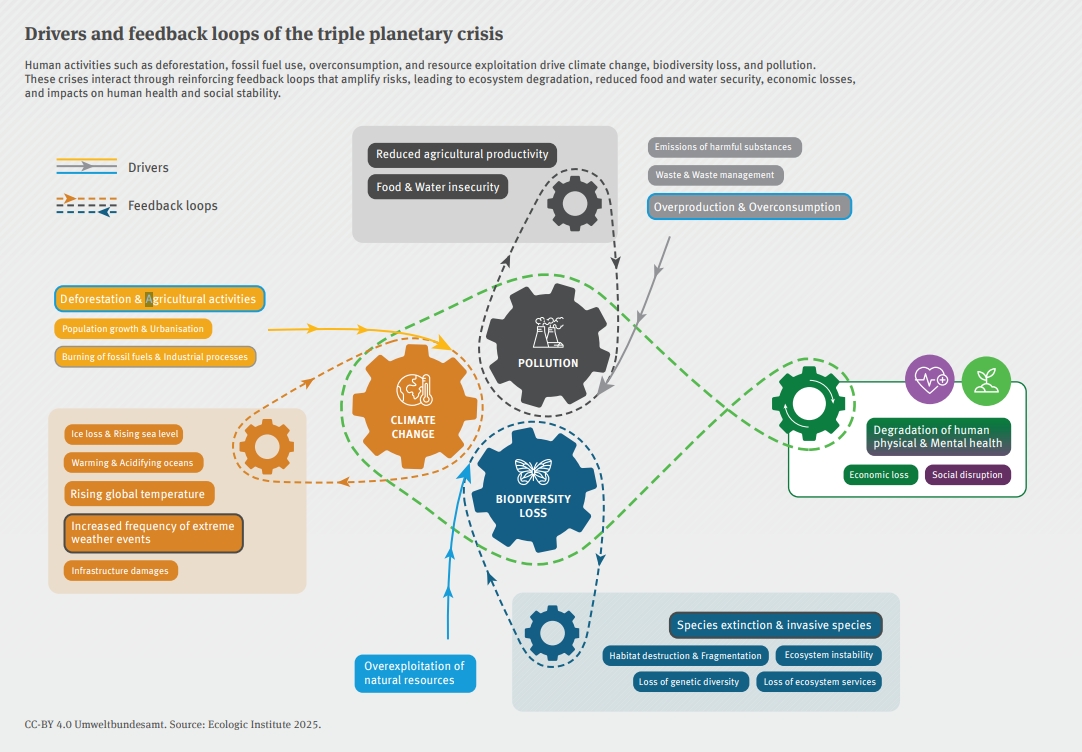
Umweltbundesamt 2025: Drivers and feedback loops of the triple planetary crisis. Infographic.
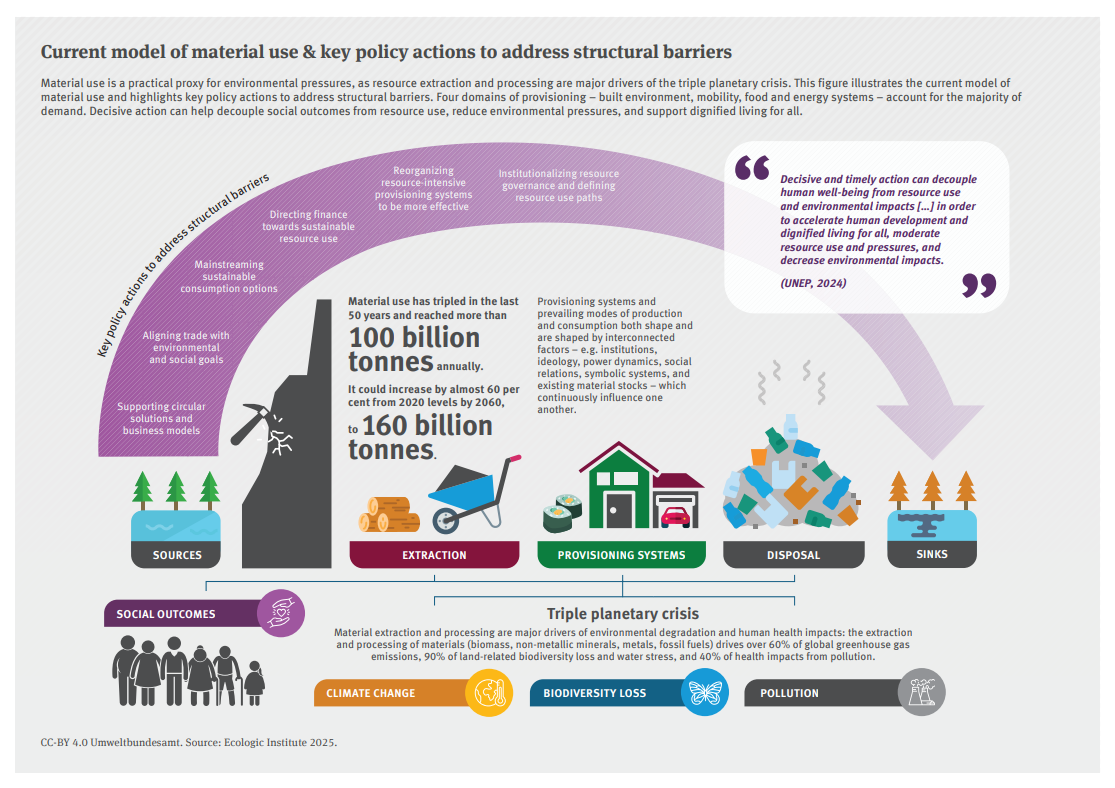
Current model of material use & key policy actions to address structural barriers
|CC-BY 4.0 Umweltbundesamt. Source: Ecologic Institute 2025.
Umweltbundesamt 2025: Current model of material use & key policy actions to address structural barriers. Infographic.