
Europe's Diversification Paradox
Growing US and Russian gas import shares in 2026
- Publication
- Citation
Raffaele Piria, Kacper Szulecki, Hannah Lentschig: Europe’s diversification paradox. Growing US and Russian gas import shares in 2026. NUPI Policy Brief 15/2026. Norwegian Institute of International Affairs. Oslo, 2026.
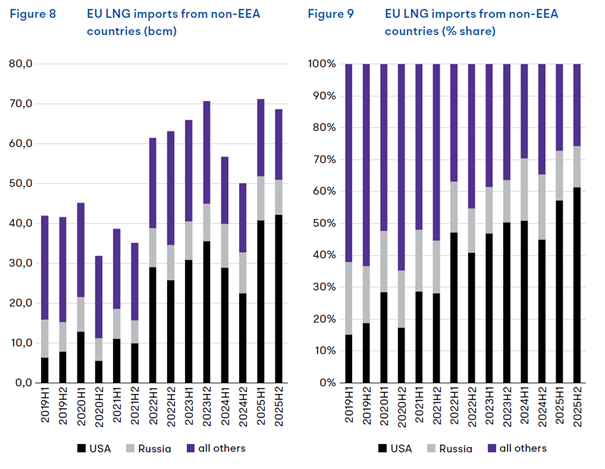
The data and charts in this brief update those presented in our January 2026 paper: Europe's Selective Blindness on Gas: US LNG and the Limits of Supply Diversification. This brief draws on the most recent (2 July 2026) version of Bruegel’s European natural gas imports dataset, covering the first half of 2026.
Our analysis of Europe’s gas import portfolio during the first semester of 2026 shows a paradoxical situation:
- Europe aims to diversify its gas supply portfolio. However, import data analysed in this brief show an uninterrupted decline in diversification.
- During the first half of 2026, Europe’s two dominant suppliers – the US and Russia – increased both the absolute volumes exported to the European Economic Area and their shares of Europe’s import portfolio.
- Europe’s enhanced dependence on LNG imports from the US worsens its exposure to geopolitical pressure at a time when US foreign policy and its disruptive impact on global energy markets are more volatile than ever.
- Collective risk exposure is further heightened by the EU’s likely failure to meet gas storage filling targets before the winter begins.
The structural solution to Europe’s energy import risks are well known: domestic renewables and storage, electrification, targeted use of low-carbon feedstocks and fuels. By accelerating the energy transition, Europe can rapidly reduce its exposure to the costs and risks arising from its heavy reliance on gas, oil, coal and nuclear fuels imports, while also achieving its climate targets.
Unlike most EU energy security analyses, this paper considers the gas import portfolio of the entire European Economic Area (EEA) instead of treating Norway as an external supplier. In other words, we consider EU imports from countries outside the EEA. This approach reflects economic, infrastructural and geopolitical realities and provides a clearer picture of major recent shifts.
Contact

- Language
-
English
- Authorship
- Published by
-
Norwegian Institute of International Affairs (NUPI), Norway - Year
- Dimension
- 4 pp.
- Project ID
- Table of contents
-
Click to show full table of contents
- Keywords
-
energy security, transatlantic, LNG supply diversification, EU energy security, gas supply diversification Europe, Russian gas phase-out, European gas dependency, LNG market volatility, geopolitical risks energy, stranded gas assets, EU energy transition, fossil fuel imports Europe, diversification of energy suppliers, EU gas policy, energy security strategy, European Union, European Economic Area, EEA, transatlantic energy relationsEurope, United States, USA, Norway, Russianovel analysis, EEA-wide analysis, gas import data analysis, LNG import share assessment, supply portfolio analysis, diversification assessment, comparative supplier classification, policy analysis, regulatory analysis, geopolitical risk assessment, energy security analysis
Raffaele Piria, Hannah Lentschig, Ana-Maria Boromisa, Anca C. Sinea, Borbála Takácsné Tóth, Loyle Campbell and Sabrina Schulz: European energy security or acquiescence? A critical review of the 24 February 2026 United States-Central and Eastern Europe Joint Statement. Ecologic Institute, Berlin, 2026.
Raffaele Piria, Kacper Szulecki, Hannah Lentschig and Louise van Schaik: Europe’s Selective Blindness on Gas: US LNG and the Limits of Supply Diversification. Clingendael, Ecologic Institute, Norwegian Institute of International Affairs, The Hague/Berlin/Oslo, 2026.