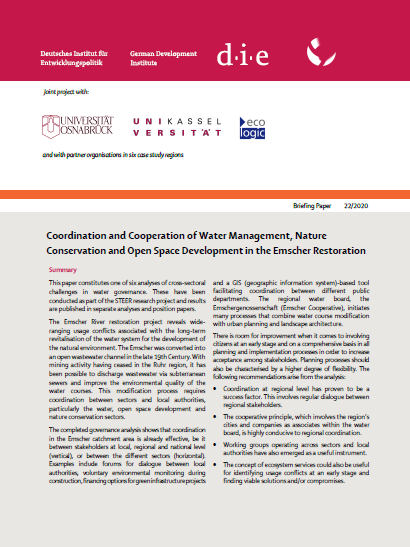
The completed governance analysis shows that coordination in the Emscher catchment area is already effective. There is room for improvement when it comes to involving citizens and planning processes should also be characterised by a higher degree of flexibility. The analysis provides recommendations. This paper constitutes one of six analyses of cross-sectoral challenges in water governance. These have been conducted as part of the STEER research project and results are published in separate analyses and position papers.
The new EU climate architecture should include a separate CDR target that builds primarily on restoring degraded ecosystems. This target should be legally binding and quantified – for the EU and Member States. It should not be a combined target which treats reductions and CDRs equally. This EU's CDR target should be enshrined in the European Climate Law.
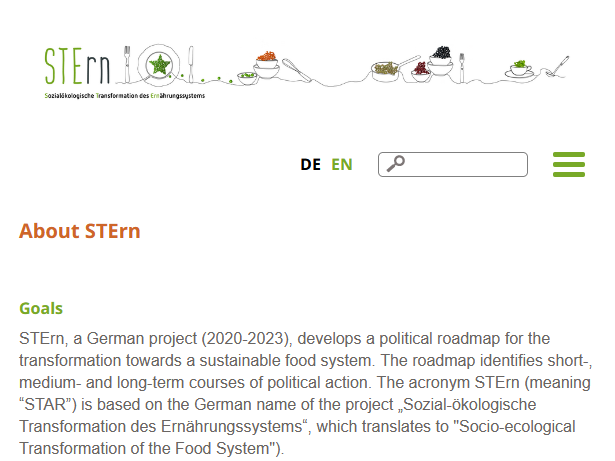
Within the project „Socio-ecological Transformation of the Food System“, policy recommendations for the transformation towards a sustainable food system were developed between October 2020 and September 2023. The STErn website was developed, implemented, and designed by Ecologic Institute. It serves the public communication of the project's goals, events, and results.
This report is complementary to the third edition of the State of Nature report, which describes the state of nature in the EU based on reports from Member States under the Birds (2009/147/EC) and the Habitats (92/43/EEC) Directives for the period 2013-2018. It details the methodologies applied in the current State of Nature report, complementing the reporting guidelines for the Member States.
To meet its increasingly stringent emissions reduction targets, the European Union plans to extend the use of emissions trading, to also cover emissions from road transport and buildings. To understand the effects of this move, DG CLIMA commissioned a comprehensive analysis to investigate the economic, social, environmental, and regulatory / administrative implications. Together with partners ICF, eclareon, Enerdata, Fraunhofer Institut, Cambridge Econometrics, CITEPA, and Milieu, the Ecologic Institute investigated the general options for either the extension of the existing EU ETS or the introduction of a stand-alone scheme.
This paper examines the role that the post-2020 Common Agricultural Policy (CAP) can play in the transformation towards more sustainable and resilient agri-food systems in the EU.
This ICARE-project online seminar served to discuss issues and relevance of the climate-resources-nexus among academic institutions. Mandy Hinzmann from Ecologic Institute, Dr. Thomas Gibon from Luxembourg Institute for Science and Technology LIST and Prof. Edgar Hertwich from Norwegian University of Science and Technology NTNU presented findings of recent research projects dealing with the nexus.
On 17 September 2020, the European Commission proposed to raise the EU climate target for 2030, so as to reduce greenhouse gas emissions by 55% compared to 1990. In this policy brief, CLIMACT and Ecologic Institute unpack the Commission's impact assessment for the new target. The brief analyses key policy options and analytical results and compares them to recent studies, in particular CLIMACT's 2030 modelling results. Within the framework of the tightened target, the EU Commission proposes to extend the EU Emissions Trading Scheme to buildings and road transport – a major change to the EU's current climate policy architecture. The team discusses potential implications and provides context to the sectoral developments and policies. The briefing highlights key points where the Commission diverges from other studies, identifying climate mitigation potentials that merit more attention in future analysis.
Launched on 8 June 2020 by our Commissioner for Environment, Oceans and Fisheries, Virginijus Sinkevičius, the EU4Ocean Coalition, which aims at supporting collective ocean literacy in Europe, is moving to action! You are invited to join the first "EU4Ocean workshop Designing Ocean Literacy actions in Europe" on 24 and 25 September 2020 (online).
Achieving the Paris Agreement Long-term temperature goal (PA LTTG) requires closing the 2030 ambition and action gap between emissions levels consistent with the Paris Agreement and emissions levels projected with current targets and policies. G20 countries have a crucial role to play in realising increased climate policy ambition, given their economic power and prosperity, as well as their influence on investments, technology deployment and financial flows. This briefing paper provides an overview of mitigation options that have been analysed in recent literature and that can contribute to closing the emissions gap in 2030. This provides the basis to identify key policy areas and promising options for intergovernmental cooperation between the G20 nations, as well as possibly other relevant actors.
Between 15 and 18 September 2020, Ecologic Institute together with ZOE Institute for future-fit economies and other partners convened a "closed-doors" EU online conference on long-term challenges from the COVID-19 crisis for the EU's economic governance and the implementation of the Green Deal.
The objective of the online event is to explore the extent to which the implementation of a bioeconomy concept can leverage the reactivation of regional economies across Europe.
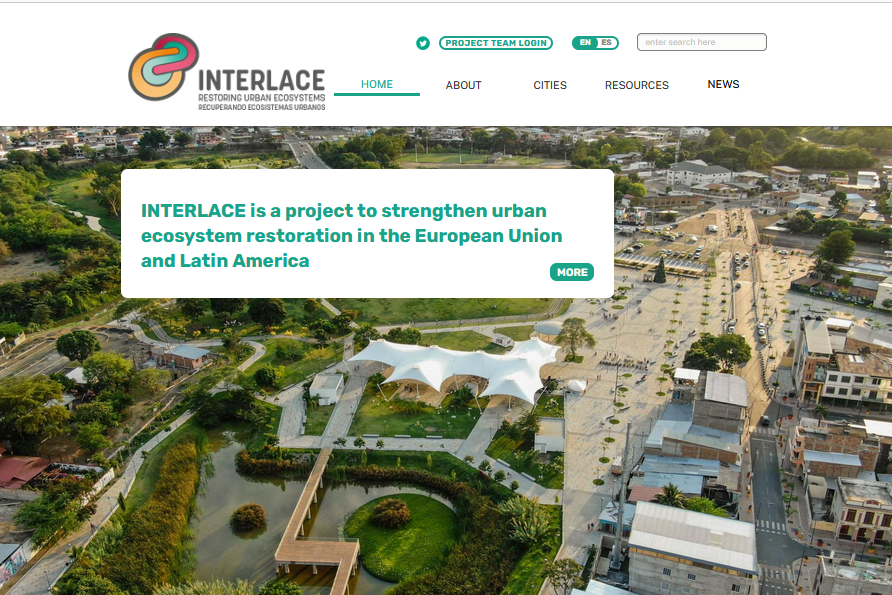
The Ecologic Institute developed the INTERLACE project website. It provides information and materials to strengthen urban ecosystem restoration in the European Union and Latin America. INTERLACE aims to strengthen cooperation, learning and peer-to-peer interactions on the local, regional and global scales through the Cities Talk Nature mechanism. The six partner cities are central to this process, providing and sharing experiences with other cities globally and building technical and procedural capacities. A web-based Innovation Hub will support these efforts by disseminating INTERLACE's results and the hands-on tools for urban decision-makers and planners created by the project.
In a new scientific article published in Agricultural Water Management, Dr. Josselin Rouillard, Senior Fellow at Ecologic Institute, and co-author Dr. Jean-Daniel Rinaudo (Brgm) examine strategies to manage the overexploitation of water by agriculture. The research focused on innovative water allocation regimes involving strong collaborative approaches between regulators and water users.