In a new scientific article published in Agricultural Water Management, Dr. Josselin Rouillard, Senior Fellow at Ecologic Institute, and co-author Dr. Jean-Daniel Rinaudo (Brgm) examine strategies to manage the overexploitation of water by agriculture. The research focused on innovative water allocation regimes involving strong collaborative approaches between regulators and water users.
The danger of a rebound in greenhouse gas emissions after the coronavirus crisis is looming on the horizon. Michał Dorociak and Michał Kamiński of 300Gospodarka, and Nils Meyer-Ohlendorf discuss in an OpEd for the EU Observer how the EU recovery programmes can avoid post-crisis emission increases.
In this paper the authors, among them Ecologic Institute's Ulf Stein, focus on the governmental bottlenecks in the Implementation of the European Water Framework Directive. The lack of horizontal, inter-sectoral communication; the insufficient land reserves; human resources and; the lack of financing were the areas that emerged as the most pressing issues. Further evidence suggests that the interaction of the WFD with other policy areas regulated at the European level might require closer inspection.
In our brochure "Ecologic Institute: Science and Policy for a Sustainable World", we introduce Ecologic Institute as a transdisciplinary research organization. Readers gain an overview of our capabilities in research, policy analysis, education, communication and stakeholder events. Suitable for clients, partners, funders and the interested public, the brochure describes the many ways that Ecologic Institute brings new insights into environmental policy.
In July 2020, the European Council agreed on an unprecedented EU recovery package – dubbed Next Generation EU. This agreement contains elements that will advance EU climate policies. However, if it is to pave the way to climate neutrality by 2050, it needs to improve.
A group of polish local government experts, landscape planners, architects and engineers participated in a study tour on nature-based solutions in Berlin on 25 and 26 August 2020, which was part of the EUKI project "Climate NBS Poland". Nature-based solutions (NBS) can be implemented in urban settings to deliver a suite of services to address climate change, such as reduce demand for heating and cooling, stormwater management, microclimate regulation but also support human health and recreation. Thanks to their multi-functionality and sustainability NBS are increasingly applied as measures to address climate change in cities – in Berlin, a number of innovative NBS projects have been implemented in Berlin already since the 1990s to address such challenges.
Marine Protected Areas (MPAs) are increasingly employed as a tool to protect Europe's swiftly declining marine biodiversity. However, despite increasing coverage, MPA effectiveness and equity is considered highly variable. Concurrently, Ecosystem-Based Management (EBM) – that is, management that aims to protect, restore, or enhance the resilience and sustainability of an ecosystem to ensure sustainable flows of ecosystem services and conserve its biodiversity – is growing in prominence.
This podcast explores different aspects of urban nature through stories of innovators from across Europe who use their passion and creativity to make cities green.
Ecosystem-based management (EBM) is the most promising approach for balancing sustainable development and biodiversity protection in aquatic ecosystems. This book introduces the essential concepts and principles required to implement Ecosystem-Based Management, detailing tools and techniques, and describing the application of these concepts and tools. This book is a joint effort with researchers from Ecologic Institute, the University College of Cork in the Republic of Ireland and the US Environment Protection Agency and can be accessed free of charge.
This podcast explores different aspects of urban nature through stories of innovators from across Europe who use their passion and creativity to make cities green.
A continuing decline in biodiversity, accelerating impacts of climate change, and the urgency of ensuring a sustainable and just recovery from the COVID-19 pandemic are generating unprecedented momentum behind the imperative of working with nature to address societal challenges. In this policy brief, McKenna Davis and Harriet Bulkeley (Durham University) highlight the importance of prioritizing nature-based solutions in the post-2020 Global Biodiversity Framework and supporting their uptake within and beyond the biodiversity community.
Int this report, Irina Herb and Christiane Gerstetter of Ecologic Institute, as well as Alexandru Matei (ICLEI), present insights on how nature-based solutions can contribute to achieving the Sustainable Development Goals (SDGs), defined in the 2030 Agenda, and recommend several pathways for doing so.
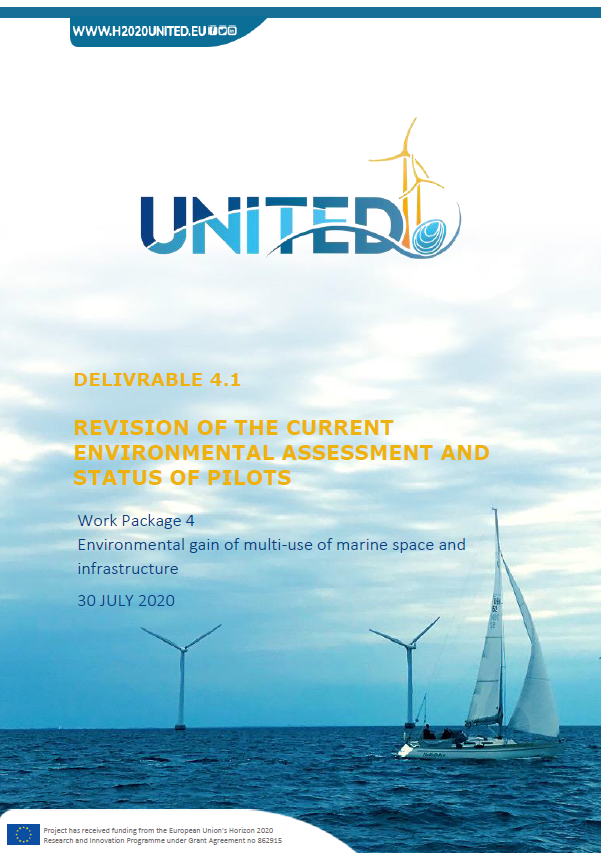
The UNITED project report "Current Environmental Assessment and Status of the Pilots" provides a comprehensive overview of the current environmental assessments and status of various pilot projects. These projects included a variety of multi-use concepts in the marine environment, including the combination of offshore wind energy with shellfish and kelp cultivation, offshore wind and solar energy, shallow estuarine aquaculture and kelp cultivation, and tourism. The report looks at the environmental aspects of these pilot projects and assesses their environmental impacts, regulatory requirements and existing environmental assessment results and monitoring capacity.
In this publication, Doris Knoblauch (Ecologic Institute), Lorenzo Felicetti, and Ulf Stein (Ecologic Institute) shed light on the untapped potential of ICT solutions in water management across Berlin, Milan, Copenhagen, Paris and Sofia, the five cities analysed in the project digital-water.city. In the analysis, the cross-cutting nature of digital water governance, and thereby its multifunctionality in terms of policy goals became evident.
This podcast explores different aspects of urban nature through stories of innovators from across Europe who use their passion and creativity to make cities green.