The funding call "Municipal Networks" is part of the National Climate Initiative (NCI) of the Federal Ministry for the Environment, Nature Conservation and Nuclear Safety. Since 2008, the NCI funds climate protection projects throughout Germany, thus contributing to the achievement of the Federal Government's climate protection goals. The funding call pursues the economic and sustainable unlocking of saving potentials in the field of energy efficiency, resource efficiency and climate-friendly mobility through cooperation between municipalities and administrative units. The two funding phases cover the recruitment of municipal participants in energy efficiency networks (recruitment phase) and the establishment and operation of these networks (network phase). The funding also serves to permanently maintain these networks beyond the funding period to continuously implement further efficiency measures within this framework.
The funding call for the Innovative Climate Protection Projects is part of the National Climate Protection Initiative (NCI) of the Federal Ministry for the Environment, Nature Conservation and Nuclear Safety. Since 2008, the NCI funds climate protection projects throughout Germany, thus contributing to the achievement of the Federal Government's climate protection goals. The innovative climate protection projects impart new or disseminate existing knowledge to change behaviour, purchasing decisions, practices, and processes. To this end, the projects run campaigns or provide direct advice, facilitate knowledge exchange, and help with capacity building and education in the diverse climate-relevant fields of action.
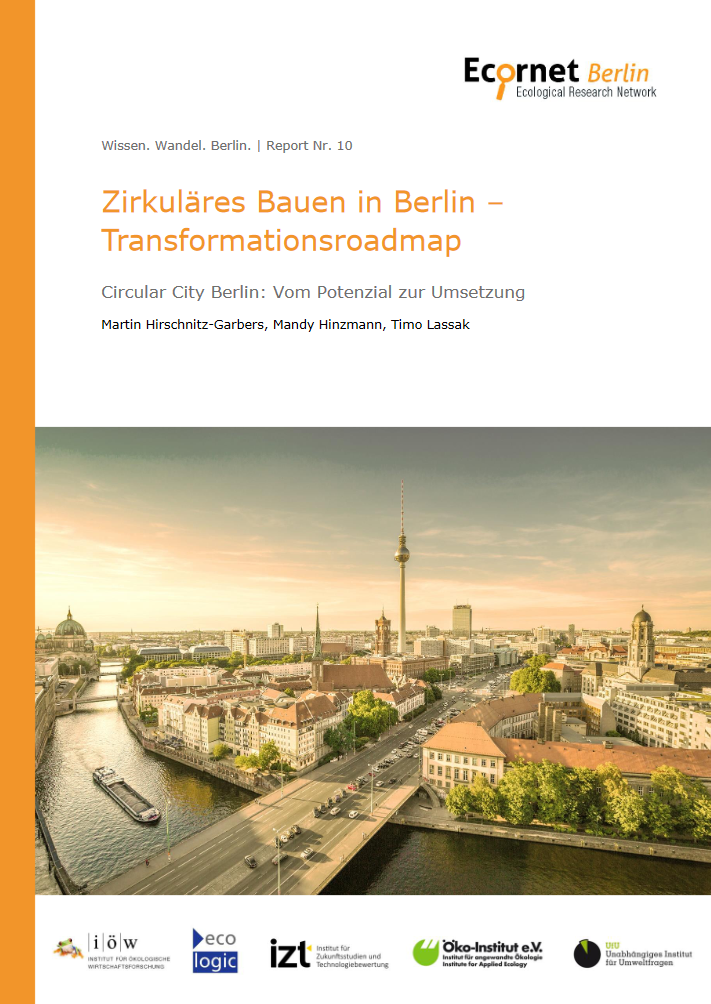
How circular economy approaches in the construction sector can be strengthened is discussed in this episode of Wandelwecker together with two proven experts in circular construction.
Stephan Sina 2021: Stellungnahme zum Entwurf der SPD für ein Gesetz zum Schutz von Menschen und Natur vor dem Klimawandel und seinen Folgen – Drucks. 20/5899 –1. Berlin: Ecologic Institute.
Re-using goods and products offers numerous economic, ecological and social potentials. An exciting case example for the reuse of building components and furnishings was presented on 15 July 2021 at the online expert dialogue "Re-use of building components and furnishings in the construction project of the church community of Staaken".
With the Green Deal, the European Union aims to reduce its greenhouse gas (GHG) emissions by at least 55 percent by 2030 compared to levels in 1990. Among other things, this goal is to be achieved through a stronger role for carbon-pricing. For industry, however, this plan carries the risk of "carbon leakage": energy-intensive industries such as steel or chemical production could move away – increasing emissions elsewhere. Other industries could also be indirectly affected. This policy brief analyzes the types of measures available to reduce risks for industry and embeds them in two basic strategies that can be pursued with regard to carbon leakage.
This table provides an overview of fish protection screens in Germany with the highest discharge per screen panel. The infographic is part of the fact sheet "Technical Functionality of Large Fish Protection Screens Confirmed in Practice."
This infographic presents the key data of the screen systems at the Willstätt, Unkelmühle, Kemnade and Öblitz hydropower sites. The infographic is part of the fact sheet "Technical Functionality of Large Fish Protection Screens Confirmed in Practice."
This infographic shows examples of screen bar shapes for fish protection screens at hydropower sites. The infographic is part of the fact sheet "Technical Functionality of Large Fish Protection Screens Confirmed in Practice."
This fact sheet examines the functional elements of a fish protection system and explains when a rake is a fish protection rake. The fact sheet "What makes a screen to a fish protection screen" is available for download.
In 2014, the German Participatory Forum on Fish Protection and Downstream Migration was able to develop a common understanding of the size of a screen up to which functioning mechanical fish protection and descent systems, including the necessary cleaning technology, can be implemented. The objective of the research underlying this Fact Sheet 04 was to verify whether the statement of the German Participatory Forum on Fish Protection and Downstream Migration is confirmed in the actual operation of existing fish protection screens. Fact Sheet 04 "Technical functionality of large fish protection screens confirmed in practice" is available for download.
The EU Climate Action Regulation governs 60 percent of EU emissions. To achieve the climate targets for 2030 and 2050, the upcoming reform of the regulation must be a success, writes Nils Meyer-Ohlendorf in the Tagesspiegel. He makes a number of reform proposals. The article is available online.
On 17 June 2021, representatives from Berlin's public administration, business and civil society discussed how to accelerate the expansion of tenant electricity in Berlin in the virtual expert workshop of the StromNachbarn project. Practical experience inputs enriched the discussion.
Wehrmann, Dorothea et. al. 2021: Wie können wir die Ozeane retten? Die Bedeutung der transdisziplinären und kollaborativen Meeresforschung. Deutsches Institut für Entwicklungspolitik (DIE): Bonn.
This report documents the project work and results of the R&D project "Information Platform for the restoration of rivers", which was jointly carried out by Ecologic Institute, Planungsbüro Zumbroich and the Institute of Aquatic Ecology and Fish Biology, Jena (IGF Jena) from 2017 to 2020. The aim of the project was to create an online information platform about river restoration (Part I of the project report) and the analysis of German restoration projects in regard to their monitoring (Part II of the project report). The report is available for download.