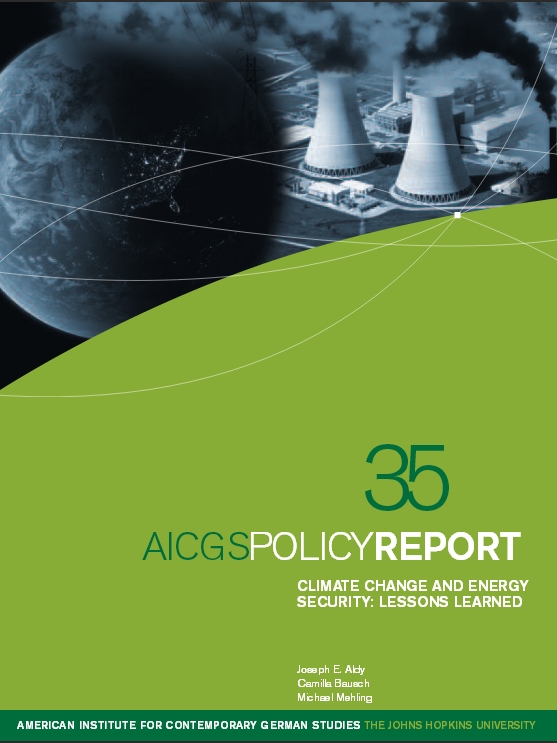
Scientific evidence that climate change is caused by human activity has boosted ongoing efforts to address the problem. Now the focus is primarily on what will happen after 2012 when the validity of the Kyoto Protocol, an international treaty designed to limit global greenhouse gas emissions, expires. From 11-12 April 2007, representatives of the EU, the World Bank and the new EU Member States met in Prague to discuss the challenges ahead.
The European Community has undertaken an ambitious program aimed at improving the sustainability of energy use across Europe. At the heart of this program are efforts by the European Union and its Member States to encourage the use of renewable sources of energy. Bioenergy has become a focal point in efforts to increase the use of renewable energy. This policy brief summarises the development and status quo of the EU bioenergy policy framework and links it to the current debate on sustainability of bioenergy.
Economic analysis for policy appraisal is generally interested in answering two questions, "is a given policy objective worth achieving" and if so, "has the policy objective been achieved in the most cost-effective way?" While the first question is addressed in a cost-benefit analysis (CBA), the second question can be answered with the help of a cost-effective analysis (CEA). The authors of this book chapter focus on ex-post CEA and reveal problems, challenges and opportunities of CEA at the European level.
<p>
The United Nations has dedicated the annual International Day of Biological Diversity on 22 May 2007 to "Biological Diversity and Climate Change", highlighting both the interlinkages between the two issues and the interaction between the relevant international or multilateral conventions. On 7 May 2007, the joint CDU and CSU party in the German Federal Parliament (Bundestag) held an Expert Meeting to review the state of the debate and explore policy options and needs. Ecologic Institute contributed a presentation focussing on the international regimes on biological diversity and climate change.</p>
The Ecological Footprint is one of the most successful indicators worldwide for conveying the concept of the ecological sustainability and the biophysical limits of the Earth. This project for the German Federal Environmental Agency consisted of a comprehensive analysis and evaluation of the "Ecological Footprint" indicator regarding its possible application as an indicator of sustainability for Germany.
The impact of climate change on Europe's water resources is a critical issue for people's lives and the economy. Even if emissions of greenhouse gases were stabilised today, increases in temperature and the associated impacts, including water availability and flooding, will continue for many decades to come. This report, which was published by the European Environment Agency (EEA) in February 2007 and co-authored by Ecologic, shows that there is a need to adapt to climate change for water resource policy and regulation across Europe. The report assesses the strengths and weaknesses of current policies and regulations, and describes progress and activities in European countries.
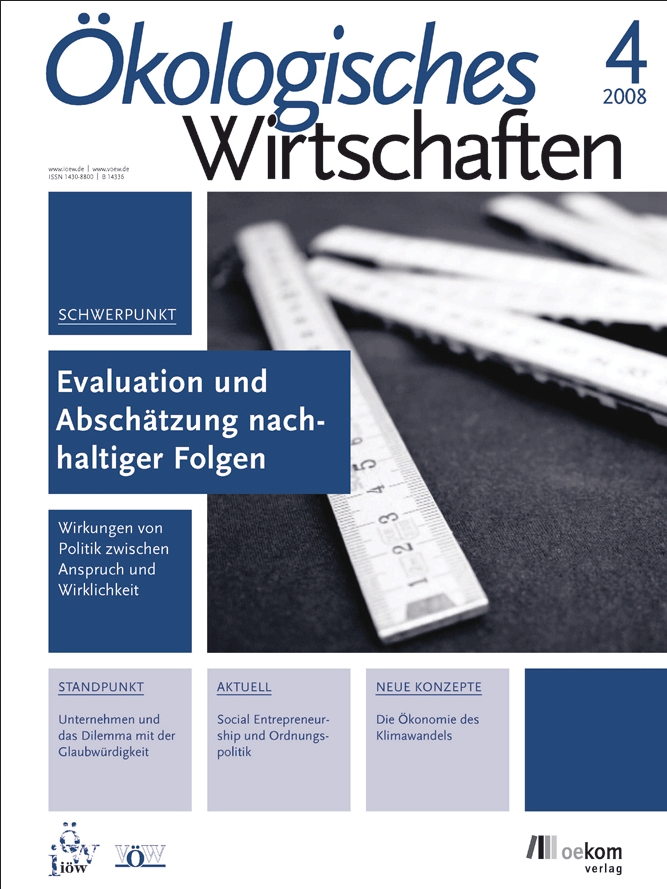
<p>Research on policy evaluation has gained in importance since the European Union introduced its new procedures on impact assessments in 2003. In the course of the EPOS project, the Institute for Ecological Economy Research (IOEW) and Ecologic Institute were organising the conference "Sustainable Development in Policy Assessment – Methods, Challenges and Policy Impacts", which took place from 15 until 16 June 2009 in Brussels. The conference seeked to contribute to the understanding of sustainability evaluation. Therefore, contributions were invited that tackle methodological challenges to sustainability evaluation, as well as the question of how the institutionalisation of sustainability evaluation can be improved.</p>
Transport subsidies are a significant piece of the policy framework that influences public and private decisions about transport. This study gathered financial data about all types of European transport subsidies and provided estimates of these subsidies' annual values. As project lead, Ecologic was responsible for the study design, data presentation and final report.
Ecologic provided expert review in support of the project "Das größere Europa" organised by the Bertelsmann Stiftung. The review is entitled: "Differentiated integration in the European environmental and energy policy".
The study "The proposed revision of the Waste Framework Directive: An assessment of the Impact Assessment and the Implications of the Integration of the Hazardous Waste Directive" examined the quality of the Impact Assessment issued by the European Commission on their proposal to amend the Waste Framework Directive and analysed the impacts of the suggested merger of the Hazardous Waste Directive with the Waste Framework Directive.
The role of renewable energy is increasing globally. Renewable energy sources are supposed to meet half of Germany's energy demand by 2050. In this article, the authors provide an overview on current developments in the law for renewable energy.
By way of the European Neighbourhood Policy (ENP) and following the enlargement process of 2004, the EU aims to redefine its geopolitical interests and relationship with its new neighbours. These neighbours will be given the opportunity to co-operate and build privileged relationships just beneath the threshold of the EU membership status. By way of this project Ecologic, IEEP and SEI-Tallinn assist in implementing selected issues of the ENP Action Plans and the EU-Russia CES roadmap.
What is the role of civil society actors in the assessment of trade agreements with regard to their sustainability impact? The book chapter authored by Markus Knigge and Nicole Kranz analyses the underlying processes and contexts and makes suggestions for the effective involvement of stakeholders in the assessment process at the EU level.