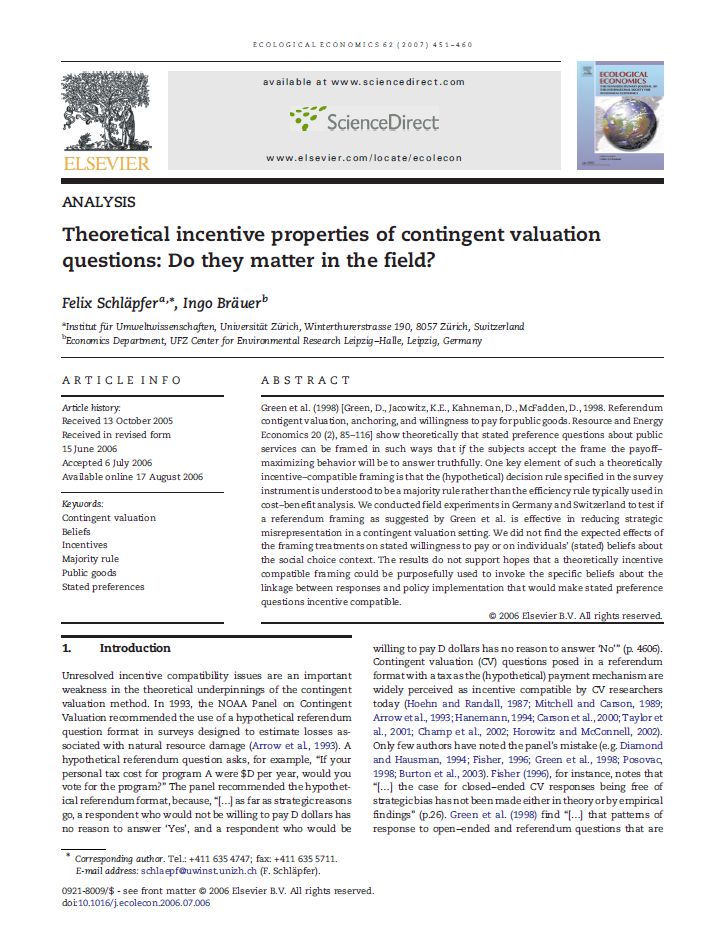
Contingent valuation studies and their results are often criticised. This paper describes the findings of an experimental survey that tests the influence of survey design on strategic behaviour.
<p>
A large percentage of Europe’s territory consists of rural areas that contain more than half of its population. Many problems of European societies such as an ageing population, high unemployment rates, social disparities and the lack of adaptive potential to the global market are more pronounced in rural areas than elsewhere. To overcome these problems, it is essential to link public, private and inter-sectoral initiatives to foster innovation. Rainer Müssner presented the EU-funded project RAPIDO, that has been established to analyse current best practices concerning the development of innovation in agriculture, forestry, the food sector and the wider rural areas, as well as to analyse methods to transfer knowledge to different target groups.</p>
<p>
The question of "Governance" of natural resources, in other words how societies deal with the use of natural ressources, is central to each discussion about sustainability. Only "good governance" can guarantee the sustainable use of natural resources, protection of biodiversity, and indirectly help to implement the EU sustainability strategy. However it is quite difficult to measure and evaluate the level of good (bad) governance and to make the somewhat abstract concept more tangible. Rainer Müssner presented two EU funded projects dealing with the issue of "Governance of natural resources", in which Ecologic is involved as co-ordinator or partner.</p>
The second transnational conference of the WaterCost project as part of the Intereg North Sea Region focused on the issue of cost-effectiveness analysis and how it to apply it to groundwater and water supply issues. Benjamin Görlach gave a presentation on the role of cost- benefit considerations in the implementation process of the Water Framework Directive. He concluded that since there is only patchy data on costs and benefits, and elaborated on the role of the AquaMoney project in addressing this gap.
The EU Water Framework Directive and ist Groundwater Daughter Directive call for a cost-effective protection of all water resources. For groundwater, the assessment of cost-effective protection measures is complicated by the long time lags and the flow dynamics within aquifers. Together with the water supply company OOWV and the Lower Saxony Board of Agriculture, Ecologic has analysed the cost-effectiveness of groundwater protection measures in a drinking water protection area, and thereby developed a practical solution for dealing with the specific problems of cost-effectiveness analyses related to groundwater.
<p>
The concept of disproportionate cost is one of the key economic elements of the EC Water Framework Directive. The practical implementation of this concept by the Member States offers a range of possible interpretations that are more or less in line with environmental economic theory. In a contribution to the envecon 2007 Applied Environmental Economics conference in London, Benjamin Görlach and Britta Pielen provided an introduction to the concept, its role in the Water Framework Directive, and provided an overview of the current discussion in some EU Member States.</p>
<p>
Benjamin Görlach presented some preliminary results of the WaterCost Project, which has been set up to develop and test a practicable methodology for cost-effectiveness analysis of groundwater protection measues. WaterCost brings together partners from five European regions, including municipalities, water supply companies and environment agencies. Ecologic Institute supports the German partners in the WaterCost project in the application of a cost-effectiveness analysis in a Frisian groundwater protection area. In his presentation, Benjamin Görlach surveyed the costs and the effectiveness of 10 possible measures to reduce nitrate pollution from agricultural sources in the groundwater catchment area, and discussed potential combinations of these measures.</p>
The EU-U.S. Summit on 30 April 2007 passed a statement on energy security, efficiency, and climate change that is strong on rhetoric but weak on substance. Sascha Müller-Kraenner, Director of the Europe program at the Nature Conservancy and Senior Policy Advisor to Ecologic Institute, provides some critical commentary on the substance of the summit.
A Tisza River Basin Analysis Report was developed by the Tisza Expert Group of the International Commission for the Protection of the Danube. The Report is an important step for the preparation of a river basin management plan under the EU Water Framework Directive. Ecologic was commissioned to assist the Tisza Expert Group with the development of three chapters on the identification of artificial and heavily modified water bodies, on the assessment of risk of failure to reach the WFD environmental objectives for surface water bodies and on the characterisation of groundwater bodies.
On 4-5 June 2007, a workshop on the Water Framework Directive and Hydropower was held in Berlin. Focus of the workshop was on hydropower use and the relationship to hydromorphological changes. The workshop aimed at the exchange of information and views on good practice in hydropower use, strategic priorities on the catchment level as well as instruments to promote hydropower and to improve water status.
The ball you see here is one of the first of its kind. It has two seals: A Fair Trade seal and the FSC seal of the Forest Stewardship Council. FSC works for the protection of forests and the peoples living and working in them. The bladder inside this ball is made from latex (rubber) produced in accordance with the strict social and environmental criteria of the FSC.