© Ecologic Institute, 2026
Urban Nature
European Networking Workshop
- Event
- Date
-
-
- Location
- Bonn, Germany
- Speaker
The European Urban Nature Networking Workshop, organised by the German Federal Agency for Nature Conservation (BfN) with the support of Ecologic Institute, took place on 5-6 May 2026 in Bonn (Germany). The invitation-only event brought together key actors working on urban nature and biodiversity across Europe, reflecting both EU and non-EU perspectives and including national authorities and agencies, cities, the scientific community, EU institutions, and relevant networks. The highly interactive and participant-driven format fostered peer learning around shared challenges and practical solutions for urban nature planning, implementation, governance, financing, monitoring, and capacity building across governance levels. It also fostered connections among actors working to advance urban biodiversity and nature restoration. Ecologic Institute’s McKenna Davis moderated the event, supported by Teresa Spantzel and Fenja Kroos.
A central theme throughout the workshop was the implementation of Article 8 of the EU Nature Restoration Regulation (NRR), which focuses on restoring urban ecosystems and increasing urban green space and tree canopy cover. Discussions highlighted both the opportunities and challenges associated with implementing the Regulation at national, regional, and municipal levels, while also looking beyond the Regulation to broader questions of urban nature quality, multi-level governance, and implementation.
Key topics discussed during the two-day workshop included the following:
- Implementation of Article 8 of the Nature Restoration Regulation: Discussions focused on challenges related to the delineation of urban ecosystem areas, defining “satisfactory levels” of urban green, and balancing EU-wide comparability with national and local flexibility.
- Data, monitoring, and indicators: Participants exchanged experiences with different datasets and monitoring approaches, highlighting issues such as inconsistent urban boundary definitions, limited GIS capacities, and trade-offs between accuracy, comparability, and feasibility for municipalities.
- Quality versus quantity in urban restoration: Participants emphasised the need to move beyond purely quantitative indicators and better integrate aspects such as biodiversity quality, ecological connectivity, accessibility, ecosystem functions, and human well-being into urban nature assessment frameworks.
- Planning tools and legal frameworks: Examples from across Europe, including Poland, Lithuania, Italy, Germany, Sweden, and the UK showcased how spatial planning, local development plans, and Urban Nature Plans can better integrate biodiversity into housing, infrastructure, and land-use decisions.
- Governance and multi-level coordination: Discussions explored how responsibilities are distributed across national, regional, and municipal levels, with regional actors highlighted as important intermediaries and local ownership seen as essential for successful implementation. The “reporting gap” between city-level action and what appears in national reporting to international fora was also raised as a key concern.
- Financing and incentives for urban nature: Participants exchanged experiences on national funding programmes, municipal incentives, biodiversity net gain approaches, blended public-private financing, and the importance of accessible and low-burden funding streams for municipalities.
- Capacity building and implementation support: A recurring theme was the limited administrative, financial and technical capacity of many municipalities, particularly smaller ones, and the need for guidance, training and peer learning opportunities. Long-term support structures through knowledge-sharing networks as well as more tailored regional support were mentioned as potential approaches to tackle these gaps.
- Citizen engagement and communication: Discussions highlighted the importance of public engagement, awareness-raising, and visible pilot projects to build acceptance around urban nature measures. The potential of improving communication of nature’s benefits for health, climate adaptation, and quality of life as well as mainstreaming biodiversity across sectors was highlighted.
The workshop also facilitated an exchange on how urban biodiversity and the role of cities can be better reflected in international biodiversity processes ahead of CBD COP17, including through a greater recognition of international city networks and the integration of city reporting into national reporting for international fora, as well as mainstreaming urban areas across multiple CBD targets.

Contact

- Funding
-
Federal Agency for Nature Conservation (BfN), Germany - Organizer
-
Federal Agency for Nature Conservation (BfN), Germany Ecologic Institute, Germany - Speaker
- Team
- Date
-
-
- Location
- Bonn, Germany
- Language
-
English
- Project
- Project ID
- Keywords
-
urban biodiversity governance, urban ecosystem restoration, nature-positive cities, urban greening strategies, climate-resilient cities, biodiversity mainstreaming, sustainable urban development, urban resilience planning, ecosystem-based urban planning, green infrastructure cities, urban climate adaptation, biodiversity-friendly urban planning, city nature restoration, urban sustainability transitions, urban ecosystem services, healthy urban environments, participatory urban governance, biodiversity financing mechanisms, urban environmental policy, nature-inclusive urban developmentEuropeinteractive, participant-driven exchange, peer learning, cross-country dialogue, networking
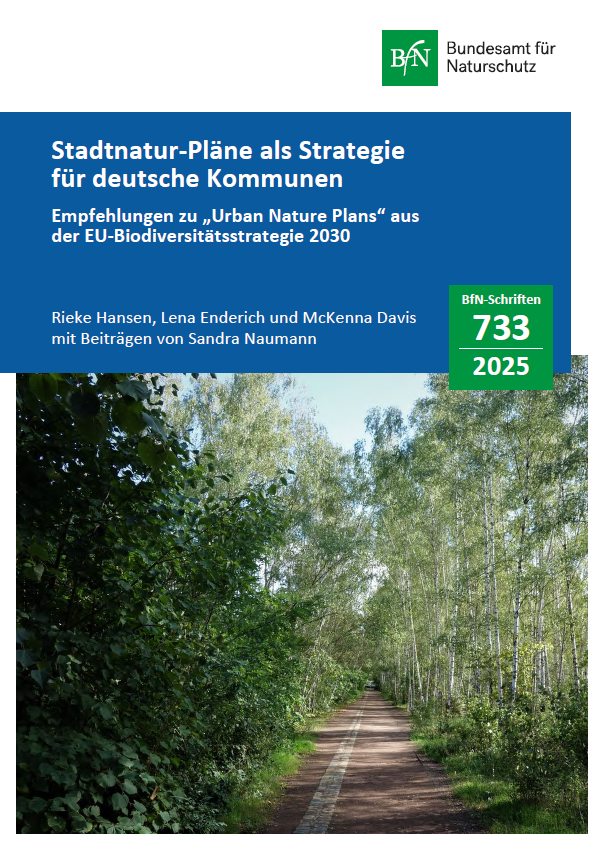
Bundesamt für Naturschutz (ed.) (2025): Stadtnatur-Pläne als Strategie für deutsche Kommunen. Empfehlungen zu "Urban Nature Plans" aus der EU-Biodiversitätsstrategie 2030. Bonn.
Ecologic Institute 2018: Urban Nature Atlas – NATURVATION. URL: https://naturvation.eu/atlas
International Cooperation to Restore and Connect Urban Environments in Latin America and Europe (INTERLACE)
- Duration
-
-
- Funding
-
European Commission, Directorate-General Research & Innovation (DG Research & Innovation), International
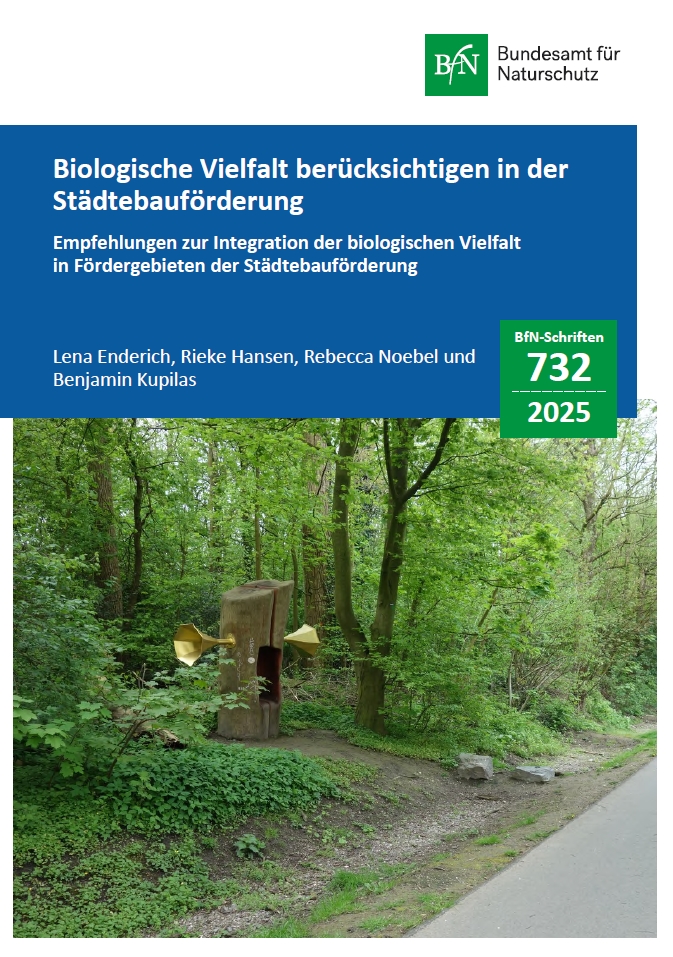
Bundesamt für Naturschutz (ed.) (2025): Biologische Vielfalt berücksichtigen in der Städtebauförderung. Empfehlungen zur Integration der biologischen Vielfalt in Fördergebieten der Städtebauförderung. Bonn.
Kupilas, B; Burgos, N; Davis, M; McDonald, H; Enzi, V; Konchenko, T (2025). Sectoral Brief: Built Environment. GoNaturePositive! Horizon Europe Grant Agreement No. 101135264, European Commission. https://doi.org/10.5281/zenodo.15517015
German Environment Agency (ed.): Naturbasierte Klimaanpassung in Kommunen. Topic page compiled by Ecologic Institute on behalf of the German Environment Agency, Dessau-Roßlau. URL: https://www.umweltbundesamt.de/themen/klima-energie/klimafolgen-anpassu…
McCormick, K., Kiss, B., Voytenko Palgan, Y., Bulkeley, H., Davis, M., Raven, R., Luque-Ayala, A., & Hörschelmann, K. (2024). Urban nature: New directions for city futures. Cambridge University Press.

INTERLACE 2024: Nature-based Solutions: How to regenerate nature to make neighborhoods more livable, biodiverse, and resilient to climate change. Massive Open Online Course. Online: https://learningwith.uclg.org/p/restoring-urban-ecosystems.